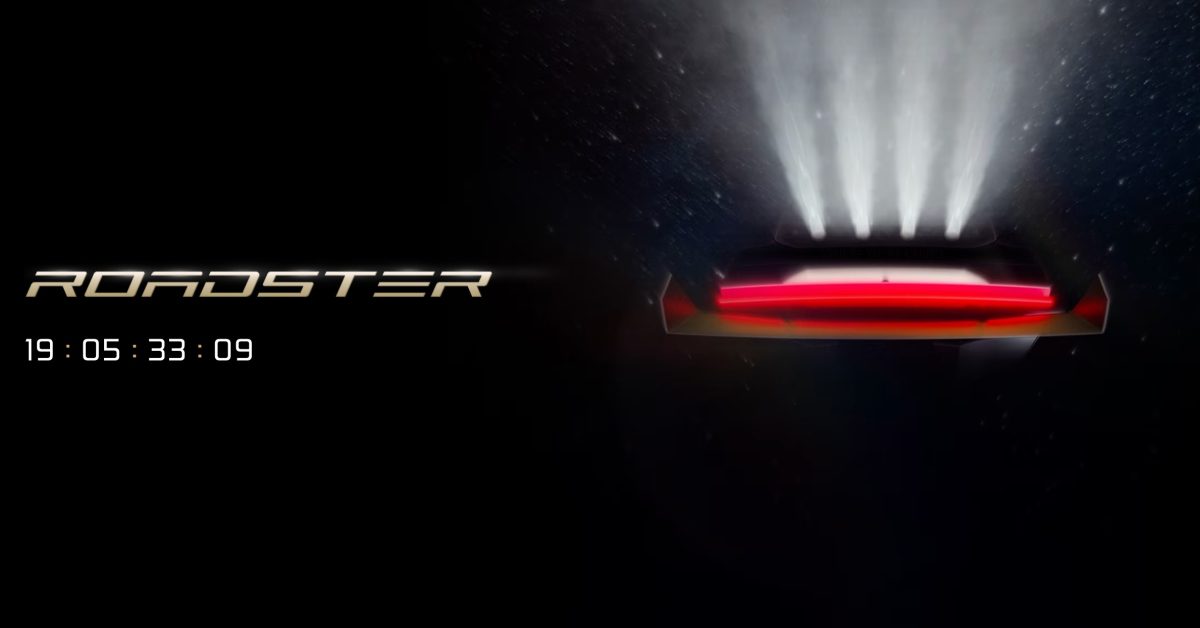
Tesla Puts a Date on the Roadster
Tesla is teasing an October 1 reveal for the new Roadster, giving the long-awaited electric hypercar a concrete date after years of ambiguity. The company posted a teaser image captioned "Go for launch" that shows off the vehicle, according to a report from Electrek. If the date holds, it would mark the first formal unveiling of the model since Tesla showed a prototype nine years earlier.
That nine-year gap is the headline as much as the car itself. A prototype debut and a customer-ready reveal are very different events, and the distance between them here spans nearly a decade — a stretch in which the Roadster has been a recurring talking point but never a delivered product. An October 1 date, even one announced through a two-word slogan, changes the character of that conversation. It moves the Roadster from the category of indefinite future plans into the category of scheduled events, which invites a different kind of attention from buyers, competitors and skeptics alike.
What Nine Years Represents
When a company first shows a prototype and then waits nine years to tease the next reveal, the vehicle in question has effectively been redesigned, re-scoped or shelved and revived at least once in the public imagination. The Roadster's long absence has made it something of an outlier even within Tesla's own story: a promise that predates much of the current electric vehicle landscape yet still has not arrived in driveways.
That patience has a cost. Enthusiasts who reserved interest in the original prototype have watched several product cycles pass. Meanwhile, the broader electric hypercar space has become a genuinely competitive arena, which means the Roadster will not be judged against the expectations of nine years ago but against whatever the market looks like on October 1. Tesla's teaser does not address any of that. It simply says a reveal is coming.
The timing also gives the announcement a symbolic weight that a routine product update would not have. Nine years is long enough that the original prototype is remembered as a moment rather than a model — a spectacle that set expectations Tesla has spent the intervening period not yet meeting. October 1 is the company's opportunity to close that loop, or to extend it.

Reading the 'Go for Launch' Message
The teaser's chosen language is deliberately evocative. "Go for launch" borrows the vocabulary of rocketry and mission control, framing a car reveal as the start of a flight rather than the completion of a build. That register fits a vehicle Tesla has always described in outsized terms — an electric hypercar positioned at the extreme end of performance rather than at the practical end of the market.
It also does useful work as marketing shorthand. Two words communicate momentum, readiness and spectacle without committing Tesla to a single specification, price or delivery window. A teaser image is not a spec sheet, and the company has kept its announcement to exactly that: an image, a date and a slogan. Everything else — what the car can do, what it will cost, when it might reach customers — remains outside the frame.
Why a Halo Car Still Matters
Hypercars rarely make money in volume, but they serve a purpose that volume models cannot. A machine like the Roadster functions as a statement of capability: a demonstration of what an automaker believes is technically possible, aimed less at the customers who will buy it than at everyone who will never sit in one. That is precisely the role the Roadster has played since its prototype debut.
For Tesla, the value of finally revealing the car is partly about credibility. A company that has been discussing a product for nine years accrues an obligation with every additional mention. Delivering a reveal on a stated date is a modest but real way to demonstrate that timelines at the top of the lineup can be met, not just announced.
There is also a competitive dimension. An electric hypercar reveal draws press coverage, social media attention and technical curiosity in a way that incremental updates to mainstream vehicles do not. Tesla gets a news cycle on its own terms, tied to a product that has been part of its identity since before many of today's EV buyers were shopping for cars at all.

What the Teaser Does Not Say
It is worth being precise about the limits of what Tesla has actually put on the table. The teaser announces a reveal date. It does not confirm production timelines, pricing, availability by region or final specifications. Nor does it indicate whether the October 1 event will present a finished production vehicle, a near-final concept or something in between.
Those omissions are normal for a teaser, but they matter for how the announcement should be read. A reveal is a moment of presentation, not a promise of delivery. Readers tracking the Roadster should treat October 1 as the point at which concrete details may finally surface — not as evidence that they already have.
What to Watch on October 1
The value of the event will depend almost entirely on how much specificity Tesla attaches to it. A few things will determine whether the reveal functions as a reset for the Roadster's story or simply another chapter in a very long preamble.
- Whether the vehicle shown is presented as a production model or as a further prototype stage.
- Whether the company offers any production or delivery timeline to accompany the visual reveal.
- Whether pricing or reservation details are disclosed, or left entirely open.
- Whether the hypercar's technical claims are framed as targets or as settled specifications.
- Whether the event produces the kind of substantive information that nine years of waiting would justify.
Until then, the Roadster's status is simple to state: a prototype shown nine years ago, a date now set for October 1, and a two-word slogan that promises motion without yet revealing direction. For a car that has spent nearly a decade as an unfinished sentence, that is at least a comma worth noting.
This article is based on reporting by Electrek. Read the original article.

Originally published on electrek.co


![Kia launches three new GT EVs, including an electric hot hatch and two SUVs [Images]](https://electrek.co/wp-content/uploads/sites/3/2026/09/Kia-EV3-GT-EV4-GT-EV5-GT.jpeg?quality=82&strip=all&resize=1200,628)