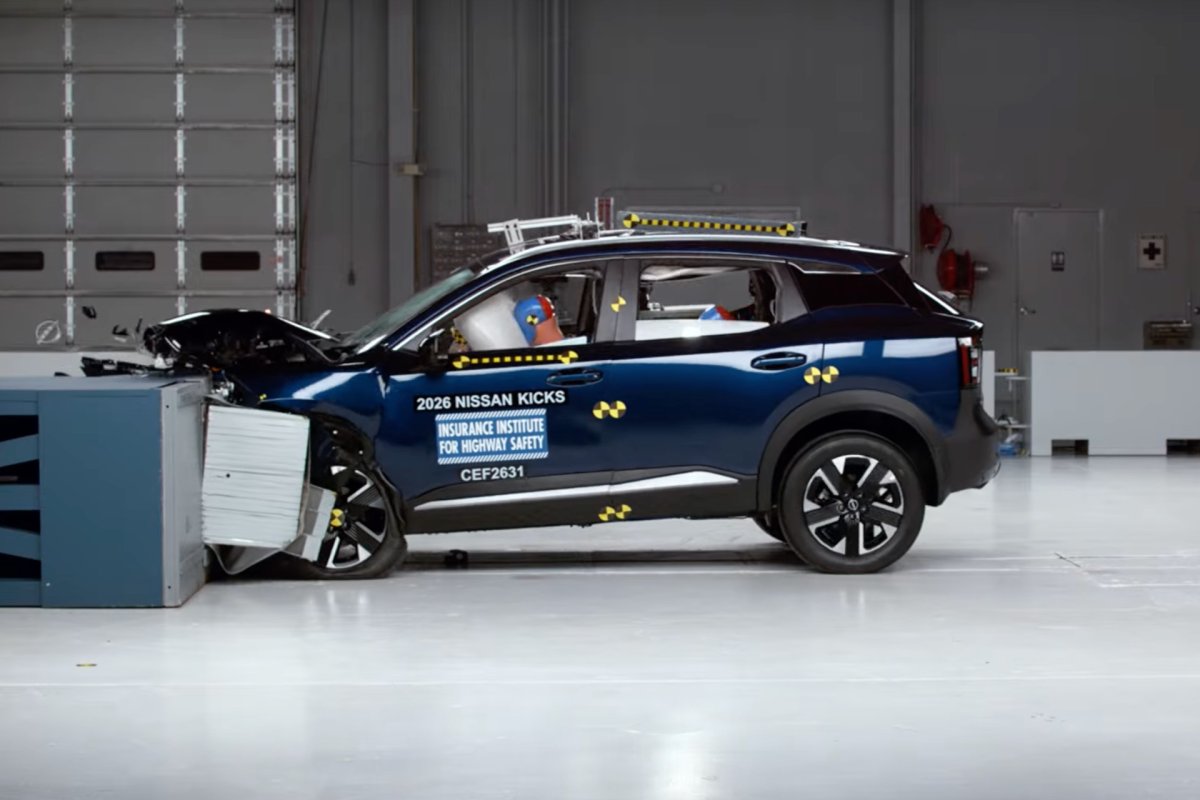
The Insurance Institute for Highway Safety’s latest crossover ratings illustrate how quickly vehicle-safety targets can move when testing protocols change. In a new round of evaluations, the 2026 Nissan Kicks was the sole vehicle among several tested crossovers to earn a Good rating in the Institute’s updated moderate overlap front crash test. That result helped it receive a 2026 Top Safety Pick award, while the Audi Q3, Chevrolet Trailblazer and Toyota RAV4 variants tested did not qualify.
A test focused on people in the rear seat
The moderate overlap front test simulates a vehicle striking a barrier at 40 mph with only part of its front end making contact. IIHS updated the test in 2022 to place greater emphasis on rear-occupant protection. That makes it a consequential evaluation for vehicles seeking the organization’s awards: a Good score in this test is required for a Top Safety Pick designation.
Rather than treating front-seat performance as a sufficient proxy for crashworthiness, the revised assessment directs attention to the people in the back. The change has made the test difficult for manufacturers to pass and has exposed differences between models that may otherwise perform well across a broader safety-rating program.
The latest results underline that distinction. The Nissan Kicks, Audi Q3 and Toyota RAV4 all had strong results in other areas cited in the testing summary, but their outcomes on the revised moderate-overlap assessment determined whether they could earn an IIHS award.
Nissan’s rear-seat-belt revision changed the outcome
The Kicks did not initially clear the tougher bar. When the current generation debuted for the 2025 model year, it received a Poor rating in the moderate overlap front test. Nissan later changed the rear seat belts on vehicles built after June 2026, including 2026 and 2027 models, and the retested Kicks achieved a Good score.
That improvement led to the model’s 2026 Top Safety Pick award, one level below the organization’s highest Top Safety Pick+ rating. The result is a concrete example of how a design revision can change a vehicle’s standing when a safety body updates its criteria. It also means buyers, safety advocates and fleet operators need to pay attention to production timing as well as model year: the favorable result described by IIHS applies to Kicks vehicles built after the stated June 2026 threshold.
The Kicks’ outcome suggests that rear-seat restraint design can be decisive in modern crash evaluations. IIHS uses testing changes to press automakers to improve performance, and Nissan’s response shows how that feedback loop can work. A low initial score was followed by a specific update and a substantially better retest result.
Redesigned rivals still missed the award
The other vehicles in the test group show why passing a wide range of safety categories is not always enough. The redesigned 2026 Audi Q3 received a Poor rating in the updated moderate overlap front test, a rating that also applies to 2027 models. The Q3 earned Good ratings in every other category mentioned in the source report, but the single Poor result disqualified it from Top Safety Pick recognition.
Toyota’s redesigned 2026 RAV4 faced a similar obstacle, although with different scores. The standard hybrid RAV4 received an Acceptable rating in the moderate overlap front assessment, while plug-in hybrid models received a Marginal rating. The report says the RAV4 otherwise earned Good ratings, but neither version met the Good threshold needed for the award.
The Chevrolet Trailblazer received a Poor rating in the same crash test. Its performance was not limited to that one measure: the report also cites low ratings for headlights and front-crash-prevention technology. Together, those results distinguish the Trailblazer from vehicles whose award prospects were mainly constrained by rear-seat protection in the moderate-overlap scenario.
Why the results matter
IIHS operates separately from the federal National Highway Traffic Safety Administration and is supported by the insurance industry. The organization can implement more demanding crash tests without waiting for a legislative change to federal standards. That flexibility can make its test program a moving target for automakers, but it can also create a faster route for identifying weaknesses and encouraging design changes.
The current crossover results make clear that safety is not a static label attached to a model at launch. A redesigned vehicle can still fall short under an updated evaluation, while a production change can improve a model’s position within a year. For the Kicks, revised rear seat belts were enough to move the vehicle from Poor to Good in a test that had prevented the prior version from earning an award.
For consumers, the practical lesson is to look beyond a vehicle’s general reputation or a single overall rating. Specific ratings, the exact test involved and the production period can all matter. For manufacturers, the lesson is more direct: protecting rear occupants is now central to meeting a prominent independent safety benchmark.
This article is based on reporting by The Drive. Read the original article.
Originally published on thedrive.com