A Small Award With Outsized Signal Value
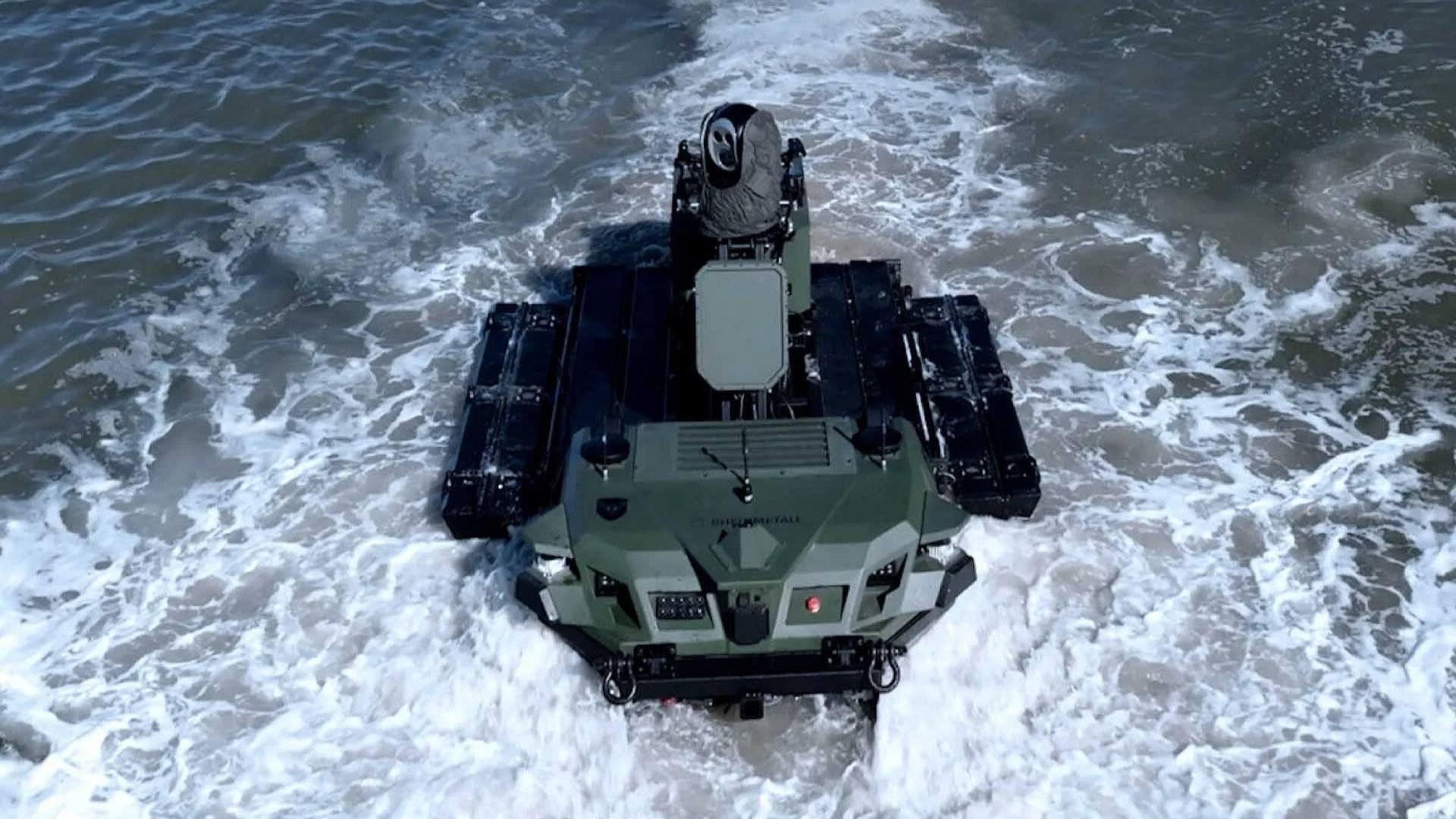
The U.S. Marine Corps is adding a dozen amphibious ground robots to its equipment roster through a new contract with American Rheinmetall, the U.S. subsidiary of the German defense manufacturer Rheinmetall. According to reporting by Interesting Engineering, the award is valued at $7.28 million and covers 12 amphibious robots intended for autonomous logistics — the unglamorous but operationally critical work of moving supplies, equipment and gear to forces that are dispersed, on the move, or positioned across water and broken terrain.
Measured against the multibillion-dollar programs that dominate defense headlines, $7.28 million is a rounding error. But procurement decisions of this size often function as probes: they let a service test whether a technology category is mature enough to absorb real missions before committing to fleet-wide adoption. A dozen machines is enough to generate meaningful data on reliability, maintenance burden and how troops actually use a robot when lives and schedules depend on it — and small enough to abandon quietly if the results disappoint.
What the Contract Covers
A focused, single-mission buy
The order centers on amphibious robots, a category that sits at the intersection of two difficult engineering problems. The first is autonomous or semi-autonomous ground navigation, which requires a machine to perceive terrain, avoid obstacles and follow routes without a human at the controls. The second is operating in the littoral zone — the shallow water, surf and beach transitions that define how Marines deploy and resupply.
Combining those two capabilities in one platform is harder than either challenge alone. Salt water, sand, shifting surf and wet surfaces are hostile to sensors, drivetrain components and electronics. A vehicle engineered to swim or wade and then drive ashore has to manage buoyancy, sealing, traction and thermal load in ways that a purely land-based robot never does.
Logistics first, weapons later
Notably, the stated purpose is logistics rather than combat. That framing matters. Cargo delivery is one of the most credible early use cases for ground robotics because the mission tolerates slower speeds, indirect routes and cautious behavior. If a supply robot takes an extra minute to pick a safe path, the cost is time. If a weaponized platform does the same in a firefight, the cost is measured differently. Militaries have generally found it easier to field robotic trucks, mules and resupply vehicles than to field armed autonomous systems, and this award follows that pattern.
Why Amphibious Logistics Is a Persistent Problem
Marine operations depend on getting the right material to the right place after forces have crossed water. Historically that has meant landing craft, helicopters, amphibious vehicles and human labor moving cargo from ship to shore to inland positions. Every one of those links is expensive, visible and vulnerable.
- Human exposure: Moving supplies often requires personnel to operate in the open, on beaches or along contested routes.
- Force dispersion: Modern tactics push small units out across wider areas, multiplying the number of resupply trips required.
- Manpower drain: Every Marine driving a supply run is a Marine not performing another task.
- Cost asymmetry: Losing an unmanned cargo platform is a materiel loss; losing a crewed convoy can be a human one.
Autonomous or remotely supervised platforms address several of those pressures at once. They can run repetitive shuttle routes, they can be sent into marginal conditions without the same risk calculus, and they can be surged without pulling personnel from other duties.
Rheinmetall's Position in the Ground Robotics Market
Rheinmetall is a long-established German defense contractor with a broad portfolio spanning armored vehicles, weapons and electronics. Its U.S. arm exists partly to sell into American programs and to build domestic industrial relationships, which is a familiar structure in transatlantic defense procurement. Partnering with a U.S. entity is often essential for access to Marine Corps and Army requirements, and it gives a foreign parent company a pathway into long-term sustainment and upgrade work.

For the Marine Corps, sourcing a dozen amphibious robots is also a way to evaluate whether a European platform can be sustained through American supply chains, spare parts pipelines and maintenance doctrine. A robot that performs brilliantly in trials but cannot be repaired quickly in the field is not a useful logistics asset.
Obstacles Between Prototype and Deployment
Autonomy in contested environments
The hardest questions around unmanned logistics are not mechanical. They concern how a robot behaves when communications are degraded or denied, whether it can be trusted to make sensible decisions around people and vehicles, and how much human supervision is actually required. If a robot needs a dedicated operator watching a screen at all times, some of the manpower savings evaporate.
Integration and sustainment
A new platform also has to fit existing formations. That means charging infrastructure, transportability, repair procedures, operator training and doctrine for when to use the machine and when to leave it behind. Units that already manage a dense inventory of vehicles and electronics may resist taking on another system unless the payoff is obvious.
Open Questions
- How much of the route planning and obstacle avoidance is genuinely autonomous versus teleoperated?
- What payload capacity and range the chosen platforms deliver in realistic surf and beach conditions.
- Whether the dozen units will be evaluated stateside or assigned directly to operational formations.
- Whether this initial award leads to follow-on orders or remains a limited trial.
The available details of the contract do not resolve these points, and early-stage defense robotics programs frequently change shape as testing reveals limits.
What to Watch Next
Three signals will indicate whether this purchase becomes something bigger. First, any follow-on award or exercised option would show the Marine Corps liked what it saw. Second, expansion of the mission set beyond cargo — to reconnaissance, screening or casualty movement — would suggest the platforms are performing reliably enough to trust with more sensitive duties. Third, evidence that the robots are deployed in exercises with real units, on real beaches, would separate this from the long history of promising unmanned concepts that never escaped the test range.
The Broader Trajectory
Ground robotics has advanced unevenly over the past two decades. Aerial drones became cheap, ubiquitous and indispensable far faster than their ground counterparts, largely because airspace presents fewer obstacles than terrain littered with people, vehicles, fences and mud. The terrestrial problem is messier, and progress has reflected that.
Logistics is where the messiness matters least. A cargo robot does not need to outthink an adversary; it needs to get from one point to another without getting stuck, breaking down or endangering anyone nearby. That is a tractable goal, and it is why supply missions have emerged as the beachhead for uncrewed ground vehicles across multiple militaries.
The $7.28 million Rheinmetall award for 12 amphibious robots is a single step in that longer arc. It is small enough to be forgotten if the machines underperform, and consequential enough to shape what the Marine Corps believes is possible the next time it writes a logistics requirement. Either way, it marks another point where autonomous systems move from demonstration footage into the procurement record.
This article is based on reporting by Interesting Engineering. Read the original article.
Originally published on interestingengineering.com