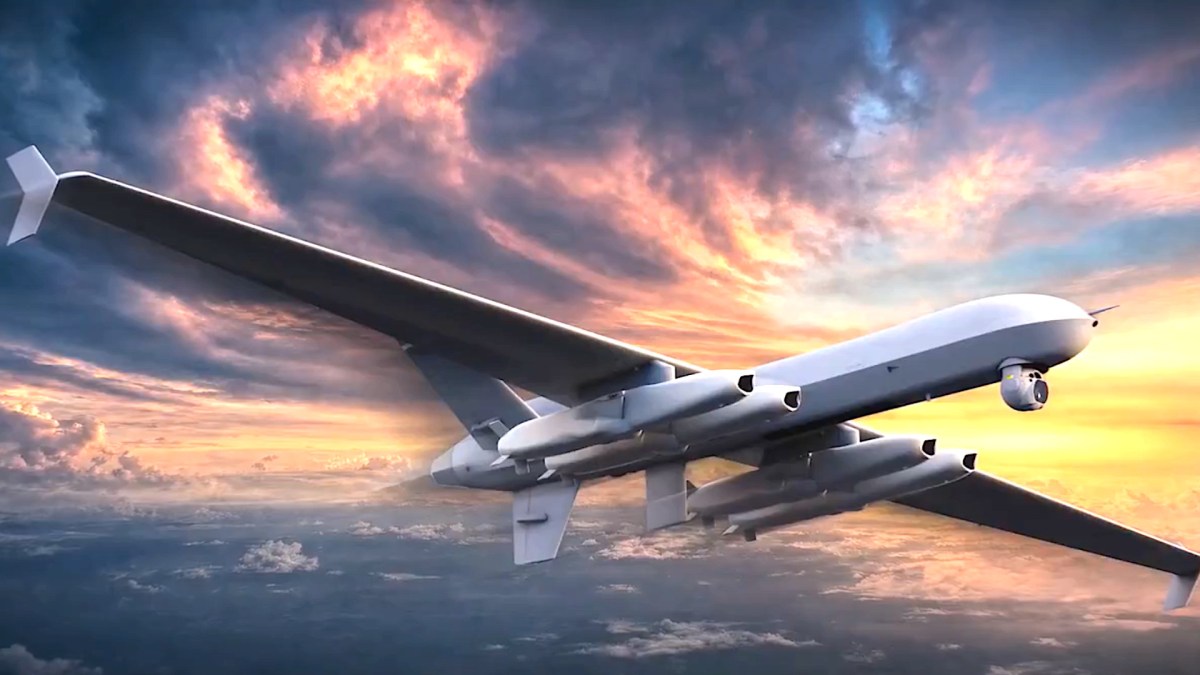
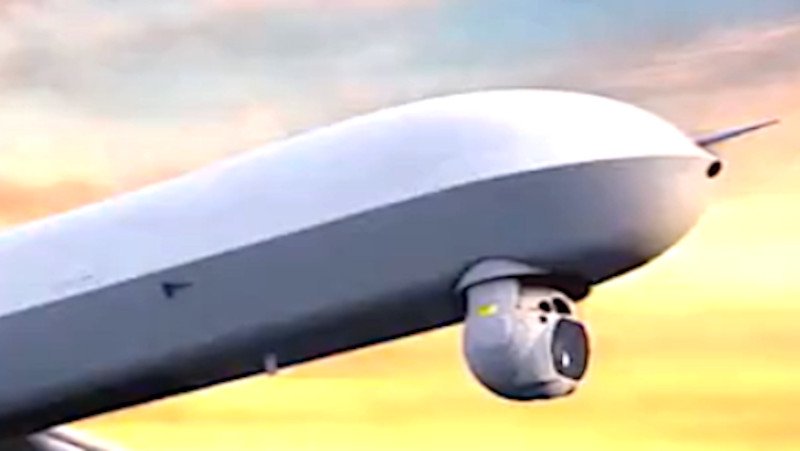
General Atomics Aeronautical Systems has pulled the curtain back on its newest uncrewed aircraft, a design known as Wildfire. The company unveiled the first image of the drone in a short video montage released on September 9, signaling a major step toward defining the next generation of U.S. Air Force drone operations. Wildfire is being developed as a lower-cost successor to the MQ-9A Reaper, a platform that has faced growing scrutiny after steep losses in recent combat environments.
GA-ASI, the subsidiary behind the MQ-9 family, announced just last month that it was working on a new drone concept. With this latest reveal, it is now clear that the effort is centered on a familiar shape that has been refined for a new era. The U.S. Air Force, in partnership with the Pentagon's Defense Innovation Unit, launched its formal search for a Reaper replacement in July under a program now called the Massed Modular Aircraft, or MMA. That initiative marks a strategic pivot away from expensive, survivable platforms toward comparatively cheap, attritable drones that can be fielded in much larger numbers.
A Response to Changing Requirements
The MQ-9 Reaper has long been a backbone of U.S. military intelligence, surveillance, and strike operations. Yet the aircraft is no longer in production, and its vulnerability to modern air defenses has become impossible to ignore. In conflict zones where adversaries possess capable surface-to-air missiles, Reapers have proved easy targets. The mounting losses have pressured the Air Force to find a different approach, and Wildfire appears to be General Atomics' answer to that call.
Wildfire is a medium-altitude, long-endurance (MALE) uncrewed aircraft, just like the Reaper. But it is explicitly tailored to meet the MMA mandate for lower acquisition costs, lower operational costs, and the ability to operate from across the globe with a smaller logistics footprint. By leveraging decades of experience with the MQ-9 and its predecessors, GA-ASI hopes to offer a platform that retains the Reaper's core strengths while stripping away the complexity that drives up price.
Wildfire's Design: An Evolution, Not a Revolution
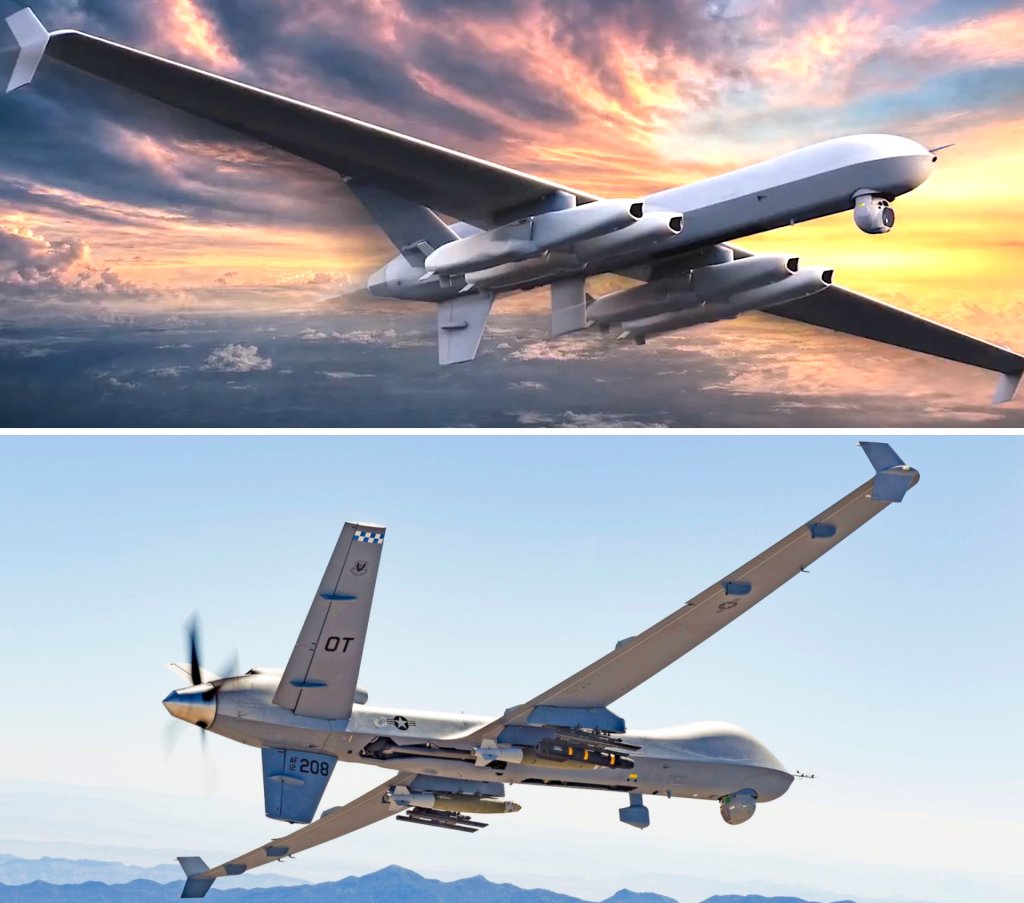
The first rendering of Wildfire shows a drone that is immediately recognizable as part of the General Atomics family. Its overall planform is strikingly similar to the Reaper, with a long, slender fuselage, broad wings, and a distinctive pusher-propeller arrangement at the rear. The drone also features a conventional tail configuration, which helps maintain the stable, predictable flight characteristics that have made the Predator and Reaper so successful in permissive airspace.
Sensor and Structural Cues
Looking more closely, Wildfire carries familiar equipment. Under the nose sits a sensor turret, likely capable of housing electro-optical and infrared cameras as well as laser designators. Along the underside of the rear fuselage, there is a large blade antenna, which could support line-of-sight data links or other communications. These elements suggest that Wildfire will be capable of performing the same kinds of intelligence-gathering and strike missions as the Reaper, while using proven components to keep costs down.
However, there is one notably absent piece of hardware. The MQ-9A Reaper has a distinctive hump on the top of its forward fuselage, which houses the satellite communications antenna. Wildfire does not have that hump. Losing this prominent feature changes the silhouette of the drone, giving its forward section a sleeker, more angular look that bears an uncanny resemblance to General Atomics' Gnat series from the 1990s. The Gnat was itself a precursor to the Predator drone, which later evolved into the MQ-1 and MQ-9 lines.
Communications and Autonomy
The elimination of the SATCOM hump is not merely a cosmetic change. It has significant implications for how Wildfire will be controlled and how it will communicate. On the Reaper, the large dorsal antenna is essential for beyond-line-of-sight operations, allowing pilots on the other side of the world to fly the aircraft via satellite links. Without that space-consuming structure, Wildfire likely relies on a smaller, lower-cost SATCOM terminal tucked elsewhere in the airframe.
Such a terminal could operate through a network like Starshield, the government-focused cousin of SpaceX's Starlink satellite constellation. Starshield offers a low-latency, high-bandwidth link that has already been adopted by several U.S. military programs. If Wildfire taps into that network, it can achieve global connectivity with far less bulky hardware than traditional military satellites require. This would reduce weight, drag, and cost, all of which align with the program's emphasis on affordability.
There is another possibility worth considering: Wildfire may be designed to fly with a higher degree of autonomy than its predecessor. With a smaller satellite antenna and potentially lower-bandwidth links, the drone might rely on semi-autonomous flight control, executing preplanned missions with limited operator input. Instead of continuously streaming full-motion video to a pilot, Wildfire could send only critical data and await commands at key decision points. Such a shift would be a major departure from the traditional remotely piloted model and could make the aircraft far more resilient in contested communications environments.
A Nod to the Gnat Legacy
Aviation historians will likely note that Wildfire's nose profile evokes the Gnat, an early General Atomics drone that flew decades ago. The Gnat was developed as a low-cost intelligence platform and eventually led to the Predator, which went on to become one of the most influential drones in military history. This stylistic echo is more than nostalgia; it is a clear statement that Wildfire is intended to be a leaner, simpler, and more expendable aircraft than the MQ-9 it seeks to replace.
By drawing on the Gnat heritage, General Atomics is signaling that it understands the market's shift toward modular, mass-produced systems. The company has seen the future of airpower not in exquisite million-dollar platforms but in swarms of affordable ones that can be sacrificed without breaking the bank. Wildfire's design reflects that philosophy, emphasizing simplicity and cost-effectiveness over technological overreach.
Operational Potential and the Road Ahead
If Wildfire succeeds, it could fundamentally change how the Air Force conducts persistent strike and surveillance. The MMA concept envisions the use of many smaller drones spread across a wide area, each capable of performing certain tasks that currently fall to a handful of MQ-9s. These drones could be launched from forward bases, provide real-time targeting data, and even conduct strike missions in support of ground troops, all while keeping a low profile and a low price.
Wildfire may also appeal to other U.S. allies, many of whom operate the MQ-9 and are looking for a more affordable next-generation option. Since the MQ-9A is out of production, the market for a modernized, cheaper alternative is wide open. General Atomics is hoping that Wildfire will become the successor to the Reaper not only in terms of timeline but also in terms of global market share.
Of course, the road from rendering to operational reality is a long one. The MMA program is still in its infancy, and no contract awards have been announced. General Atomics will almost certainly face stiff competition from other defense giants, each eager to elbow its way into the Air Force's future drone fleet. Yet by getting the first look out into the public domain, the company has taken a decisive step in shaping the narrative and generating interest among potential customers.
Wildfire is far more than just a new picture. It is an acknowledgment that the era of the MQ-9 Reaper is ending, and that the next generation of armed drones must be different. It must be cheap enough to lose, simple enough to field in numbers, and smart enough to fly itself when connections are poor. With Wildfire, General Atomics is making its pitch for that future, and the Air Force is watching closely.
This article is based on reporting by twz.com. Read the original article.
Originally published on twz.com