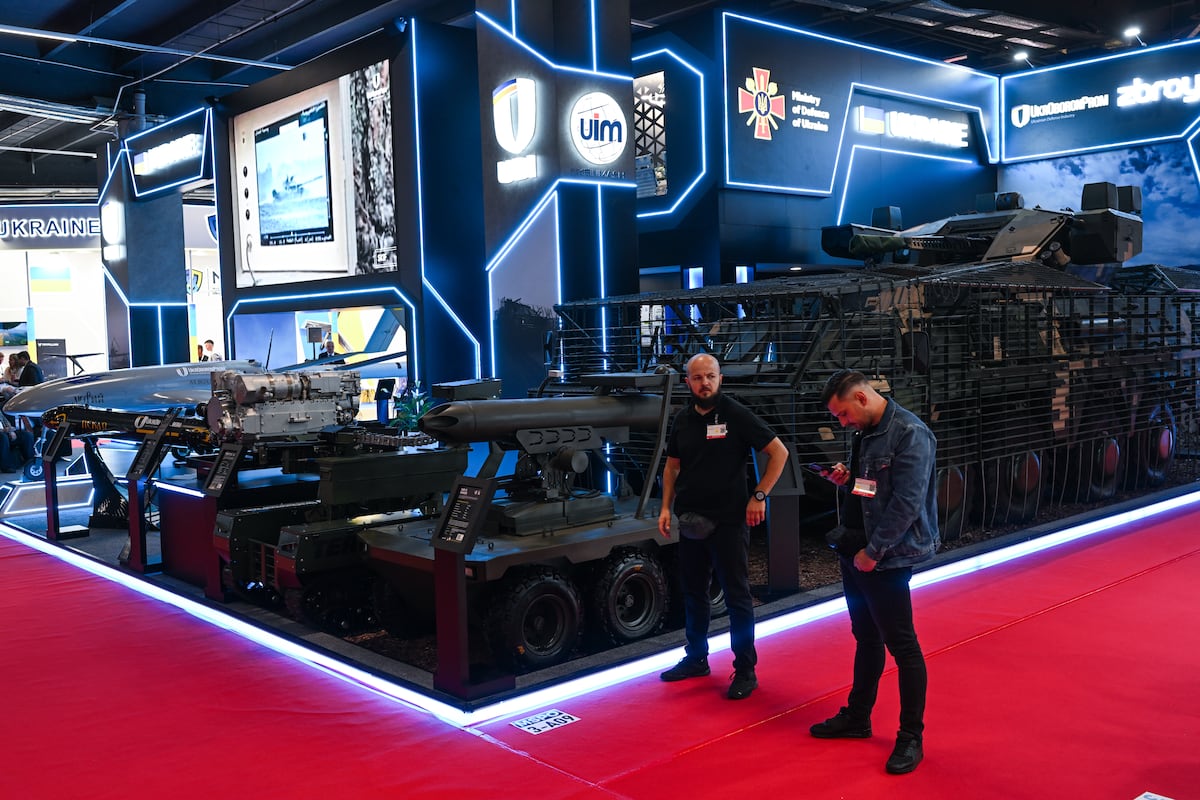
KIELCE, Poland — Ukrainian drone makers are converging on MSPO, Central Europe's largest defense exhibition, with a shared priority: catching up to Russia's growing fleet of jet-powered unmanned aircraft. Several companies are showing or announcing interceptor programs designed to fly significantly faster than previous-generation counter-drone systems, an acknowledgment that the threat's speed and altitude have changed the mathematics of aerial defense.
The evolution of the Russian threat has been difficult to ignore. Older propeller-driven attack drones could often be engaged by relatively slow FPV interceptors and other short-range systems, but their jet-powered successors call for much higher closure speeds. Industry officials at MSPO, which runs Sept. 8–11, said Ukrainian developers have had to rethink airframe materials, propulsion and unit cost to keep pace.
At the show, Ukrainian companies were visible across counter-UAS product areas, presenting interceptors, electronic warfare equipment and detection sensors to potential partners. The emphasis on kinetic interception reflects a practical choice: drones can be manufactured quickly in Ukraine and adapted to lessons learned from the battlefield.
General Cherry pushes a booster Bullet
One of the most tangible responses comes from General Cherry, a Ukrainian UAV producer. The company is developing a kinetic booster version of its Bullet interceptor, intended to reach around 450 km/h (280 mph). The upgrade is not simply a change of motor. According to Andrii Oliinyk, General Cherry's senior international affairs manager, the faster version requires modifications to the frame and materials, including more heat-resistant components to handle high-speed flight. The company plans to release the new interceptor this fall after testing is complete.
The Bullet effort is a useful example of how Ukrainian designers are treating interception as a kinetic problem to be solved with relatively small unmanned aircraft. The booster version is meant to close the speed gap with Russian jet-powered drones while preserving the flexibility of a drone-based interceptor that can be deployed close to the frontline or around key cities.

Grim Tech targets higher speeds
Grim Tech, another Ukrainian vendor, is taking an even more aggressive path. The company is developing a new interceptor specifically designed to counter jet-powered drones, with a target maximum speed of 500 to 700 km/h. A Grim Tech official said Russia has used almost only jet-powered Shahed drones in attacks on Kyiv, partly because earlier Ukrainian interceptors achieved around 90 percent effectiveness against older generations of drones. By raising speed significantly, the firm hopes to restore high interception rates against the newer, faster threat.
The company wants to present its jet-powered interceptor by the end of October, a timeline that reflects the pressure on Ukrainian industry to field countermeasures ahead of the winter campaign. Though specifications remain undisclosed, the speed objective would put the interceptor closer to hobby-scale jet aircraft than typical propeller-driven FPV drones.
BlueBird Tech prioritizes cost and cycle time
BlueBird Tech, which supplies FPV drones, drone detectors, electronic warfare systems and unmanned ground vehicles to Ukraine's military, is also entering the air-defense interceptor field. Vadym Stepanchuk, head of business development, said the company has announced development of an air-defense interceptor but is still at an early stage.
Stepanchuk said BlueBird Tech wants its interceptor to cost less than the targets it destroys. That fundamental design requirement forces engineers to get the cost structure right from the start. The goal is a jet-powered interceptor that is affordable, mass-producible and sustainable over a long conflict in which Russia can launch large salvos of drones.
The economic dimension is critical. If interceptor prices approach or exceed the value of inbound drones, Ukraine risks burning through its defense budget in a pure attrition contest. By contrast, low-cost interceptors can be deployed in quantity and can make every engagement affordable.
R&D speed as differentiator
BlueBird Tech's representatives also emphasized that research-and-development speed separates Ukrainian producers from Western peers. Stepanchuk said his company has built a very effective R&D system, with development cycles usually measured in weeks, whereas analogous Western programs can take years. This rapid iteration lets Ukrainian industry react quickly to Russian tactical shifts and field incremental improvements in sensors, propulsion and airframes.
That speed is visible in the broader Ukrainian defense sector. Rather than waiting for a perfect solution, companies are testing, failing, correcting and re-deploying in cycles. In countering jet-powered drones, this trial-and-error model may be the best hope for finding an affordable technical answer before the threat becomes even more widespread.
What MSPO presence signals
The presence of Ukrainian anti-drone producers at MSPO also signals a deepening defense-industrial relationship between Ukraine and its allies, especially Poland. Company representatives were on hand to showcase solutions to military and industry officials from Poland and other countries, opening the door to cooperation in a common counter-UAS architecture for the region.
For now, though, immediate attention remains on the interception problem inside Ukraine. Russia's shift to jet-powered drones is not a temporary battlefield tactic but a systematic approach intended to overwhelm air defenses. Ukrainian industry is responding with greater speed, cost discipline and a willingness to experiment. The first results will be seen this autumn, as the new boosters and jet-powered interceptors move from testing into combat use.
This article is based on reporting by Defense News. Read the original article.
Originally published on defensenews.com