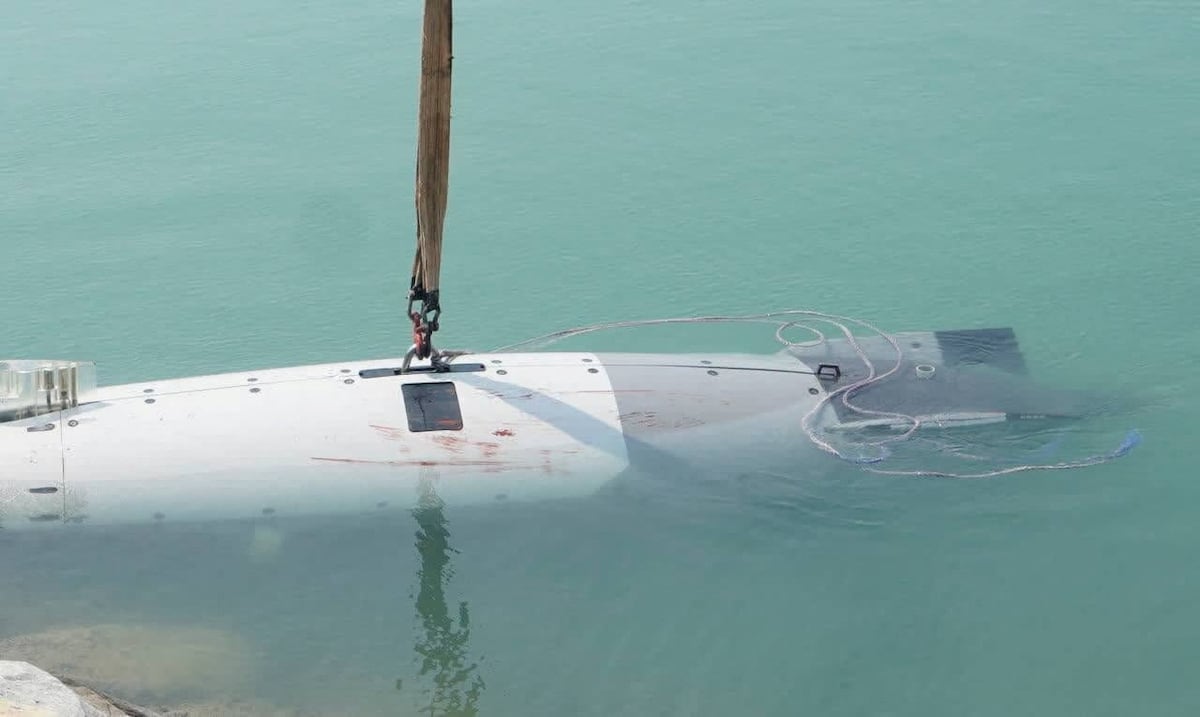
Iran’s Islamic Revolutionary Guards Corps (IRGC) announced on Tuesday that it had captured an American uncrewed submarine near the entrance to the Strait of Hormuz, a strategic waterway through which a significant share of global oil trade passes. The claim immediately drew attention both for the technology involved and for the rare admission from Washington that one of its submersible drones had malfunctioned in the area.
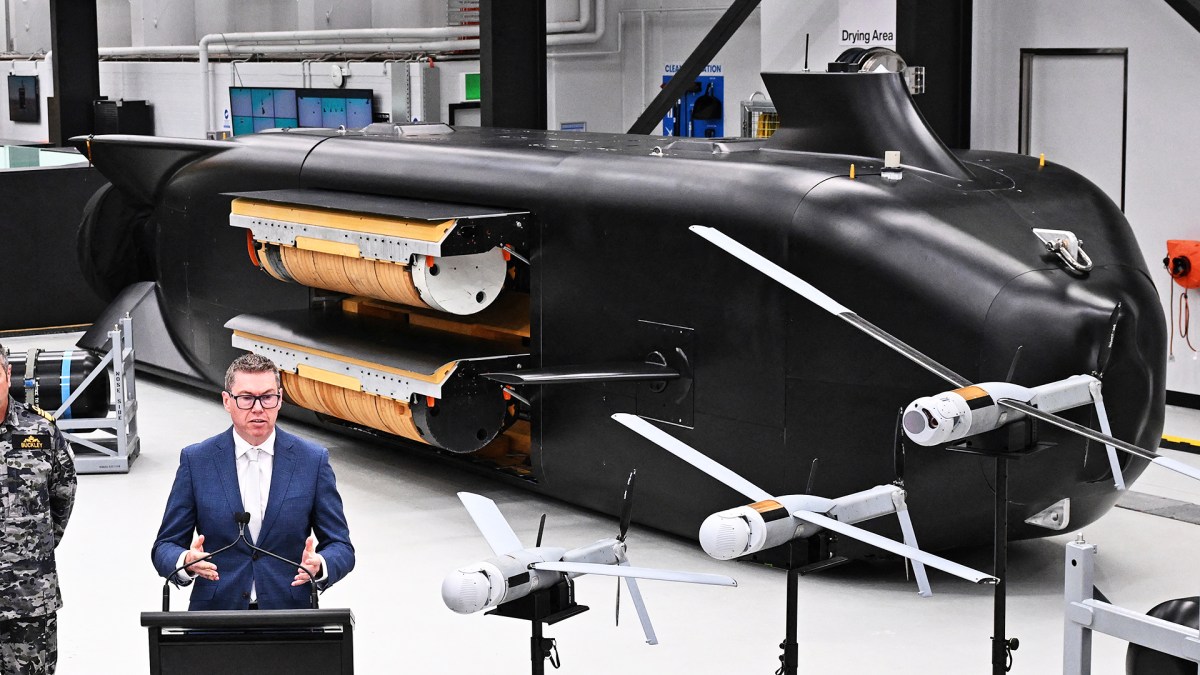
Iranian state media identified the captured vessel as a Dive-LD, a large autonomous underwater vehicle produced by Anduril, a California-based defense company. The IRGC Navy said in a statement that it had “trapped one of the most modern, intelligent and unmanned submarines of the terrorist American army at the entrance to the Strait of Hormuz,” and described the submersible as equipped with the latest technologies.
The United States, for its part, did not confirm the seizure but acknowledged that one of its underwater drones had malfunctioned more than a day earlier. A Pentagon spokesperson said the defective drone was an older model, was not carrying classified sonar or radar equipment, and had not collected sensitive data. The statement avoided directly addressing Iran’s capture claim, and Reuters reported that it could not independently verify the Iranian account.
The Dive-LD in Focus
Anduril’s Dive-LD is a substantial submersible system. The 19-foot (5.8-meter) autonomous underwater vehicle is designed to remain on mission for up to ten days without returning to base and is engineered to reach depths of as much as 6,000 meters (19,700 feet), according to company information cited in the Iranian state media report. It belongs to a class of large undersea vehicles that have become increasingly important in military operations.
According to Anduril’s published specifications, the Dive-LD can be configured for a variety of missions. Those include mine countermeasures, seabed mapping, intelligence gathering, and inspection of underwater infrastructure such as cables and pipelines. That mission profile suggests a multi-purpose intelligence, surveillance, and reconnaissance platform that can operate independently or as part of a broader naval network.
Anduril did not respond to a request for comment when approached by Reuters. The Pentagon’s spokesperson did not comment on the specific technology involved, aside from calling it “an underwater drone.” Interestingly, the U.S. military’s description of “an older model” may conflict with the Iranian claim that the vehicle was among “the most modern” in the American arsenal. Without images or verification, analysts say the discrepancy underscores the fog of competing narratives in the region.
What the Pentagon Told the Public
The Pentagon’s response was carefully worded. It stated that the drone had malfunctioned and was surveying regional waters in support of ongoing operations when it broke down. The spokesperson emphasized that the vehicle was not carrying any classified sonar or radar equipment and would not have offered an adversary significant intelligence value even if recovered.
That explanation appears designed to minimize the significance of the potential capture. By characterizing the device as a defective older model, the Department of Defense may hope to steer attention away from any suggestion that sensitive operational technology fell into Iranian hands. The Iranian Guards, however, framed the incident as a successful field operation against a sophisticated piece of American military equipment, describing it as “one of the most modern” of its kind.
Notably, the Pentagon’s statement did not explicitly confirm or deny that the drone was in Iran’s possession. It simply said the vehicle malfunctioned. This leaves open many questions. For example, why did it take more than a day for Washington to acknowledge the malfunction? What were the “ongoing operations” it was supporting? And was there any attempt to recover or destroy the drone before it could be captured by Iranian forces?
A Pattern of Rising Tensions in the Gulf
The Strait of Hormuz has been a flashpoint for Iranian-U.S. tensions for decades. The waterway, situated between Iran and the Arabian Peninsula, sees a substantial share of the world’s crude oil shipments. Iran has periodically threatened to close the strait in response to sanctions or military pressure, and the U.S. Navy conducts regular patrols to keep shipping routes open.
The capture of an uncrewed undersea vehicle would be a new data point in that long-running rivalry. In recent years, Iran has been suspected of seizing or harassing tankers, and has also used small fast-attack boats to shadow U.S. warships. Underwater drones are a lower-profile presence, but they are becoming a more common tool for both navies and commercial operators.
Iran has also invested in its own unmanned underwater capabilities, though defense analysts generally assess that its technology lags behind that of the United States. The IRGC’s announcement may be partly intended for domestic audiences, showcasing an ability to counter American technology, and partly to signal to international observers that Iran remains an active player in the region’s underwater domain.
The Push Toward Unmanned Naval Power
The incident highlights a broader trend in U.S. defense strategy. The American military is placing an increasing emphasis on unmanned naval systems, including both surface and underwater vessels. The rationale is straightforward: these platforms offer a cheaper way to monitor vast expanses of ocean, gather intelligence, and track adversary ships and submarines without putting sailors directly at risk.
Investments in systems like the Dive-LD reflect a desire to move away from large, expensive crewed submarines for certain missions. Instead, a distributed network of relatively low-cost autonomous drones can quietly cover more territory. Anduril’s vehicle, with a price tag of roughly $2.5 million per unit as reported by the U.S. military news site DefenseScoop in 2024, is orders of magnitude less expensive than a fast-attack or ballistic missile submarine.
That cost point may partly explain why a loss of a single drone is not a major operational setback, even if it ends up in Iranian hands. The Pentagon appears to be gambling that the recovery of an older, unclassified platform will not meaningfully compromise current capabilities or reveal future design concepts.
Yet the incident also reveals some of the risks associated with operating autonomous vehicles in contested environments. Drones can malfunction, drift off course, or be snared by adversary nets or divers. Over time, as adversaries build their own anti-drone capabilities, such losses may become more frequent. The balance between operational advantage and potential technological exposure is one that defense planners continue to weigh.
What Comes Next?
Neither Iran nor the United States has indicated that the incident will lead to further escalation. Iran’s statement was brief and focused on the capture, while Washington’s response was designed to downplay the relevance of the lost drone. That suggests both parties are treating the affair as a minor operational incident rather than a deliberate confrontation.
Still, the episode provides a rare public glimpse into the shadowy world of underwater drone operations. For observers, it raises important questions about how these systems are used, how their loss is managed, and what kind of intelligence an adversary might be able to pull from even an older, declassified model.
For the IRGC, the headline itself may be the victory. Announcing the capture of an American “submarine” – even a small uncrewed one – plays well in the Iranian press and supports a narrative of Iranian defense preparedness. For the Pentagon, the response is likely aimed at preventing the incident from becoming a legitimate political issue, while quietly continuing the broader expansion of unmanned naval forces.
The coming days may produce more clarity, perhaps through satellite imagery, visual media released by Iran, or further statements from the Department of Defense. Until then, the only certainties are that a U.S. underwater drone malfunctioned in a critical shipping lane, that Iran claims to have seized it, and that both nations are carefully crafting their public narratives around a technology that is becoming ever harder to keep out of the headlines.
This article is based on reporting by Defense News. Read the original article.
Originally published on defensenews.com