A test Super Hornet offers a rare public look at two new missiles
A U.S. Navy F/A-18F Super Hornet assigned to Air Test and Evaluation Squadron 31 has been photographed carrying both the AIM-174B and AIM-260 Joint Advanced Tactical Missile during a flight over Ridgecrest, California. The October 14 image is the first known publicly documented instance of the two advanced air-to-air weapons appearing on the same aircraft.
The aircraft was also fitted with an IRST21 infrared search-and-track pod on its centerline station. Together, the visible equipment provides a limited but notable public glimpse of how the Navy is testing elements of a changing long-range air-combat toolkit.
Complementary roles in the air-to-air arsenal
The AIM-174B and AIM-260 are intended to address different aspects of the Navy’s future air-combat requirements. The AIM-174B is based on the SM-6 missile family and provides an extended-range air-to-air capability. Its size and reach make it especially relevant to holding high-value airborne assets at risk at long distances.
Those potential targets include aerial refueling tankers and airborne early warning and control aircraft. Such support platforms help fighters reach distant operating areas, remain on station and maintain surveillance and coordination. Threatening them from farther away could complicate an adversary’s ability to sustain air operations.

The long distances involved in the Indo-Pacific make that capability particularly significant. Combat aircraft in the region may depend heavily on tankers to travel to, and persist over, contested areas. A missile capable of challenging those enablers at extended range can affect planning well beyond a fighter-versus-fighter engagement.
Range remains classified
The AIM-174B’s range is classified. The source report says it is expected to exceed that of the AIM-120D AMRAAM by a substantial margin and notes that it could extend into the hundreds of miles. That assessment is not an official range disclosure, and the exact capability remains undisclosed.
The AIM-260, formally the Joint Advanced Tactical Missile, is another critical modernization program for the U.S. air-to-air missile inventory. Its appearance beside the AIM-174B on the VX-31 aircraft indicates that the Navy is publicly visible testing both weapons together, though the image alone does not reveal their operational status, employment doctrine or eventual fleet configuration.
The role of VX-31
VX-31 is an air test and evaluation squadron, so the photographed aircraft should be understood in the context of testing rather than as proof of routine operational deployment. The pairing nevertheless matters because it shows two closely watched missile programs on one Navy fighter in a publicly documented flight.
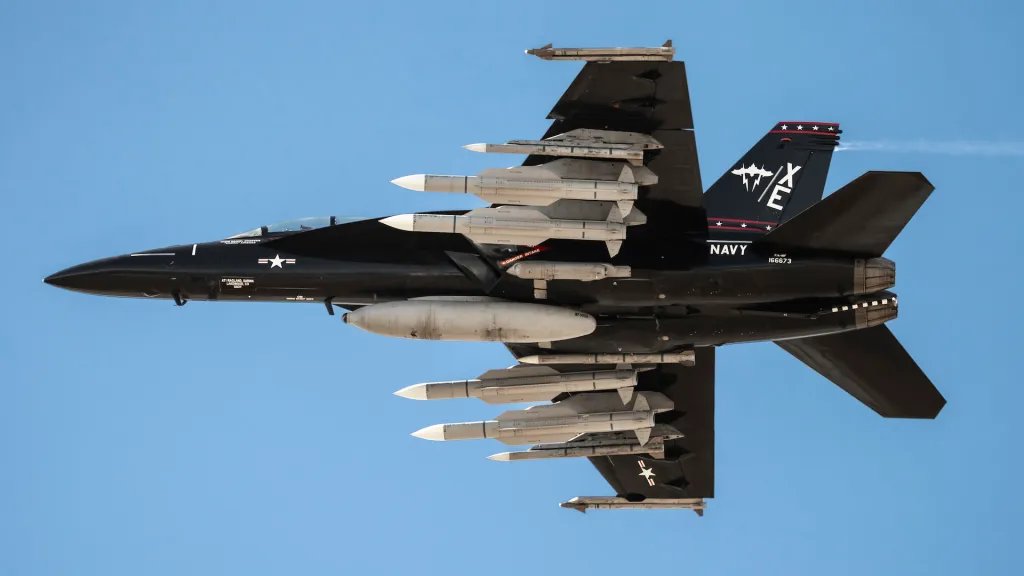
The IRST21 pod adds another relevant capability to the aircraft’s configuration. Infrared search and track systems can help detect and track aircraft using infrared signatures. In this case, the pod’s presence alongside the two missiles illustrates the broader combination of sensors and weapons being evaluated for demanding air-combat missions.

A visible sign of a broader modernization effort
The photograph arrives as the Navy updates its air-to-air weapons portfolio for long-range operations. The report notes that the AIM-174B and AIM-260 will also be joined by the AIM-424 Malice. Taken together, the programs point toward a layered missile mix rather than a single replacement for existing weapons.
Public imagery rarely settles the most important questions about advanced weapons. Details including range, guidance, networking, seeker performance and tactics are either classified or cannot be inferred from a single image. But the Super Hornet’s loadout does provide evidence that the Navy is bringing the AIM-174B and AIM-260 into the same test environment.
For observers of military aviation, that is the central development: two new long-range air-to-air weapons, each associated with a distinct role, have now been publicly seen together under a Navy test F/A-18F.
This article is based on reporting by twz.com. Read the original article.
Originally published on twz.com