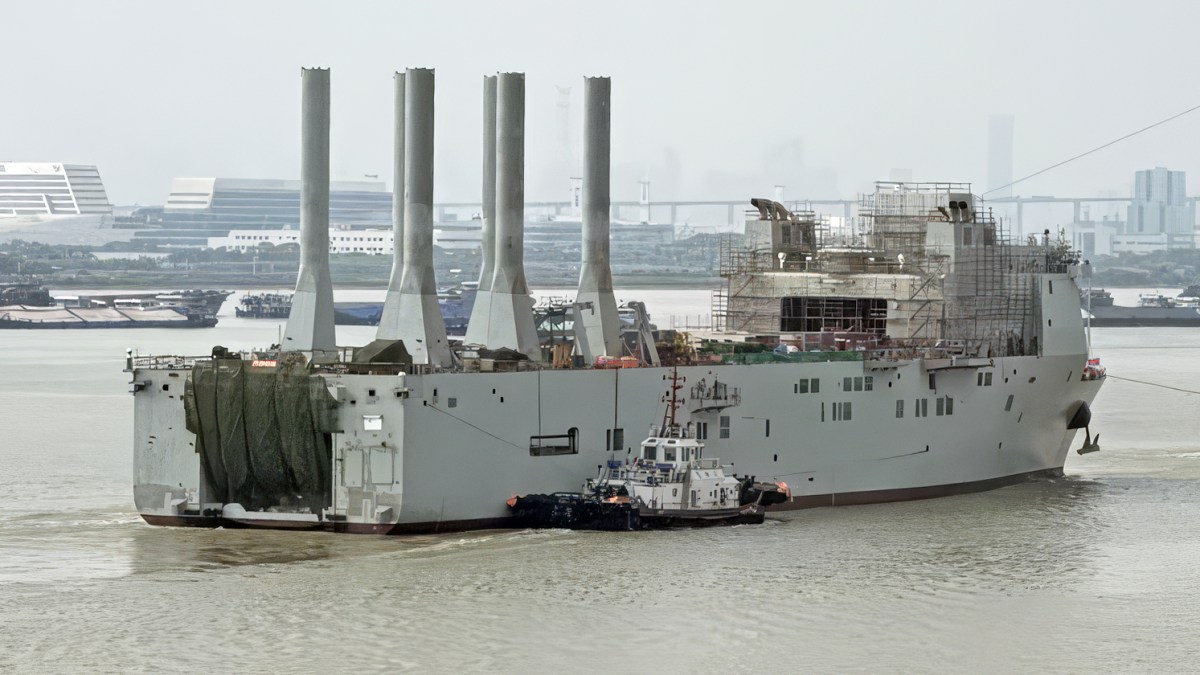
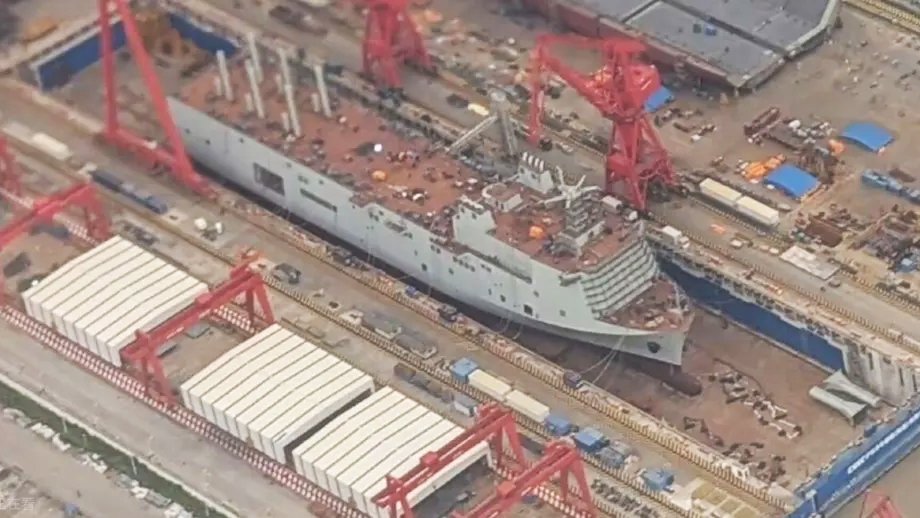
China appears to be nearing completion of a second purpose-built vessel configured to deploy, recover and support uncrewed underwater vehicles, or UUVs. Newly circulated imagery from Guangzhou shows a ship with a layout closely resembling a larger vessel previously identified under construction in Shanghai, but in a more compact form.
The two ships have not been officially described by Chinese authorities in the supplied reporting, so their exact mission and capabilities remain unconfirmed. Still, their shared features offer a strong indication that they are meant to act as motherships for underwater drones: vessels that can transport UUVs, put them into the water, recover them and sustain their operations away from shore.
A second vessel with a familiar layout
The first vessel drew attention less than a month earlier while under construction at Hudong-Zhonghua Shipyard on Changxing Island in Shanghai. It had a highly unusual configuration that appeared suited to handling underwater vehicles through a stern garage door and well deck. Large pylons were assessed as a possible means of moving vehicles between the water and different levels aboard ship.
The Guangzhou vessel has a near-identical overall shape, according to the report, although it is estimated to be roughly one-third smaller than the Shanghai counterpart. The newer ship also differs in the arrangement of its lifting structures. It appears to have six lift towers, while the larger vessel has six larger and six smaller towers.
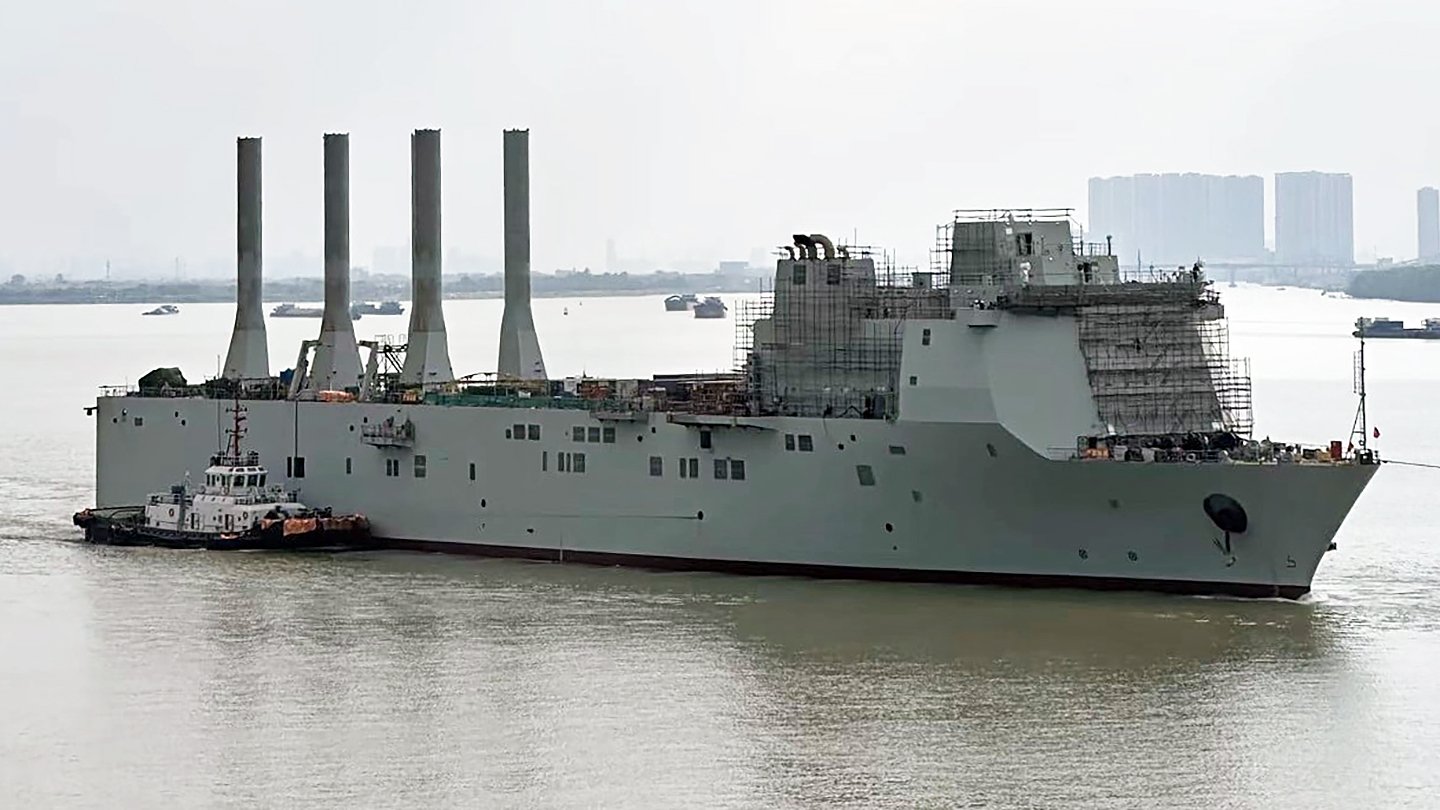
Other design cues are shared. Both vessels appear to include a flight deck and hangar behind a forward superstructure, as well as similarly located smokestacks. That combination matters because it suggests the design is not an isolated experiment or a one-off auxiliary ship. Instead, it may represent the early outline of a class of support vessels built around uncrewed maritime systems.
Why a UUV mothership would matter
Underwater drones can undertake missions that are difficult, risky or expensive for crewed submarines and surface ships. Depending on their design, they can be used for surveillance, seabed mapping, mine-related tasks, communications support or persistent patrols. A dedicated mothership would address a central operational limitation: getting those systems to distant waters and keeping them available once they arrive.
Rather than requiring every UUV to operate close to a home port, a support ship could bring a collection of vehicles forward, launch them in an operating area, recover them after their missions and potentially provide maintenance or other tending functions. The reported well-deck and lifting arrangement could be especially relevant for handling a mixture of vehicle sizes, from a few very large UUVs to a larger number of smaller systems.
The concept also points to a more distributed approach to naval operations. A host vessel operating with uncrewed underwater systems could expand the number of sensors and platforms available in a region without sending an equivalent number of crewed submarines. The value would not come from the support ship alone, but from the combined system of ship, vehicles, launch-and-recovery equipment and the networks used to direct or collect information from those vehicles.
Early signs, not confirmation of a fleet
Two near-complete vessels are a notable development, but they do not by themselves prove that China is fielding a mature UUV-mothership fleet. The reporting characterizes the vessels’ apparent roles as an assessment based on their configuration. Their final equipment fit, the types of drones they carry and their eventual operators are not established in the source material.
Even so, the appearance of a second, related design is significant. A single unusual ship can be a testbed. A second ship, especially one that retains the central features while changing scale and tower arrangement, can indicate that a concept is being explored across more than one hull or operational use case.
The broader context is China’s visible investment in uncrewed underwater systems. The report notes that a growing fleet of support ships capable of launching, recovering and tending UUVs would carry tactical and potentially strategic importance, particularly if those vehicles can stay on patrol for extended periods. It also notes the public appearance of China’s HSU100 uncrewed underwater drones during a military display in Beijing in 2025.
What to watch next
The next clues will likely come from launch, fitting-out and sea-trial activity. High-resolution imagery could reveal how the stern facilities are arranged, whether the ships carry cranes or additional handling gear, and how their flight decks and hangars are intended to be used. Observers will also look for the vessels operating alongside identifiable UUVs, which would help move the assessment from design inference to firmer evidence.
For now, the Guangzhou hull adds weight to the view that China is experimenting with specialized naval infrastructure for underwater drones. If the vessels enter service in the roles their design suggests, they could give the People’s Liberation Army Navy another way to extend uncrewed operations farther from Chinese shores and make UUVs a more persistent element of its maritime posture.
This article is based on reporting by twz.com. Read the original article.
Originally published on twz.com