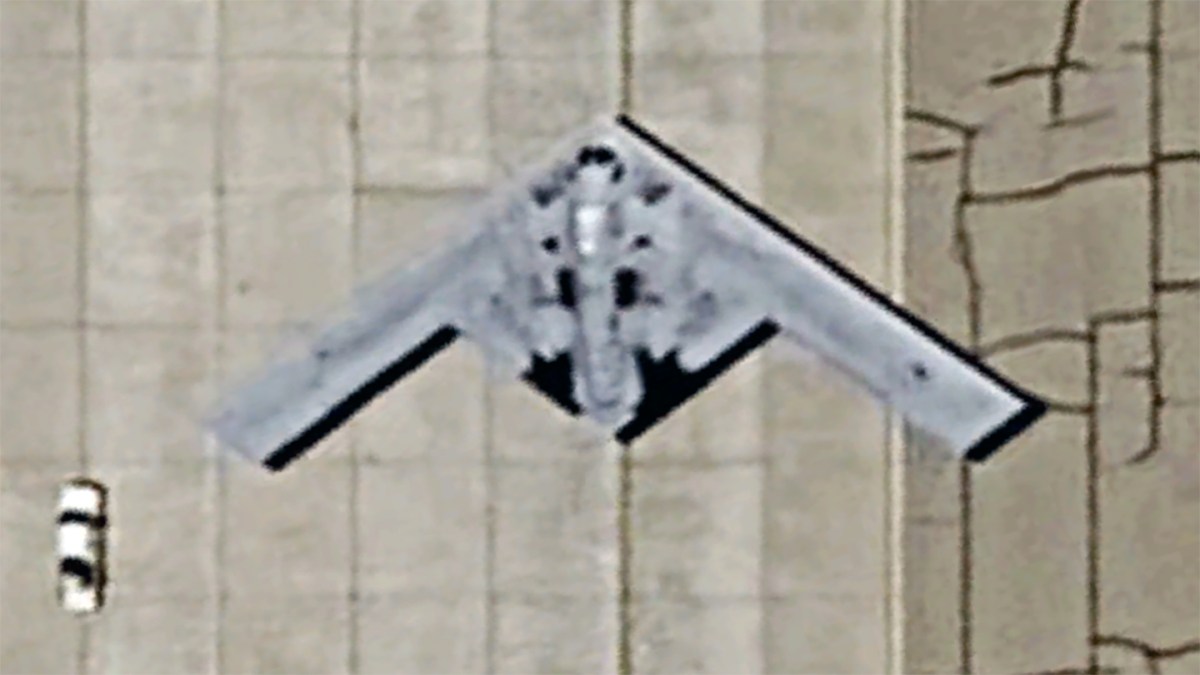
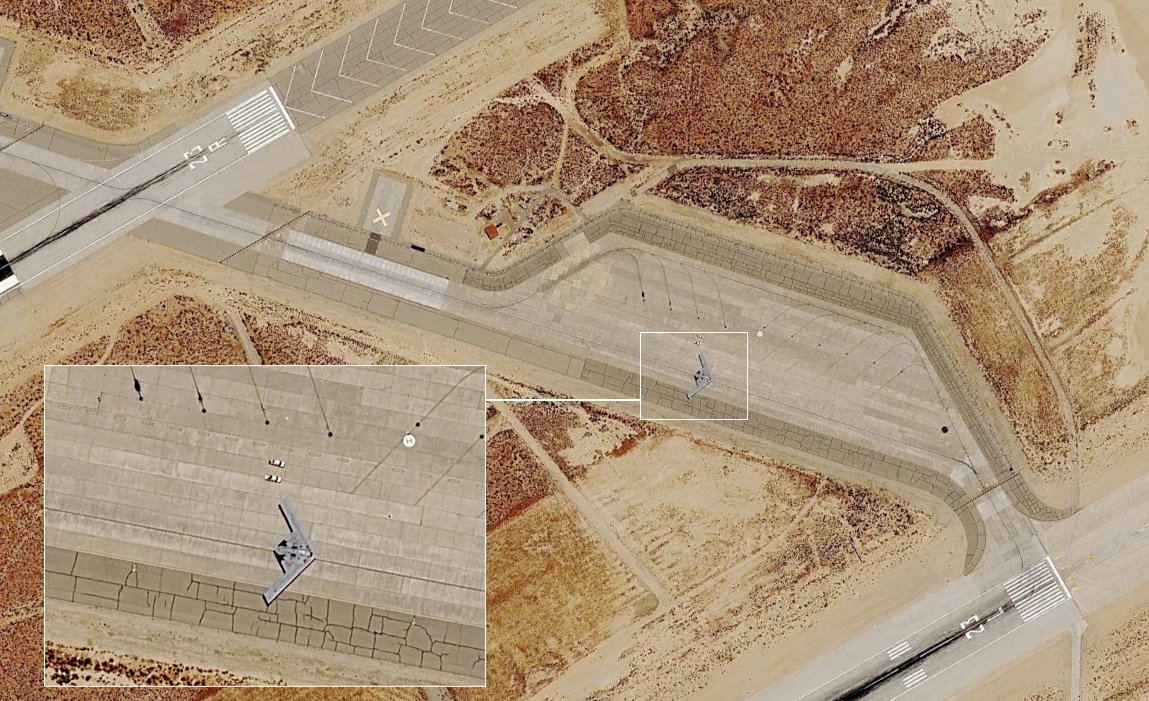
Publicly available satellite imagery has offered the clearest estimate yet of the B-21 Raider’s physical dimensions. Analysis of a Google Earth image of Edwards Air Force Base places the stealth bomber’s wingspan at about 152 feet and its length at about 61 feet, according to The War Zone.
The estimate addresses years of competing claims about the size of the U.S. Air Force’s next-generation bomber. Since the aircraft’s public unveiling, some viral graphics and online fact sheets have assigned it a wingspan below 130 feet. The new imagery suggests that figure is far too small.
The image used for the measurement is dated June 20, 2026, and shows a B-21 taxiing between Edwards’ parallel runways. With known features in the image and Google Earth’s measuring tools, analysts could estimate the aircraft’s scale more directly than had been possible from earlier public views.
A narrower range for a closely watched aircraft
The resulting estimate is not an official specification from Northrop Grumman or the U.S. Air Force. Satellite-image measurements carry uncertainty, and the article characterizes the 152-foot span as an approximation that could vary by a few feet. Even so, it puts the aircraft within a much narrower and more credible range than many prior public claims.
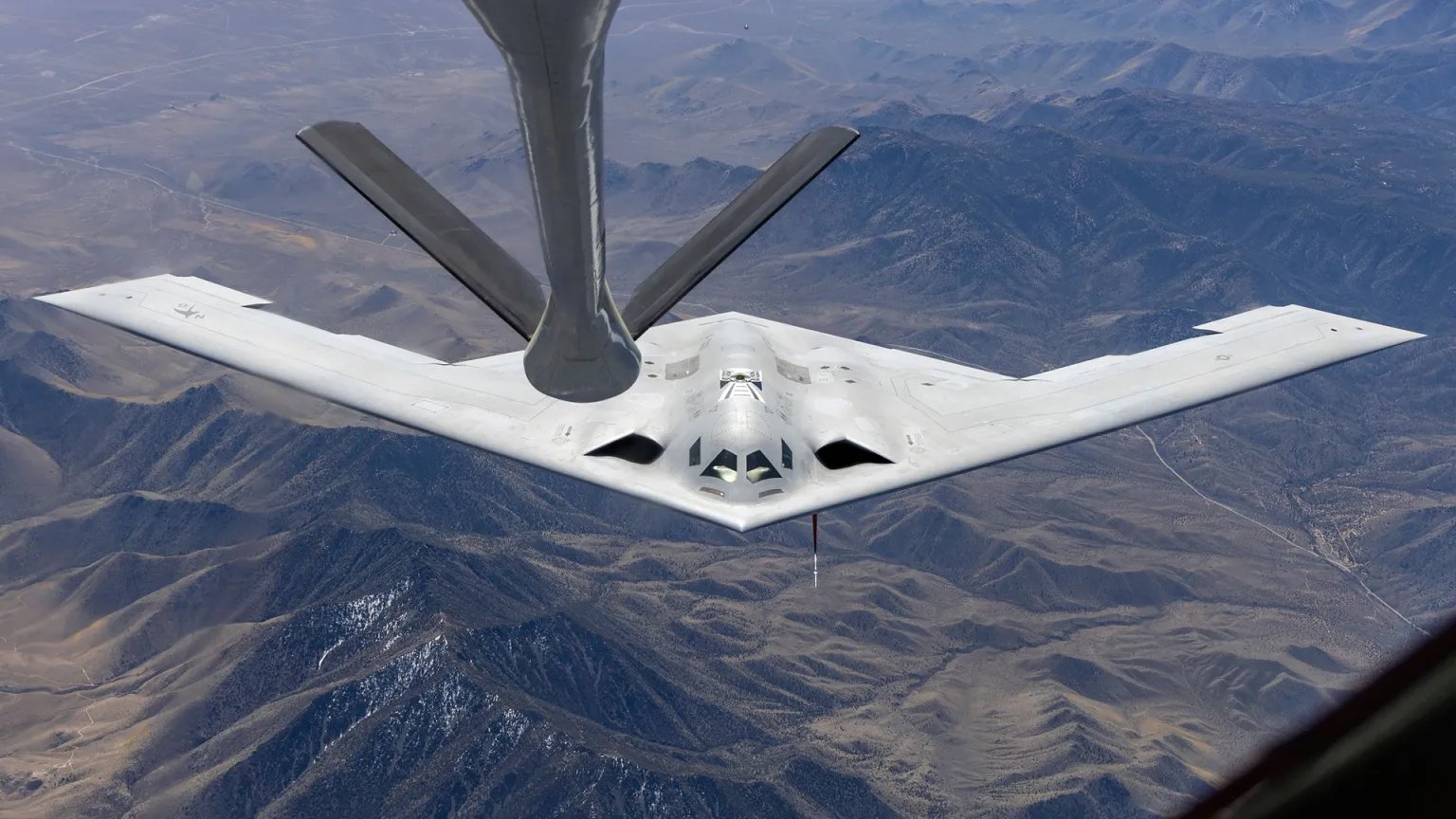
The reported dimensions are consistent with a wingspan in the roughly 150- to 155-foot range and with earlier assessments that the aircraft was smaller than the B-2 Spirit, but not dramatically smaller. The B-21 is estimated to be about 12% smaller than the B-2 in wingspan and roughly 12% shorter in length.
That comparison matters because the B-2 has long served as the most visible reference point for judging the newer flying-wing design. Both aircraft have an unusual planform intended to reduce observability, making simple visual estimates especially unreliable when photographs lack an obvious scale reference.
Why the size became a point of contention
The B-21’s profile makes it easy for misleading dimensions to spread. It has a broad, tailless flying-wing form and has been seen publicly only in limited settings. Images taken from different angles can distort apparent proportions, while images shared without reliable scale information invite speculation.
That uncertainty was amplified by AI-generated and enthusiast-produced aircraft fact sheets circulated on social media, according to the report. Some listed spans under 130 feet, a number the publication says did not match its own longstanding analysis of the aircraft.
The newly available Google Earth image does not reveal classified capabilities, but it gives observers a clearer reference point for one basic question: how large the airframe is. Its resolution and the availability of measurement tools allowed analysts to compare the bomber against the airfield environment rather than rely solely on appearance.
Smaller than the B-2, with different priorities
The reported dimensions reinforce a broad understanding of the B-21’s design. The aircraft was expected to be smaller than the B-2, with a design that places priority on range, affordability and very low observability rather than the massive payload associated with its predecessor.
Aircraft size can affect many engineering tradeoffs, including internal volume, fuel capacity, payload space, manufacturing and operational costs. But an external measurement alone does not disclose the B-21’s payload, range, sensors or survivability. The article cautions against reading more into the estimated dimensions than they can support.
What the size estimate does establish is that the Raider is not the extremely compact design described in some widely shared online graphics. A wingspan near 152 feet places it much closer to the larger end of prior public estimates and preserves a significant, though reduced, physical relationship to the B-2.
The value and limits of open-source observation
The episode illustrates how commercial imagery and mapping platforms have become part of the public conversation around military technology. Google Earth imagery can make routine movements at a major air base visible to anyone with access to the platform. When an image contains usable scale references, it can also support straightforward geometric analysis.
Open-source analysis is not a substitute for official data. Image resolution, aircraft orientation, shadows and measurement assumptions all affect the result. A figure derived from imagery should be treated as an estimate, not as a confirmed program specification.
Still, the analysis has practical value in separating defensible evidence from unsupported claims. Public discussion of high-profile military programs often moves faster than authoritative details are released. A measurable satellite image can provide a check on claims that are otherwise based on visual impressions or repeated without sourcing.
A basic fact, newly visible
The B-21 Raider remains one of the most closely watched aerospace programs in the United States. Its development is associated with a shift toward a bomber designed to combine long range, low observability and affordability. Many performance details remain undisclosed.
For now, the Google Earth image has resolved a more elementary question. The available evidence indicates a B-21 with a wingspan of roughly 152 feet and a length of roughly 61 feet—smaller than the B-2, but nowhere near the sub-130-foot span that circulated in some online depictions.
That may not answer the larger questions surrounding the program, but it gives public observers a firmer physical baseline for understanding the aircraft now entering a more visible phase of its history.
This article is based on reporting by twz.com. Read the original article.

Originally published on twz.com