An Arctic surveillance test with an unusual transmitter
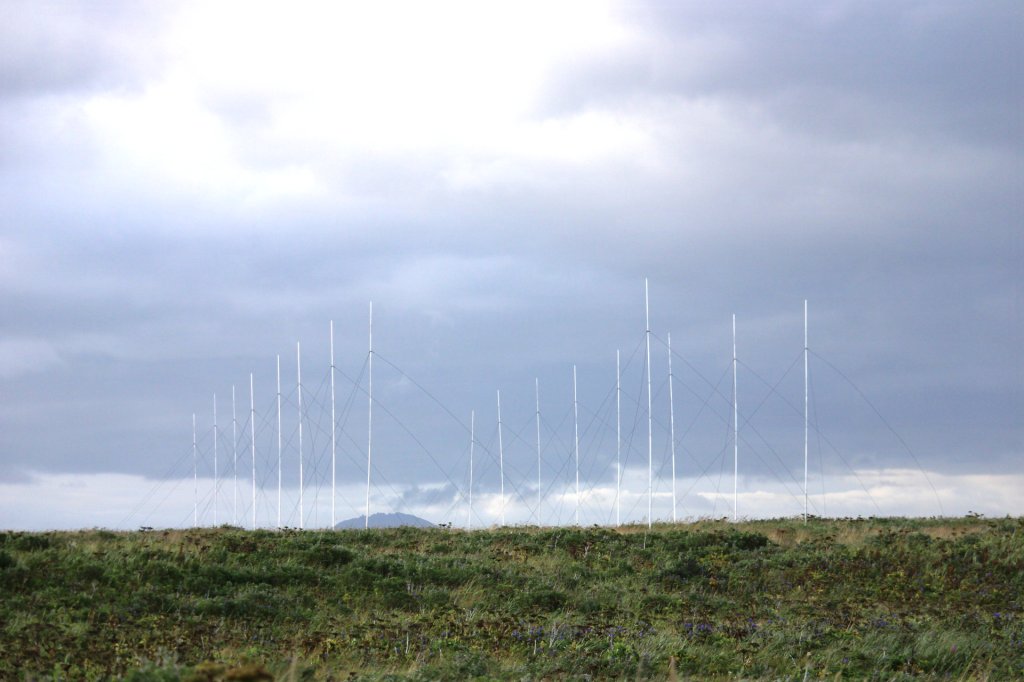
The United States and Canada have completed an experiment that tested whether Alaska’s High Frequency Active Auroral Research Program, better known as HAARP, could help detect aircraft beyond the reach of existing long-range radar sites. The work paired HAARP’s high-frequency transmitter with a newly developed, lower-cost 16-element receiver array in Cold Bay, Alaska.
The September 7–11 exercise was the final phase of a three-year series of “Arctic air domain awareness” experiments involving U.S. and Canadian authorities. According to the U.S. military’s account of the test, researchers used the HAARP facility and the MITRE-developed receiver array to collect data on participating aircraft operating over the Gulf of Alaska and the Bering Sea.
The core question was practical: can an existing high-frequency transmitter, combined with an economical receiving system, detect aircraft outside the coverage of today’s long-range radars? The test was conducted in a region where distance, harsh weather and limited infrastructure all complicate conventional air-surveillance networks.
Why over-the-horizon radar matters in the north
Over-the-horizon radar is designed to extend surveillance beyond the line of sight of conventional radar installations. For the United States and Canada, that capability is increasingly relevant in the Arctic and adjacent northern approaches, where the geography is vast and the number of suitable sites for permanent radar infrastructure is limited.
The experiment’s focus on the Gulf of Alaska and Bering Sea also underscores the operational problem. A radar network may have strong local coverage around established sites while leaving substantial spaces between them. In the High North, closing those gaps with conventional systems can require expensive construction, logistics and maintenance. A system that makes use of a pre-existing high-frequency transmitter and a relatively small receiver array could offer a different cost and deployment profile.

The testing did not establish that HAARP is becoming an operational radar site, nor did it announce a new fielded system. It did, however, demonstrate an approach that officials are examining as part of broader Arctic air-domain-awareness work. The significance lies in the combination of an existing transmitter, a purpose-built receiver array and experiments involving real aircraft rather than solely laboratory measurements.

HAARP’s potential role
HAARP is widely known as a research facility, and the U.S. Air Force transferred the site away more than a decade ago. Its use in this experiment raises the possibility that the facility could contribute to future operational needs, though the supplied information describes a demonstration rather than a decision to repurpose the site.
For this test, the transmitter’s value was its ability to work at high frequency while the Cold Bay array performed the receiving function. MITRE developed the receiver system and supported the field experiment with government, scientific and operational participants. The division of functions is important: the test explored a networked sensing arrangement rather than a conventional single-site radar installation.
That architecture may be attractive in remote environments. If a transmitter can already operate in a strategically useful location, the remaining task is not necessarily to build a complete new radar complex. It may instead be to deploy, connect and validate receivers capable of extracting useful information from the signals reflected or otherwise received over long distances. The test’s emphasis on a lower-cost array suggests that affordability is part of the program’s rationale.
A regional problem shared by allies
The United States is not alone in pursuing this kind of coverage. Canada is already working with Australia on a multibillion-dollar over-the-horizon radar project intended to improve surveillance in the Arctic. That parallel effort highlights the shared concern among northern partners: air approaches that are strategically important but difficult to watch continuously with existing infrastructure.
The U.S.-Canadian experiments therefore fit into a wider push to improve awareness rather than a stand-alone technology trial. The new receiver concept could become one option among several, particularly if follow-on analysis shows it can reliably identify aircraft in conditions representative of Arctic operations.
Much remains unknown from the announced test. The available account does not provide detection ranges, accuracy results, aircraft types, or a timeline for any next phase. Those details would determine whether the approach can progress from an experiment into a capability with a defined operational role.

What comes next
For now, the test is a signal of intent: U.S. and Canadian organizations are looking for ways to expand northern surveillance while confronting the cost and logistical realities of the Arctic. The work also shows that older or research-oriented infrastructure can be evaluated for new missions when strategic conditions change.
Whether HAARP itself ultimately gains a continuing operational role remains unresolved. But the September experiment demonstrated that its transmitter can be paired with a modern receiver array in a real-world air-domain-awareness scenario. In a region where surveillance gaps are difficult and expensive to close, that is enough to make the concept worth watching.
This article is based on reporting by twz.com. Read the original article.
Originally published on twz.com