A major submarine buy signals the Navy’s long game
The U.S. Navy has awarded contracts worth a combined $76.6 billion for a new batch of Columbia-class and Virginia-class submarines, locking in one of the Pentagon’s largest recent commitments to undersea warfare. According to the Defense Department announcement reported by Defense News, the package covers five Columbia-class ballistic missile submarines and nine Virginia-class fast-attack submarines, along with billions more for nuclear shipbuilding programs and industrial infrastructure.
The scale of the award matters on its own, but its broader significance is strategic. The submarine fleet sits at the center of two missions the Navy sees as non-negotiable: maintaining the sea-based leg of the U.S. nuclear deterrent and preserving an attack-submarine force able to operate globally for surveillance, strike, and special operations support. By funding both programs together, the Navy is trying to secure continuity across those missions rather than treating them as separate procurement problems.
How the money is divided
The reported contract structure allocates $29.5 billion for Columbia-class Build II submarines, $42.1 billion for Virginia-class Block VI submarines, and another $5 billion for investments tied to nuclear shipbuilding programs and shipyard infrastructure. The industrial portion is notable because submarine procurement in the United States is not only about buying hulls. It is also about sustaining the specialized workforce, supplier base, and construction capacity needed to deliver boats on schedule.
Vice Adm. Robert Gaucher, the Navy’s director of submarine programs, framed the package as a commitment to “undersea superiority” and to recapitalizing the nuclear triad. That language reflects the dual nature of the award. Columbia is a strategic deterrence platform designed to replace the aging Ohio-class ballistic missile submarines, while Virginia is the Navy’s workhorse attack boat, built for conventional missions and operational flexibility.
Why Columbia is the priority program
The Columbia class carries outsized weight because it is intended to replace the Ohio-class boats that provide the Navy’s portion of the U.S. nuclear triad. Those Ohio submarines remain central to deterrence, and the replacement schedule is sensitive because gaps in deployment capacity would carry national-security consequences far beyond normal shipbuilding delays.
The Navy currently has seven Columbia-class submarines under contract, according to the report. The newly awarded boats extend that pipeline and help define what the next generation of strategic deterrent patrol capability will look like. Defense News reported that the Columbia class is expected to improve on the Ohio class in both missile payload and stealth, while fielding the Trident II D5 Strategic Weapons System and hypersonic missiles.
That capability ambition helps explain why the program remains the Navy’s top submarine priority even as costs remain immense. Replacing the Ohio class is not optional from the service’s perspective. It is a deadline-driven modernization effort tied directly to the long service lives and eventual retirement of the existing ballistic missile submarine fleet.
Virginia remains essential to day-to-day naval power
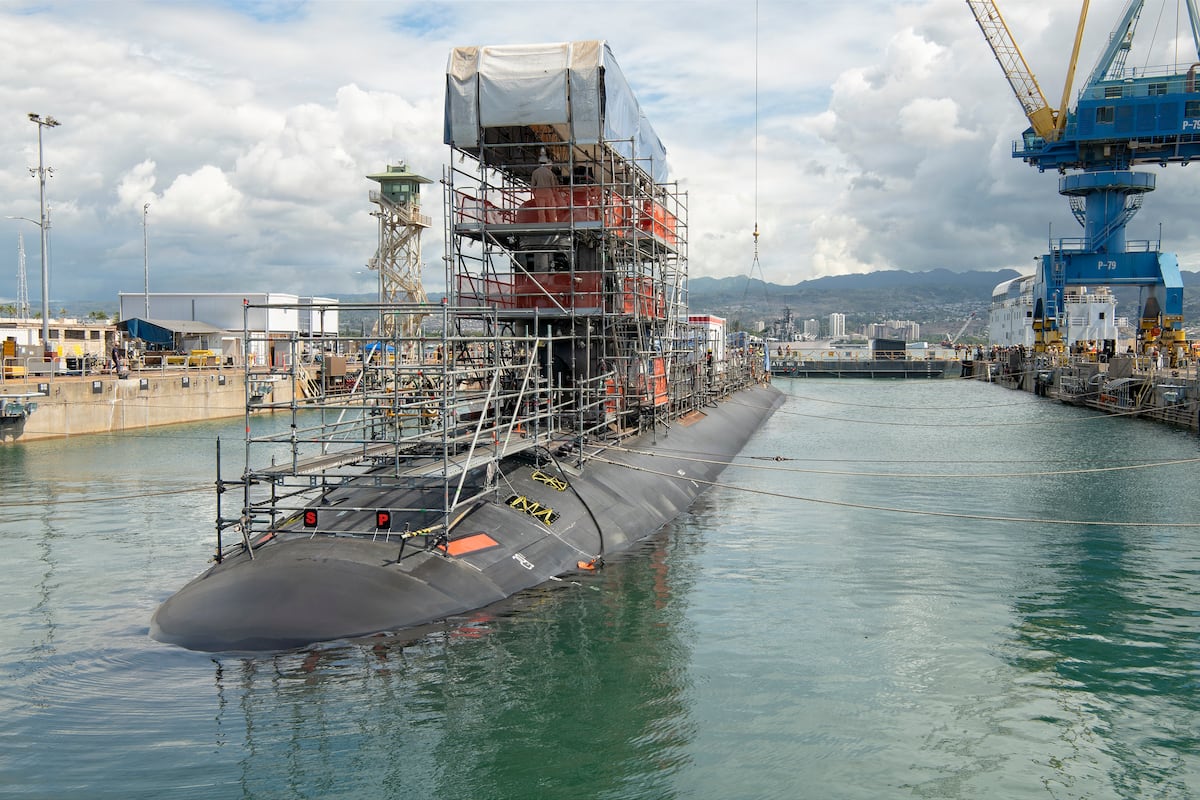
If Columbia is about strategic deterrence, Virginia is about operational tempo. The Virginia-class attack submarine has been in service since the early 2000s, with the lead ship launched in 2003. The class was designed to replace Los Angeles-class submarines and has become a central asset for conventional maritime operations.
Defense News noted that Virginia-class submarines can support special operations forces during long deployments and feature a reconfigurable torpedo room. That flexibility has made the class useful across a wide mission set, from intelligence and surveillance to strike operations and support for irregular or covert maritime tasks.
The Navy said it currently has 26 active Virginia-class submarines, with 23 more already in the future construction pipeline. Adding nine more under the Block VI contract continues that buildup, but it also reflects a basic pressure point: attack submarines are in persistent demand, and replacing older boats while expanding production has been difficult for the industrial base.

The industrial base is part of the story
The additional $5 billion for shipbuilding programs and infrastructure may end up being one of the most consequential parts of the package. U.S. submarine production depends heavily on General Dynamics Electric Boat and Huntington Ingalls Industries-Newport News Shipbuilding, along with a network of suppliers that cannot be expanded overnight. Skilled labor, nuclear-certified manufacturing, and yard capacity all constrain output.
That matters because even large contract awards do not automatically translate into on-time delivery. The Columbia program in particular has already faced schedule pressure. Construction began in 2020, but the lead ship’s expected delivery slipped from 2027 to 2028, according to the report, with delays tied to steam turbines and sections of the bow and stern.
Those delays are not just program-management footnotes. They illustrate the narrow margin the Navy is operating within as it tries to replace strategic submarines, sustain attack-submarine output, and rebuild confidence that industry can execute on overlapping nuclear shipbuilding demands.
What this contract really says
The award is less a sudden expansion than a formal acknowledgment of long-term priorities the Navy has been signaling for years. The undersea fleet remains one of the few areas where the service appears willing to sustain very high investment despite competing budget pressures elsewhere. That is partly because submarines are seen as survivable, difficult to counter, and central to both conventional and nuclear planning.
It also reflects a more practical reality. Nuclear submarine construction is not something the United States can surge easily if production falls behind. Contracts at this scale are one way of giving shipbuilders and suppliers the confidence to keep hiring, investing, and coordinating around a multiyear pipeline.
The immediate headline is the $76.6 billion figure. The deeper takeaway is that the Navy is trying to buy time as much as submarines: time to replace the Ohio class, time to keep Virginia production moving, and time to stabilize a specialized industrial base that has little room for error.
Key points
- The package covers five Columbia-class and nine Virginia-class submarines.
- Funding includes $5 billion for nuclear shipbuilding and yard infrastructure.
- Columbia remains the Navy’s top strategic modernization priority.
- Virginia production continues as the backbone of attack-submarine operations.
- Schedule pressure on Columbia highlights ongoing industrial-base constraints.
This article is based on reporting by Defense News. Read the original article.

Originally published on defensenews.com