For the first time, a senior US military official has publicly confirmed that the United States has placed weapons in orbit. Air Force Secretary Troy Meink made the declaration Monday during the Air and Space Forces Association's annual Air, Space & Cyber Conference near Washington, DC — a statement that closes years of official silence on one of the most sensitive corners of American military planning.
Meink's prepared remarks were brief but unambiguous. He said the United States "now has on-orbit space control weapons capable of defending the joint force against hostile adversary action," positioning the deployment as part of a wider effort to stay ready for evolving threats wherever they arise.
That single sentence represents a significant shift. Until a few years ago, no senior Pentagon official would discuss orbital combat on the record, and the existence of American space-based weapons was treated as a subject best left unaddressed in public. Meink's disclosure, delivered at a major industry and military conference, moves that conversation firmly into the open.
What Meink Said, and What He Withheld
The secretary offered no specifics about the nature of the weapons, how many exist, or what capabilities they possess. He also declined to say when the Space Force deployed them, leaving open the question of which presidential administration oversaw the program's transition from development to fielding. Because space technology programs often take years to mature, the effort behind whatever is now in orbit likely spans multiple administrations.
Meink was explicit that the omission was deliberate. He described a careful internal calculus about how military leaders discuss sensitive capabilities, noting that the decision to speak at all is itself weighed against operational risk.
Deterrence Built on Ambiguity
According to Meink, the public acknowledgement serves a deterrent purpose even without technical detail. He explained that revealing specifics — whether a system has been tested, how it performs, or what it targets — would work against deterrence rather than reinforce it. In his framing, confirming that the capability exists sends the necessary signal, while silence about the particulars preserves strategic flexibility.

That approach is familiar from other corners of nuclear and strategic weapons policy, where governments frequently confirm the existence of a capability while refusing to describe its performance envelope. Applied to orbit, the same logic means adversaries are left to plan against an uncertain threat rather than a documented one.
A Broader Shift in Pentagon Discourse
The announcement did not emerge from nowhere. Space Force officials have previously expressed interest in acquiring space-based weapons, and Pentagon leaders have grown steadily more open to discussing space warfare over the past several years. Military officials have recently spoken publicly about orbital combat, about defensive countermeasures installed on satellites, and about a new ground-based weapon designed to disable an enemy satellite in orbit.
Those public discussions have gradually normalized a subject that was once effectively off-limits. Meink's remarks extend that trajectory by moving beyond ground-based or defensive systems to acknowledge weapons stationed in orbit itself.
Photo Underscores the Operational Context
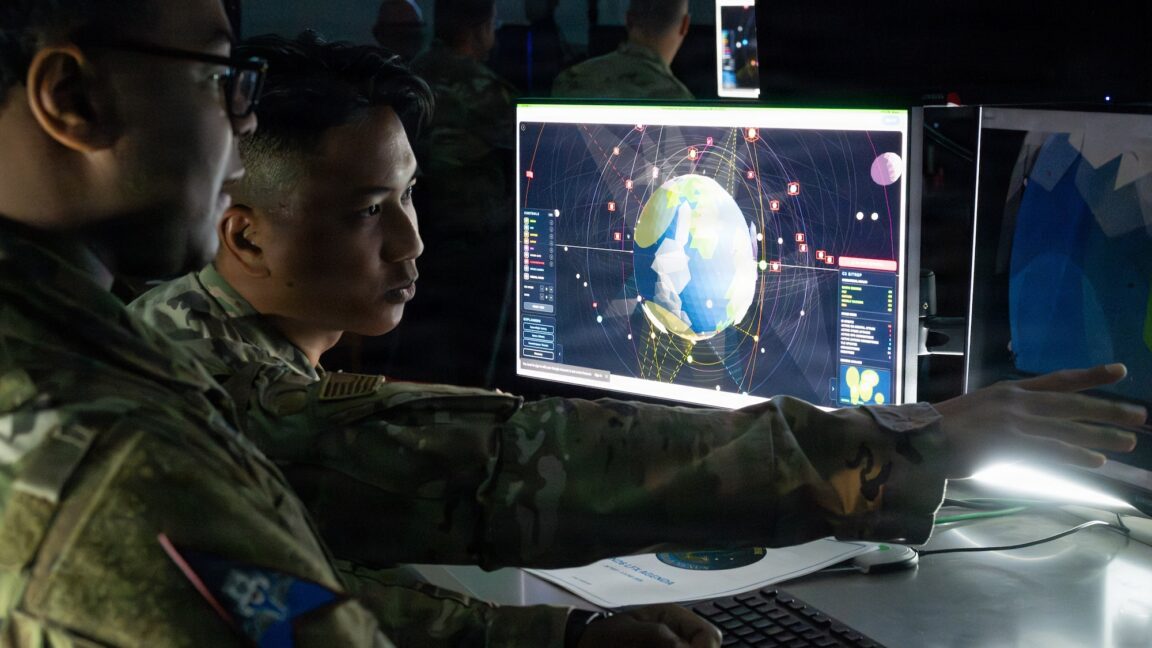
The announcement comes amid visible activity at the institutions that manage space operations. A US Space Force Guardian was photographed monitoring a space effects command and control display at the Combined Space Operations Center at Vandenberg Space Force Base, California, on May 28, 2026 — imagery credited to the US Space Force and photographer David Dozoretz. The center serves as a hub for tracking and coordinating space effects, the kind of function that would be central to operating any on-orbit capability.
Why the Timing Resonates in Beijing and Moscow
The confirmation is expected to reverberate in the power centers of both Beijing and Moscow, where the United States' space ambitions are watched closely. Announcing an operational orbital weapon changes the assumptions those governments must build into their own military planning, particularly regarding the survivability of their satellites and the forces that depend on them.
For the joint force Meink referenced, space-based systems underpin navigation, communications, missile warning, and intelligence collection. A weapon described as defending that force against hostile action in orbit fits logically into a strategy of protecting the infrastructure that conventional military operations increasingly rely upon.

The Questions That Remain
Several fundamental details are still unknown. The Pentagon has not identified the systems involved, described their operating orbits, or explained how they would be employed in a crisis. It has not confirmed whether the weapons have been tested, nor has it set out any doctrine governing their use.
That silence is likely to persist. Meink made clear that the United States intends to keep adversaries guessing about capabilities and limits alike, treating opacity as an asset rather than a liability. The confirmation of existence, in this formulation, is the message — everything else is withheld by design.
What to Watch
Observers tracking the program will have few official breadcrumbs to follow. Still, several indicators may prove instructive over time:
- Further public statements from Air Force and Space Force leadership at conferences and congressional hearings.
- Budget documents that reference space control programs, even in unclassified summary form.
- Changes in how the Pentagon describes counterspace activities in strategy publications.
- Reactions from foreign governments and any adjustments to their own space programs.
- Continued reporting from the Combined Space Operations Center and similar facilities.
The Strategic Significance
The value of Meink's statement lies less in technical disclosure than in precedent. A capability that was previously unacknowledged is now officially part of the public record, and the United States has signaled that it is willing to say so at a major defense gathering.
That changes the baseline for future discussion. Once a government confirms that it fields a class of weapon, subsequent questions shift from whether the capability exists to how it is used, how it is controlled, and how adversaries respond. For orbital warfare, that transition has now begun.
What remains to be seen is whether the disclosure produces the deterrent effect Meink described, or whether it accelerates a competition in space that has been building quietly for years. Either way, the era in which the Pentagon would not discuss weapons in orbit has ended.
This article is based on reporting by Ars Technica. Read the original article.

Originally published on arstechnica.com