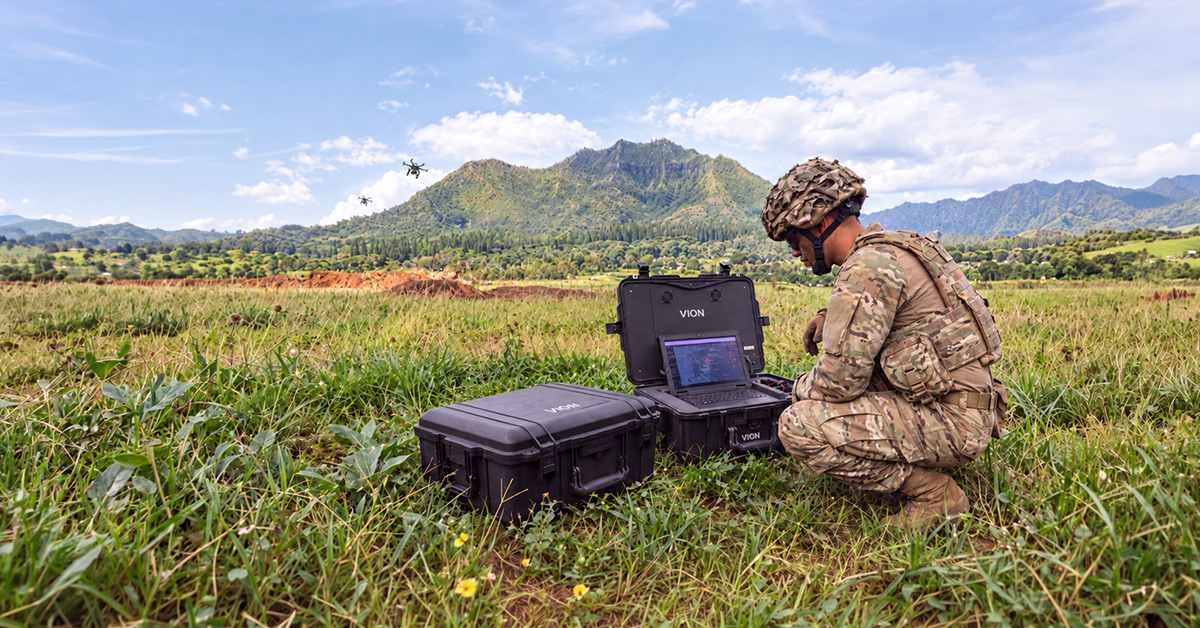
A portable system aimed at coalition connectivity
General Dynamics Information Technology has unveiled Vion, an artificial-intelligence-enabled portable communications system intended to help U.S. ground troops exchange information with command centers and coalition partners from remote, contested environments.
The suitcase-sized platform is described as a Mission Partner Environment solution. At its most basic level, it is meant to let users exchange messages and files. The company’s larger objective is to reduce the friction created by separate military and allied networks, applications and data environments.
Jason Myers, vice president of defense agencies at General Dynamics Information Technology, said the system is designed to establish secure connections quickly for troops operating away from fixed infrastructure. The stated emphasis is interoperability: enabling forces to work with systems in which they have already invested, rather than requiring them to adopt a single proprietary kit.
Open architecture, AI and zero trust
GDIT says Vion combines open architecture, AI capabilities and zero-trust cybersecurity protections. The company says the platform can connect to outside networks, adapt or patch connections, and translate written messages, voice memos and video while maintaining those security protections.
That mix addresses a familiar problem in military communications. Different organizations often operate with customized systems, and vendors can build platforms around their own equipment and software. While those approaches can meet specific needs, they can also make integration, updates and upgrades harder and more expensive.
Myers said GDIT wanted to provide a comprehensive option without locking users into a particular offering. He described a modular approach that can use proven technologies while allowing components to be replaced as new technologies emerge. The company argues that securely carrying out that replacement within a modular architecture is a departure from the way such systems have commonly been fielded.
A response to siloed information systems
The backdrop for Vion is a broader Pentagon effort to improve information sharing among U.S. forces and partners. The Defense Information Systems Agency, or DISA, has been exploring the Coalition Information Environment, described as a modernized architecture built around zero trust and data-centricity.
GDIT took part in a Joint Staff J6-led demonstration known as Olympus Fires, where DISA examined ways to improve that coalition environment. The company positions Vion as a deployable implementation of similar goals: bringing communications, collaboration and security functions closer to personnel who need them in the field.
At a June panel discussion, U.S. Army Lt. Col. David Courter, DISA’s Combatant Command Integration and Plans chief, summarized the challenge in direct terms. Military organizations have spent decades building siloed networks, siloed applications and siloed environments for internal collaboration. The emerging requirement is to move beyond that arrangement.
What Vion is intended to do in the field
For a deployed unit, the value of a portable platform would depend on whether it can make different systems work together quickly and securely. GDIT says Vion is intended to help users establish links to a command center and coalition forces, share files and messages, and work across external networks from remote locations.
The company also says its AI capabilities can support translation across multiple forms of communication, including text, voice memos and video. In coalition operations, language and format differences can slow the movement of information even when a network connection exists. The reported feature set is therefore aimed at both connectivity and practical collaboration.
Cybersecurity remains central to the pitch. GDIT says the system maintains zero-trust protections as it connects systems and adapts network links. Zero trust is a security model that does not assume a user or device should be trusted simply because it is already inside a network. In the context of a portable coalition communications kit, that principle is intended to limit risk while allowing more flexible connections.

An industry announcement, not a deployment record
Vion’s unveiling is a product announcement, and the available information does not establish that the system has been broadly adopted or deployed operationally. Its claims about interoperability, AI-assisted translation and secure connectivity are those presented by GDIT.
Even so, the announcement reflects the direction of military networking efforts: less reliance on closed, isolated environments and more emphasis on secure data exchange across U.S., allied and partner systems. If systems such as Vion can perform as intended in difficult field conditions, they could give ground units a more flexible way to connect to a wider mission network without carrying an array of separate communications tools.
The near-term significance lies in the design priorities. Vion is built around portability, modularity, coalition access and zero-trust security—an attempt to turn a long-running defense information-sharing problem into equipment that can travel with the unit that needs it.
This article is based on reporting by Defense News. Read the original article.
Originally published on defensenews.com