Small drones have quietly become one of the most awkward problems in modern air defense. They are cheap, numerous, easy to launch from a truck bed or a rooftop, and — increasingly — capable of flying a mission without ever transmitting a radio signal a defender can listen for. A newly reported 3D lidar sensor aims squarely at that blind spot, with the ability to pick up drone threats from nearly one mile away.
The claim matters because counter-UAS work has, for years, leaned heavily on detecting the electronic emissions that drones produce. That approach works well against a hobby quadcopter streaming video back to an operator. It works poorly against a machine that has been programmed with a flight path, carries no radio link, or is tethered by fiber optic cable. Lidar offers a different kind of answer: instead of listening for a signal, it looks directly at the airspace and measures what is physically there.
Why radio-silent drones are the hardest targets
The phrase "radio-silent" covers several distinct threat profiles, and each one undermines a different assumption embedded in traditional detection.
- Waypoint autonomy. A drone can be loaded with a route, launched, and left to fly it without any command link. There is no uplink to intercept and no downlink to triangulate.
- Inertial and optical navigation. As onboard computing has improved, aircraft can hold a course using cameras, inertial sensors, and stored terrain data rather than external signals.
- Fiber-optic tethering. Some systems trade wireless freedom for a physical cable, gaining a high-bandwidth link that emits nothing that a radio-frequency sensor can detect.
- Low, slow, and small. Even radar, the traditional backbone of air surveillance, has to contend with tiny radar cross-sections, slow groundspeeds, and clutter that makes a small airframe look a great deal like a bird or a patch of moving vegetation.
The result is a detection gap that widens as autonomy becomes cheaper and more widely available. Analysts have repeatedly warned that the same consumer electronics driving the commercial drone boom also lower the barrier for adversaries seeking a quiet, deniable surveillance or strike platform. Defenders are being pushed toward sensors that do not depend on the target cooperating electronically.
What a 3D lidar sensor brings to the problem
Lidar — light detection and ranging — works by firing laser pulses and timing how long they take to return. A 3D lidar unit sweeps or scatters those pulses across a field of view, building a point cloud that describes the shape, position, and motion of objects in three dimensions.
Applied to counter-drone missions, that offers several practical advantages over purely electronic detection:
- No emissions required from the target. A radio-silent aircraft is still a physical object occupying physical space, and lidar sees it regardless of what it transmits.
- Geometric classification. Point clouds can reveal rotor configurations, wingspan, and the characteristic hover-and-translate motion of a multirotor, helping separate drones from birds and balloons.
- Direct bearing and range. Because lidar measures distance directly rather than inferring it, a detection can come with an accurate position track suitable for cueing other systems.
- Day or night operation. Unlike a camera that depends on ambient light, an active laser illuminates its own scene.
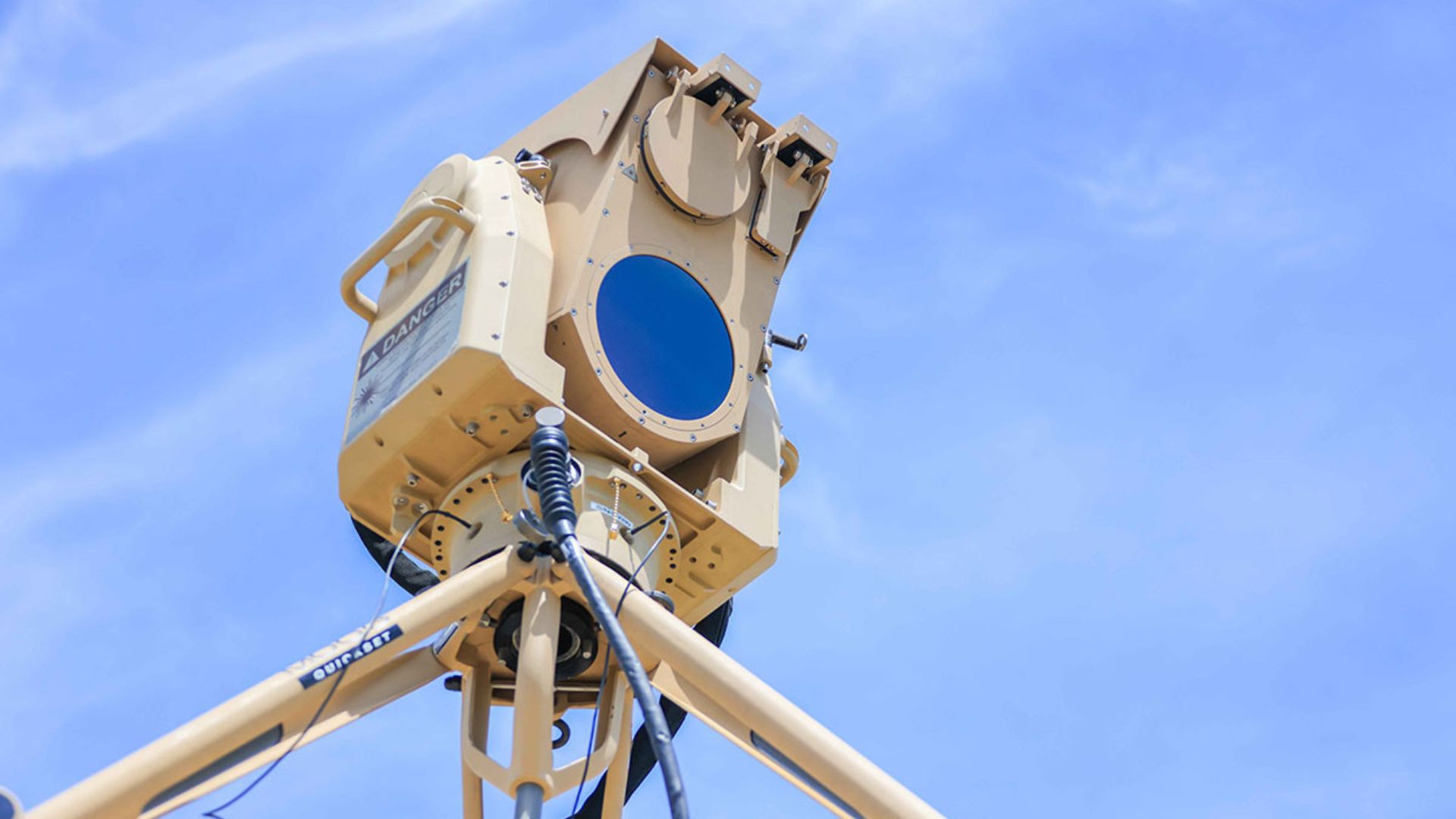
The sensor described in source materials for this report, identified as Stratos, is presented as a 3D lidar counter-drone system with a detection envelope approaching one mile. That figure is significant: it moves optical detection from a short-range, last-ditch capability into something closer to an area sensor.
Nearly a mile of warning time
Range is not a vanity metric in air defense — it converts directly into decision time. A detection at the outer edge of a sensor's envelope gives operators room to confirm whether a contact is a genuine threat, determine its intent, and choose a response. A detection at a few hundred feet leaves almost no margin at all.
That margin is what makes long-range lidar attractive alongside radar and RF receivers. A sensor that can see a small airframe from nearly a mile away can contribute to a track before the object enters the tighter engagement envelope of jammers, interceptors, nets, or directed-energy effectors. In layered defense architectures, the outer sensor does not have to defeat the threat — it only has to hand off a good enough track in time for something else to act.

It also changes how sites think about placement. Airfields, forward operating bases, prisons, stadiums, and critical infrastructure all wrestle with the same question: how far out do you need to see? A longer-range optical layer can be sited to cover approaches that radar struggles to illuminate cleanly, such as low-altitude corridors where ground clutter dominates.

Where lidar fits in a layered counter-UAS stack
No single sensor wins the counter-drone problem, and the emergence of a longer-range lidar does not change that. The credible architecture remains a fused one.
- Radar provides wide-area surveillance and tracks through weather, but can struggle with very small, very slow targets.
- RF detection identifies control links and video feeds, offering strong classification when a drone is emitting — and nothing when it is not.
- Electro-optical and infrared cameras deliver visual confirmation and operator identification, but depend on line of sight and, for EO, on daylight.
- Acoustic arrays can cue on rotor noise at short range, though urban noise and wind degrade performance.
- Lidar adds a direct physical measurement of the airspace that does not require the target to radiate and does not depend on vision through a lens alone.
Fusing these inputs is where much of the engineering effort now sits. The value of a lidar track rises sharply when it can be correlated with a radar or RF detection to raise confidence and suppress false alarms — the persistent curse of counter-drone operations, where every bird, plastic bag, and hobby flight risks pulling an operator's attention.
The limits worth watching
Optical sensing has well-known constraints, and lidar inherits most of them. Fog, heavy rain, dust, smoke, and dense haze all attenuate laser returns and shorten effective range. Terrain, buildings, and vegetation create occlusion shadows that leave gaps in coverage. Line of sight is a hard requirement, which limits how much ground a single unit can watch.
Cost and integration are the other hurdle. A long-range 3D lidar is not a cheap add-on, and mounting it on mobile platforms means contending with size, weight, power, and the vibration of a moving vehicle. Calibration and alignment must hold up over time, and field maintenance in austere conditions is rarely kind to precision optics.
There is also the question of what happens after detection. Surveillance is only half of a counter-UAS mission. Defeating a drone — through jamming, spoofing, interception, or capture — raises legal and safety questions that vary widely by jurisdiction, and electronic attack against drones near civil airspace remains tightly restricted in many countries.
What to watch next
The near-term story is less about any single sensor and more about how quickly long-range optical detection becomes a standard layer rather than a niche addition. Key indicators include whether systems like the reported Stratos sensor move from demonstration into fielded procurement, how well lidar tracks hold up in rain and dust, and whether fused sensor architectures can bring false-alarm rates down far enough for operators to trust the alerts.
The underlying trend, however, looks durable. Autonomy is getting cheaper, and radio silence is getting easier. Detection that does not depend on an adversary's electronics will keep growing in importance — and range will keep being the number defenders ask about first.
Key takeaways
- A reported 3D lidar counter-drone sensor can detect radio-silent drone threats from nearly one mile away.
- Radio-silent drones defeat RF-based detection through autonomy, pre-programmed flight paths, and fiber-optic links.
- Lidar measures physical objects directly, providing bearing, range, and shape data suitable for classifying drones versus birds.
- Longer detection range buys operators decision time and supports cueing of effectors in layered counter-UAS architectures.
- Weather attenuation, occlusion, cost, and legal constraints on drone defeat remain significant limiting factors.
This article is based on reporting by Interesting Engineering. Read the original article.
Originally published on interestingengineering.com