Mention American military transport and the Jeep is usually the first thing that comes to mind. The compact 4x4 has become the archetype of the rugged reconnaissance vehicle, a machine so closely tied to the U.S. Army that it is hard to imagine soldiers getting around without one. Yet the Jeep did not reach service until 1940, and in the decades before that, the Army was already wrestling with a stubborn question: how do you move troops, cargo, and casualties across ground that was never built for wheels? The answers ranged from modified civilian cars to purpose-built four-wheel-drive trucks — and, for a long stretch, to animals.
From Mule Power to Motor Power
Before motorization took hold, pack animals did much of the heavy lifting for the Army, hauling supplies and equipment where roads gave out. Replacing those mule-drawn units was not simply a matter of buying cars; it required vehicles designed for the specific jobs that animals had performed, including moving loads over broken, muddy, or steep terrain. That realization pushed the Army toward specialized machines rather than generic runabouts.
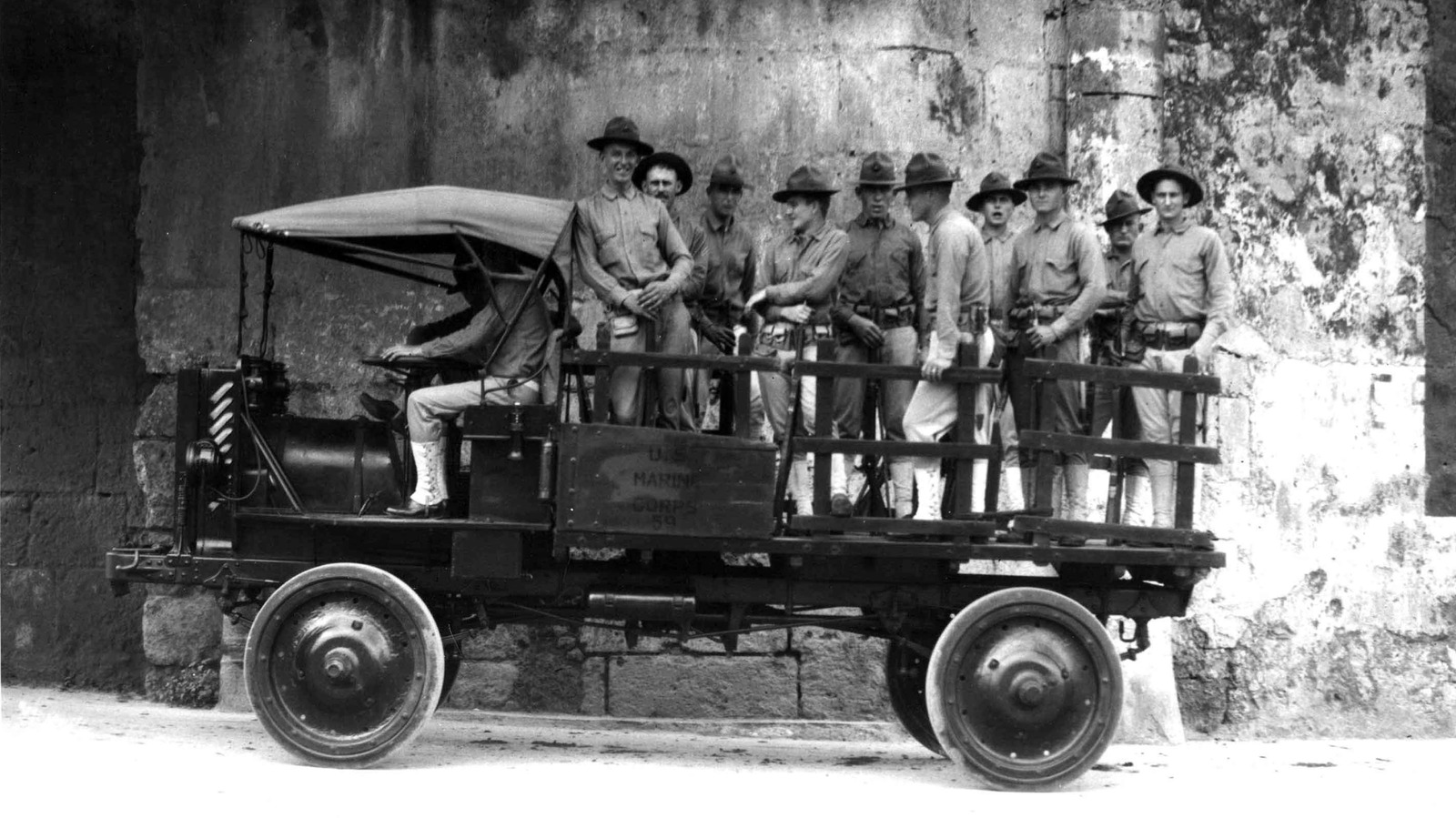
The clearest early expression of that thinking was the Jeffery Quad, developed in 1913. Built to take over duties previously handled by mule teams, the Quad offered four-wheel drive at a time when the feature was rare and exotic. Its capability over difficult ground made a lasting impression on military planners and demonstrated how much efficiency could be gained by matching a vehicle to a particular team and task rather than improvising.
The Jeffery Quad: Four-Wheel Drive Before It Was Famous
The Quad's reputation was not confined to American soil. Thousands are said to have been sold, with the truck seeing service not only in the United States but across Europe and into Russia. Motivation came from a Buda-built inline-four engine, and the vehicle's ability to keep going where conventional trucks faltered was its chief selling point.
It was not, however, a fast machine. The Quad topped out at roughly 14 mph, which was still a meaningful improvement over moving at the pace of a mule train. That trade-off — excellent off-road traction in exchange for modest speed — framed much of the debate that followed. As cars and trucks grew more sophisticated and more powerful, more capable alternatives began to appear, and the Quad's moment gradually passed.
The 1916 Punitive Expedition: The Army's First Big Motor Test
A turning point for Army transportation arrived with the 1916 Punitive Expedition into Mexico, which served as the service's first major trial of motor vehicles on the battlefield. Quads were part of the effort, but just as significant was the deployment of motorized truck companies in support of General John J. Pershing's forces. This was not a handful of vehicles pressed into ad hoc service; it was an organized, motorized logistics operation.
The expedition put a wide assortment of machines through their paces. Dodge Brothers cars featured prominently, including Pershing's own 1915 four-cylinder touring car, a vehicle that reportedly still survives and runs today. Alongside those touring models came cargo trucks, among them GMC Model 15 three-quarter-ton trucks that hauled materiel for the column.
Dodge, GMC, and the Engines That Powered the Columns
American automakers played a central role in Army transportation well before the Jeep existed. Early Dodge models such as the Model 30 — the same family of vehicles associated with Pershing — used the L-Head engine design that also appeared in the GMC fleet. Those GMC trucks, powered by Continental L-Head inline-four engines producing up to 35 horsepower, went on to serve in two key roles during World War I: as ambulances and as the Army's standard anti-aircraft trucks.
The reliance on commercial platforms was both practical and revealing. Civilian manufacturers already had the factories, the engineering talent, and the production volume that the military lacked, so adapting existing designs was far quicker than designing military vehicles from scratch. That relationship between Detroit and the armed forces would only deepen in the following decades.
The Ford Model T Goes to War
No discussion of early military motorization is complete without the Ford Model T. Inexpensive, mass-produced, and mechanically simple in concept — though famously tricky for a novice to actually drive — the Model T was adapted by the Army for a variety of duties during the First World War. Its most common military assignment was as an ambulance, carrying wounded soldiers away from the front.
Ford's willingness to serve the war effort extended well beyond automobiles. The company once constructed a factory a mile long for the purpose of building bombers, a sign of how thoroughly the industrial base could be redirected toward military needs. That same mass-production philosophy — build a huge number of standardized machines cheaply — is arguably the deeper ancestor of the Jeep than any single truck on this list.
The Vehicles That Paved the Way
Looking back, the pre-Jeep era reads like an extended series of experiments, each one testing a different answer to the mobility problem:
- Jeffery Quad (1913): four-wheel drive, Buda inline-four power, roughly 14 mph top speed, built to replace mule-drawn units and used in the U.S., Europe, and Russia.
- Dodge Brothers touring cars: including Pershing's 1915 four-cylinder model used during the Punitive Expedition.
- GMC Model 15: three-quarter-ton cargo truck deployed with Pershing's forces in Mexico.
- Other GMC models: Continental L-Head inline-four engines up to 35 hp, serving as ambulances and standard anti-aircraft trucks in World War I.
- Dodge Model 30: an early Dodge design sharing the L-Head engine lineage.
- Ford Model T: mass-produced and adapted for multiple military duties, most often as an ambulance.
- Horses and mules: still part of the transportation picture until motorization displaced them.
Why the Pre-Jeep Years Mattered
What emerges from this history is not a story of one brilliant machine but of incremental learning. The Army discovered through the Quad that four-wheel drive was worth the cost and complexity. Through the Punitive Expedition it learned that motorized truck companies could sustain a force far from its supply bases. Through Dodge, GMC, and Ford it learned how quickly civilian industry could be converted to military production. And through the limitations of each design — speed, terrain, maintenance, cost — it developed a clearer picture of what an ideal light military vehicle would need to do.
When the first Jeep arrived in 1940, it inherited all of that accumulated experience. The small 4x4 was not a sudden invention so much as a synthesis: the off-road capability pioneered by the Jeffery Quad, the standardized mass production perfected by Ford, and the practical lessons of two decades of trial and error. The vehicles that came before may not have the same fame, but they are the reason the Jeep could be built at all.
This article is based on reporting by Jalopnik. Read the original article.
Originally published on jalopnik.com