A supercar whose fastest configuration is open to the air
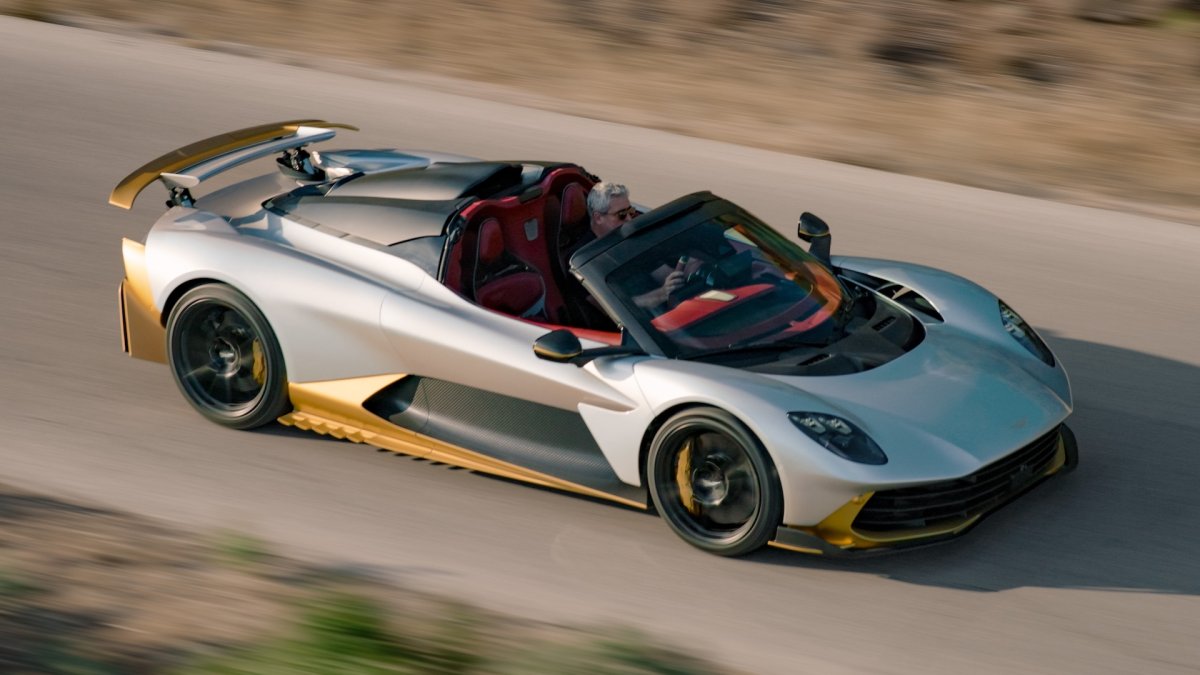
Aston Martin has unveiled the Valhalla Spider, an open-top version of its hybrid supercar that the company says can reach 217 mph with its roof removed. That claimed figure is especially notable because the car is electronically limited to 124 mph when its removable soft roof is fitted.
The 93 mph difference is an unusual detail for a convertible performance car. Aston Martin says a sensor detects whether the roof is on or off, preventing the Spider from exceeding 124 mph with the soft top in place. A carbon-fiber hardtop is also available, although it cannot be stored in the vehicle.
The Valhalla Spider is set to make its debut at the 2026 Concours at Wynn Las Vegas. Pricing has not been announced. The Valhalla coupe starts at $1,051,700.
Hybrid power, limited electric range
Like the coupe, the Spider uses a flat-plane 4.0-liter twin-turbocharged V8 combined with three electric motors and a 6.1-kWh battery. Aston Martin quotes total system output of 1,064 horsepower and 811 lb-ft of torque.
The car is a plug-in hybrid, but its electric-only capability is limited: Aston Martin lists 8.7 miles of pure-electric range. The specification underscores the intended role of electrification in this model. Rather than positioning the battery as a long-distance zero-emission system, the company combines it with the combustion engine and electric motors for performance.
Aston Martin says the Valhalla Spider can accelerate from 0 to 60 mph in 2.5 seconds and has a 217 mph top speed in its roof-off configuration. It also has 10 levels of adjustable traction control and torque vectoring, systems intended to let drivers alter how the car manages available performance.

A removable soft roof and a fixed alternative
The Spider’s removable soft cloth roof can be rolled up and stored in the car. That gives drivers a weather cover without requiring them to leave a hard roof at home, but it comes with the reduced 124 mph limit when installed.
For buyers who prefer a hard roof, Aston Martin offers a carbon-fiber hardtop. Unlike the soft roof, it is not stowable in the car. The two approaches reflect different priorities: a compact, removable roof for flexibility, or a fixed component for those willing to manage it separately.
The company says the open-top model receives revised aerodynamics and electronic changes intended to deliver an equally dynamic driving experience to the coupe. It also adds a wind deflector that folds into three parts and stores in the sill cubbies, a practical feature for an open cockpit at road speeds.
Designed for performance, with a touring option
The Valhalla Spider is not being presented solely as a track-focused machine. Aston Martin fits trim-specific touring seats as standard and describes the car as suitable for longer trips. Buyers can instead select more aggressive carbon-fiber bucket seats at no additional cost.
That choice is consistent with the car’s broader positioning. The Valhalla combines extreme output and hybrid hardware with features intended to make road use more manageable, including the stowable roof, wind deflector and touring-oriented seating option.
Its roof-related speed restriction also illustrates how modern performance cars increasingly link physical components with electronic controls. The top is not merely a passive body panel: the vehicle detects its status and changes the permitted operating envelope accordingly.
What the Spider signals
The Valhalla Spider arrives as manufacturers continue to use hybrid systems in high-performance vehicles to add power and control alongside internal-combustion engines. In this case, the hybrid system combines a twin-turbo V8, three motors and a relatively small battery, resulting in a headline output above 1,000 horsepower while providing only a short electric range.
The most distinctive specification remains the roof-off top speed. Convertibles commonly involve compromises in body structure, weight, airflow or both. Aston Martin’s claim that this Spider reaches its maximum speed with the roof removed reverses the usual expectation, while the 124 mph roof-on limitation makes the design choice explicit.
For Aston Martin, the Valhalla Spider extends the coupe’s hybrid supercar formula into an open-air model without changing the stated headline power or acceleration figures. Its public debut in Las Vegas will give the company its first major opportunity to show how that package translates from a specification sheet to the road-going car.
This article is based on reporting by The Drive. Read the original article.
Originally published on thedrive.com