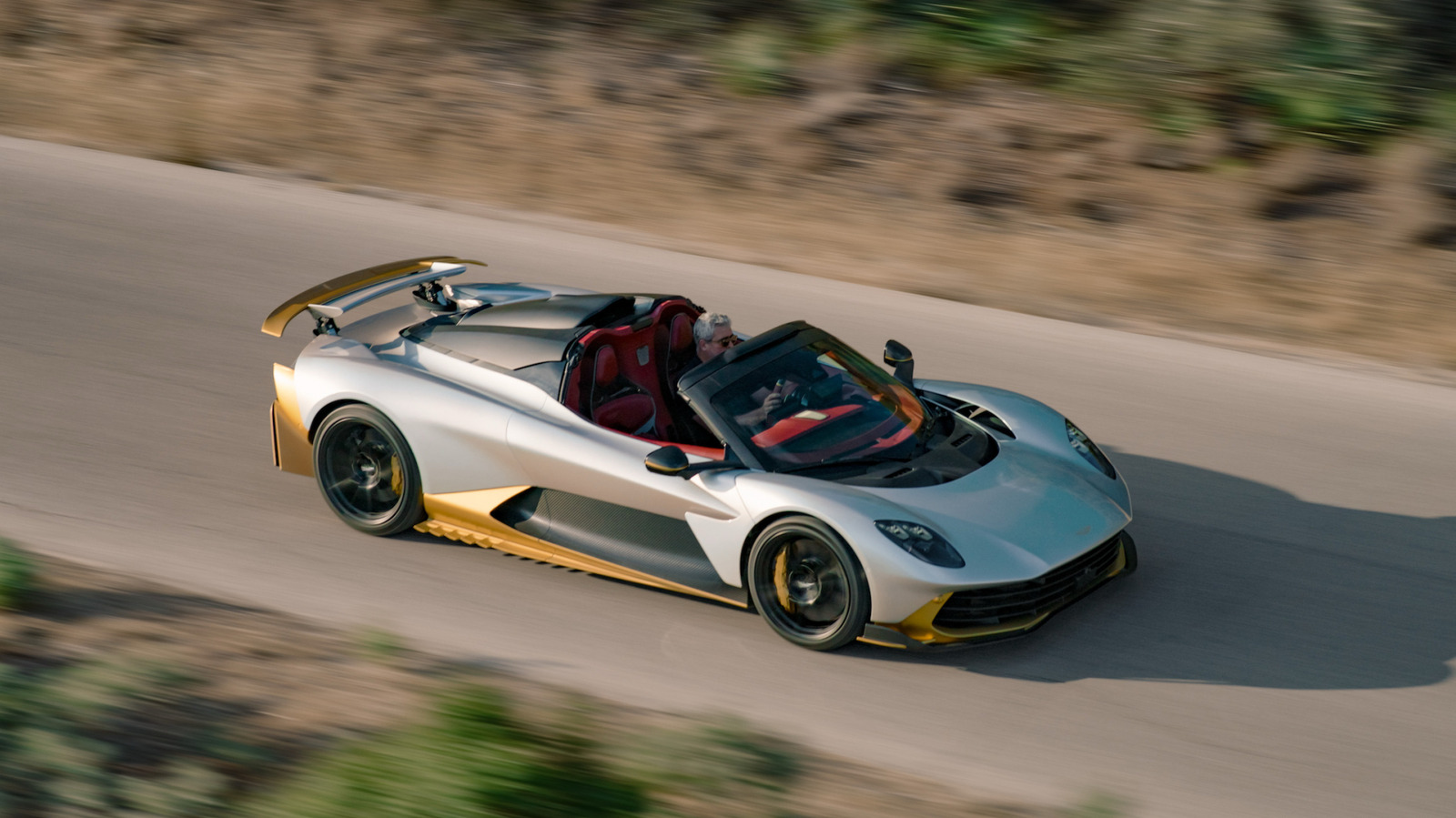
Aston Martin has revealed an open-top version of its Valhalla supercar, bringing the model’s plug-in hybrid powertrain and more than 1,000 horsepower to a Spider designed for roof-on and roof-off high-speed driving.
The Valhalla Spider is scheduled to debut at the 2026 Concours at Wynn Las Vegas. It retains the output of the Valhalla coupe: a combined 1,064 horsepower and 811 pound-feet of torque from a twin-turbocharged 4.0-liter flat-plane-crank V8 and hybrid system. Aston Martin claims a 217-mph top speed for the open car, matching the coupe, subject to how the roof is configured.
Hybrid power with an electric front axle
The drivetrain combines the V8 with two electric motors mounted at the front axle and another motor integrated into the eight-speed dual-clutch transmission. There is no mechanical connection between the front and rear axles, an arrangement that gives the car an electrified front axle while the combustion engine and transmission serve the rear.
That layout is a central feature of the Valhalla rather than an added flourish for the Spider. Aston Martin has carried the same power figure from coupe to convertible, aiming to avoid the performance penalty traditionally associated with removing a fixed roof from a high-performance car.
Keeping that performance is not simply a matter of power. An open-top car must manage airflow, structural loads and vehicle-control behavior differently as the roof is fitted or removed. The Spider receives a taller intake snorkel, revised electronic stability programming and active-aerodynamics changes intended to account for those two configurations.
Two roof choices, two speed limits
In most markets, the Valhalla Spider comes with a black fabric roof. With that roof fitted, its top speed is limited to 124 mph. Drivers seeking the claimed 217-mph maximum must either drive without it or choose the carbon-fiber hard top. The carbon roof is optional in most markets and standard on cars destined for the United States.
The unusual limitation illustrates the engineering constraints behind the headline figure. The car is not presented as a conventional convertible that can be driven at maximum speed with any roof arrangement. Its highest-speed configuration depends on either open-air operation or the more rigid carbon-fiber roof.
A clip-in wind deflector, stored in the sills, is among the Spider-specific details. Along with the revised active aero and stability controls, it is meant to make the open cabin more manageable without changing the model’s core mechanical package.
Carbon structure and revised entry
Despite losing its fixed roof, the Valhalla Spider uses a version of the coupe’s bespoke carbon-fiber tub, designed and engineered by Aston Martin Performance Technologies, the consulting arm of Aston Martin’s Formula 1 team. Carbon-fiber structures are especially important in an open car because the roof normally contributes to body stiffness.
The Spider retains the Valhalla’s carbon-fiber dihedral doors, but Aston Martin says their kinematics have been refined for smoother operation. The doors now use a frameless design, and the top edge of the door glass has a slightly greater curvature intended to improve entry and exit when the roof is fitted.
Inside, a carbon-fiber Touring Seat is standard. Aston Martin says it is also intended to aid access with the roof in place. Buyers can specify the coupe’s original carbon-fiber seat form at no extra cost if they prefer its added support.
A halo-car formula, adapted
Supercar convertibles often face a familiar compromise: retain the coupe’s structure and performance at the cost of weight and complexity, or accept a measurable loss in capability. The Valhalla Spider’s specification is Aston Martin’s attempt to present a third outcome—an open-top derivative that preserves the coupe’s stated power and top-speed claim while adding tailored roof and control-system rules.
The model is also a clear expression of the direction of the brand’s highest-performance road cars. Rather than relying solely on a large combustion engine, the Spider uses a hybrid system with multiple electric motors, a dual-clutch transmission and electronically coordinated axles. The result is a supercar whose performance identity is tied as much to software and power management as to engine displacement.
Pricing was not provided in the supplied announcement. The Valhalla coupe was priced at about $1 million when it debuted in 2024, placing the Spider firmly in the limited-volume, high-end segment. Its Las Vegas debut will show how Aston Martin positions the model, but the engineering brief is already clear: make open-air driving part of the Valhalla experience without surrendering the numbers that define the coupe.
This article is based on reporting by Jalopnik. Read the original article.
Originally published on jalopnik.com