Rubin starts the survey it was built for
After years of development, commissioning and anticipation, the Vera C. Rubin Observatory has begun the Legacy Survey of Space and Time, or LSST, a 10-year campaign to repeatedly image the southern sky and build what may become the most comprehensive time-lapse record of the visible universe ever assembled from the ground.
The start of the survey marks a transition from promise to production. Rubin was conceived not simply as another large telescope, but as an observatory built around repeated, wide-field observation at scale. Its role is to watch for change: objects that brighten, fade, move, appear or vanish. That makes the beginning of the LSST important not only for astronomy as a whole, but for the emerging infrastructure of alert-driven science in which telescopes generate constant streams of events for researchers worldwide to follow up.
Universe Today reports that the observatory’s long-awaited survey is now underway, using the 8.4-meter Simonyi Survey Telescope and the Rubin camera system to produce a continuing movie of the southern sky over a decade.
A telescope optimized for motion and change
Rubin’s operating model differs from observatories built mainly for targeted, narrow-field observations. The LSST is designed to repeatedly image the entire southern sky, looking for variation in both brightness and position. That includes violent and short-lived events such as supernovae, but also slower-moving targets such as asteroids and other Solar System objects.
The article notes that researchers around the world can sign up for nightly automated alerts tailored to their interests. That means Rubin is not just collecting images for later archival use. It is acting as a discovery engine that can trigger rapid response from other instruments, allowing deeper or more specialized telescopes to pivot toward events identified in Rubin data.
That alert model is central to why the observatory matters. Modern astronomy increasingly depends on combining wide, repeated surveys with networks of follow-up assets. A survey instrument finds the anomaly; other observatories characterize it. Rubin was built to sit at the front end of that chain.
The camera scale behind the survey
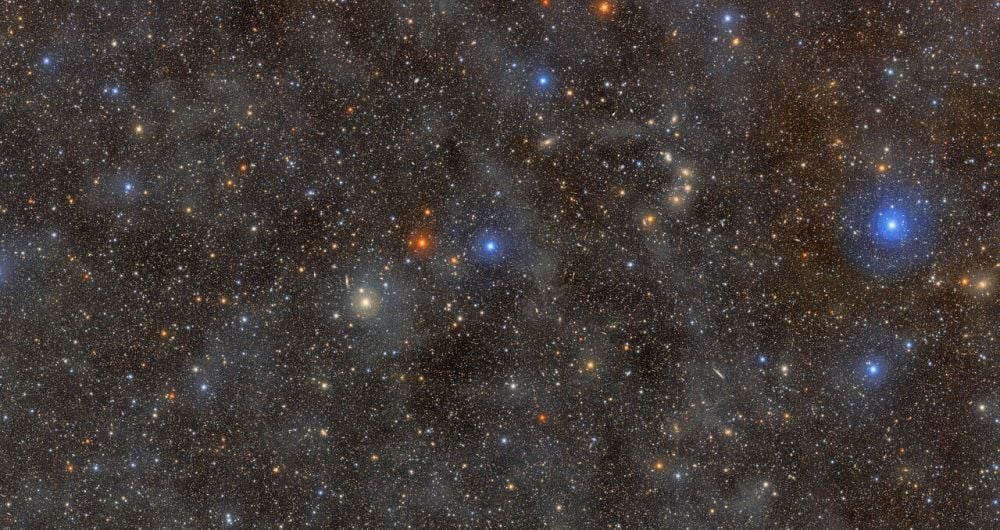
The source text highlights the observatory’s enormous imaging hardware. It references a 1.7-gigapixel image from the instrument and describes the Rubin camera as the largest digital camera in the world. It also states that the observatory’s 3.2-gigapixel camera will capture 30-second exposures that are stitched into an ongoing movie of the sky.
Those numbers are not just engineering trivia. They explain why Rubin occupies such a distinctive place in astronomy. The scientific goal requires a combination that is difficult to achieve: wide sky coverage, high detail, repeated cadence and enough throughput to keep doing it night after night for years. The observatory’s camera and telescope pairing were built for that balance.
Repeated imaging at this scale produces a kind of astronomical memory. Instead of isolated observations, scientists receive a baseline against which subtle changes can be detected. That supports work ranging from transients and variable stars to orbital refinement for near-Earth objects.
Dark matter, dark energy and nearby hazards
The LSST is expected to support a wide span of science, from large cosmological questions to practical planetary defense. The article says the survey will study “everything from cosmos-defining things like dark energy and dark matter, down to small asteroids in our own Solar System.” That range reflects the observatory’s unusual breadth.
Rubin was named for Vera Rubin, the American astronomer whose work helped establish the case for dark matter. The observatory therefore carries a symbolic connection to one of modern astrophysics’ deepest unsolved problems. By tracking how matter and structure appear across the sky over time, Rubin data could feed major investigations into the universe’s composition and evolution.
At the same time, the same repeated sky coverage can help identify moving bodies much closer to Earth. Small asteroids are scientifically interesting, but they also matter for risk assessment and trajectory tracking. A survey that regularly revisits the sky increases the odds of finding such objects earlier and characterizing them better.
That combination of frontier cosmology and Solar System vigilance is one reason the project has attracted such broad interest. Few facilities can contribute to both with the same core observing strategy.

From delayed ambition to operational reality
The start of the survey also closes a long chapter in the observatory’s public story. The article recalls that nine years ago the project was still discussed as an upcoming “super telescope” under its former name, the Large Synoptic Survey Telescope. Since then, the instrument has been renamed, assembled, commissioned and extensively tested before reaching this operational milestone.
Large scientific facilities often spend years in a liminal state where their potential is widely praised but their real impact remains deferred. Rubin has now moved beyond that phase. The significance of June 2026 is that the data stream has begun. A decade from now, the LSST may be remembered as one of the defining astronomy datasets of its era, but that future legacy depends on the survey starting, running consistently, and delivering discoveries night after night.
The article quotes Brian Stone, performing the duties of the U.S. National Science Foundation director, calling the effort “the greatest cosmic movie ever made.” The phrasing is grand, but it captures something real about Rubin’s mission: its science depends on continuity. The survey gains power not from a single spectacular image, but from the accumulation of repeated observations over years.
Why the beginning matters more than a first image
Many space and astronomy milestones are defined by launches, impacts or one-off first light moments. Rubin’s key milestone is different. Its importance lies in operational cadence. Once the observatory repeatedly scans the sky and sends alerts into the research ecosystem, astronomy changes a little each night. New transients can be found more quickly. Variable objects can be studied with better temporal context. Long-baseline datasets start to form almost immediately.
That is what makes the beginning of the LSST a consequential science infrastructure story. It is the activation of a platform for discovery, not simply the unveiling of a machine. The observatory is now doing what it was built to do: generating a systematic, decade-long record of change in the sky.
If the survey meets its aims, Rubin will become indispensable to astronomers studying the evolving universe, and not just because of scale. It will matter because it turns the sky into a monitored environment, one where change is expected, logged and distributed quickly enough for the global scientific community to act on it.
This article is based on reporting by Universe Today. Read the original article.

Originally published on universetoday.com