One image, three different stories of how galaxies meet
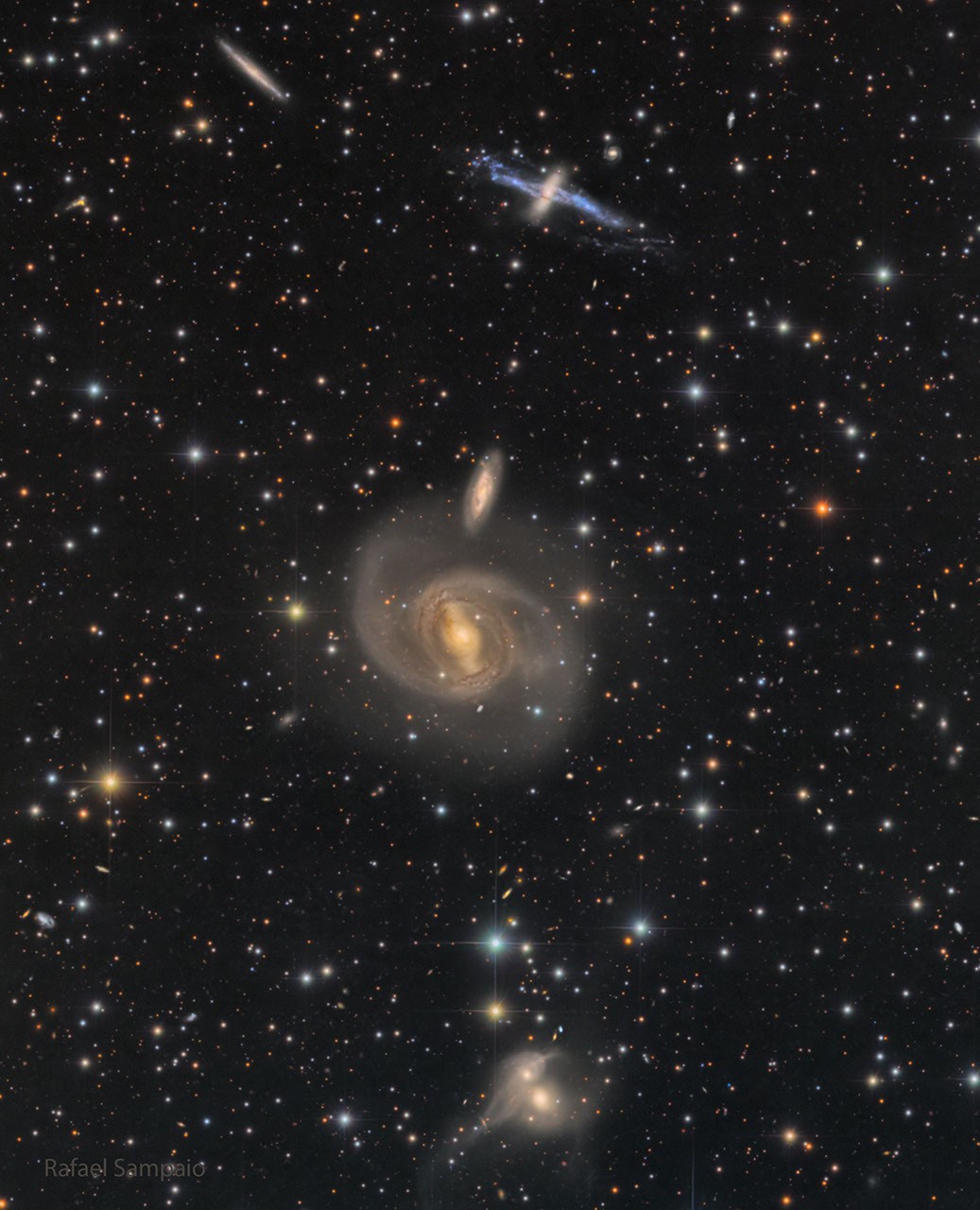
NASA’s Astronomy Picture of the Day for August 10 uses a simple but effective idea: place three galaxy pairs in one frame and let the comparison do the teaching. Rather than presenting a single spectacular merger, the image emphasizes that galactic relationships come in stages. Some neighbors appear close but are not actively affecting one another. Some show shapes that invite suspicion of interaction, yet likely are not colliding now. Others are clearly in the middle of a more consequential gravitational encounter.
That contrast is the point. Galaxy interaction is not a binary state where objects are either isolated or crashing together. It is a spectrum shaped by distance, speed, geometry, and time. By assembling three examples from the larger Centaurus Galaxy Cluster, the APOD entry turns that abstract lesson into something visual and immediate.
The top pair: quiet now, but not necessarily uneventful
At the top of the image are two galaxies that are likely not interacting at present. Even that relatively calm assessment comes with an important caveat. The upper object with the blue stripe, NGC 4650A, is identified as a polar ring galaxy, and the APOD explanation notes that it may be the result of a past galaxy collision.
That matters because galaxies preserve memory in their structure. A system can look dynamically quiet in the present while still carrying evidence of a dramatic earlier event. In this case, the unusual ring geometry is the clue. Polar ring galaxies are notable because material orbits in a plane that differs from the main body, making them especially interesting for astronomers studying galactic assembly and past disruption.
So the top pair introduces a useful distinction: lack of present interaction does not mean lack of historical interaction. A galaxy can emerge from collision with a long-lived structural signature that outlasts the event itself by immense spans of time.

The middle pair: appearances can mislead
The middle galaxies look as though they could be interacting gravitationally. But the APOD text says their relative speeds make that unlikely. This is a reminder that a two-dimensional image can only reveal part of the story. Proximity on the sky is not enough. Astronomers also need velocity information and three-dimensional context to determine whether two systems are truly engaged or simply passing in ways that create a visual impression of connection.
The larger member of this middle pair, NGC 4650, is described as a spiral galaxy with a bright bar of stars across its center. Barred spirals are important because those central bars can help redistribute gas and stars inside a galaxy, influencing internal evolution even without a dramatic external collision. In other words, not every striking galactic feature has to come from a neighboring body tugging on it in real time.
This middle example is perhaps the most instructive of the three because it highlights a basic challenge in astronomy: interpretation requires more than appearance. Many cosmic scenes are legible only when motion, orientation, and environment are considered alongside light.
The bottom pair: an active interaction in progress
The bottom pair offers the clearest case of active interaction. According to the APOD explanation, NGC 4622A and NGC 4622B are currently interacting, and in roughly a billion years they may merge into a single galaxy.
That prediction places viewers inside a process that is both violent and slow. Galactic mergers unfold over timescales so large that “active” still means something impossible to witness directly within a human life. Yet astronomers can infer the trajectory from present structure and dynamics. Tidal effects, distortions, and shared gravitational influence reveal that the system is no longer just a pair of nearby objects. It is becoming something new.
Mergers are central to how galaxies grow and change. They can rearrange stellar orbits, reshape overall morphology, and alter the distribution of gas. Over cosmic time, such encounters help build the diversity of galactic forms observed today. The bottom pair therefore serves as more than a dramatic visual endpoint in the image. It represents a fundamental mechanism of large-scale cosmic evolution.
Why the cluster setting matters
All three pairs are likely members of the Centaurus Galaxy Cluster, according to the APOD text. That shared setting is significant. Galaxy clusters are dense environments where many large systems coexist, making them natural laboratories for studying how environment influences structure and interaction history.
Within a cluster, close passes and long-term gravitational relationships become more common than they would be in emptier regions. At the same time, not every apparent neighbor is destined to merge. Relative velocity can be high, and the cluster’s overall gravitational framework complicates the simple picture of one galaxy drifting neatly into another.
That is why the APOD’s three-pair layout works so well. It does not flatten galactic behavior into a single storyline. Instead, it shows multiple outcomes arising within the same broader environment: lingering signs of past disruption, apparent but unlikely present interaction, and an encounter now underway.
A compact lesson in cosmic timescales
The most effective astronomy images do more than impress. They organize complexity. This APOD entry succeeds because it compresses several core ideas into one comparison: structure can preserve history, appearance can deceive, and interaction unfolds over immense timescales.
For non-specialists, galaxy mergers are often imagined as straightforward crashes. The reality is subtler. Galaxies can retain scars from ancient collisions, pass each other without immediate entanglement, or spend eons gradually moving toward union. The featured image captures all three conditions in a single field.
That makes the August 10 APOD a useful public-facing piece of science communication. It does not announce a new mission or a fresh discovery. Instead, it clarifies how astronomers read the sky: by comparing form, motion, and context to distinguish what is happening now from what happened long ago and what may happen next.
In a universe measured in billions of years, that kind of comparative view is essential. The three galaxy pairs are different not because some are interesting and others are not, but because each one reveals a separate chapter in the long gravitational life of galaxies.
This article is based on reporting by science.nasa.gov. Read the original article.
Originally published on science.nasa.gov