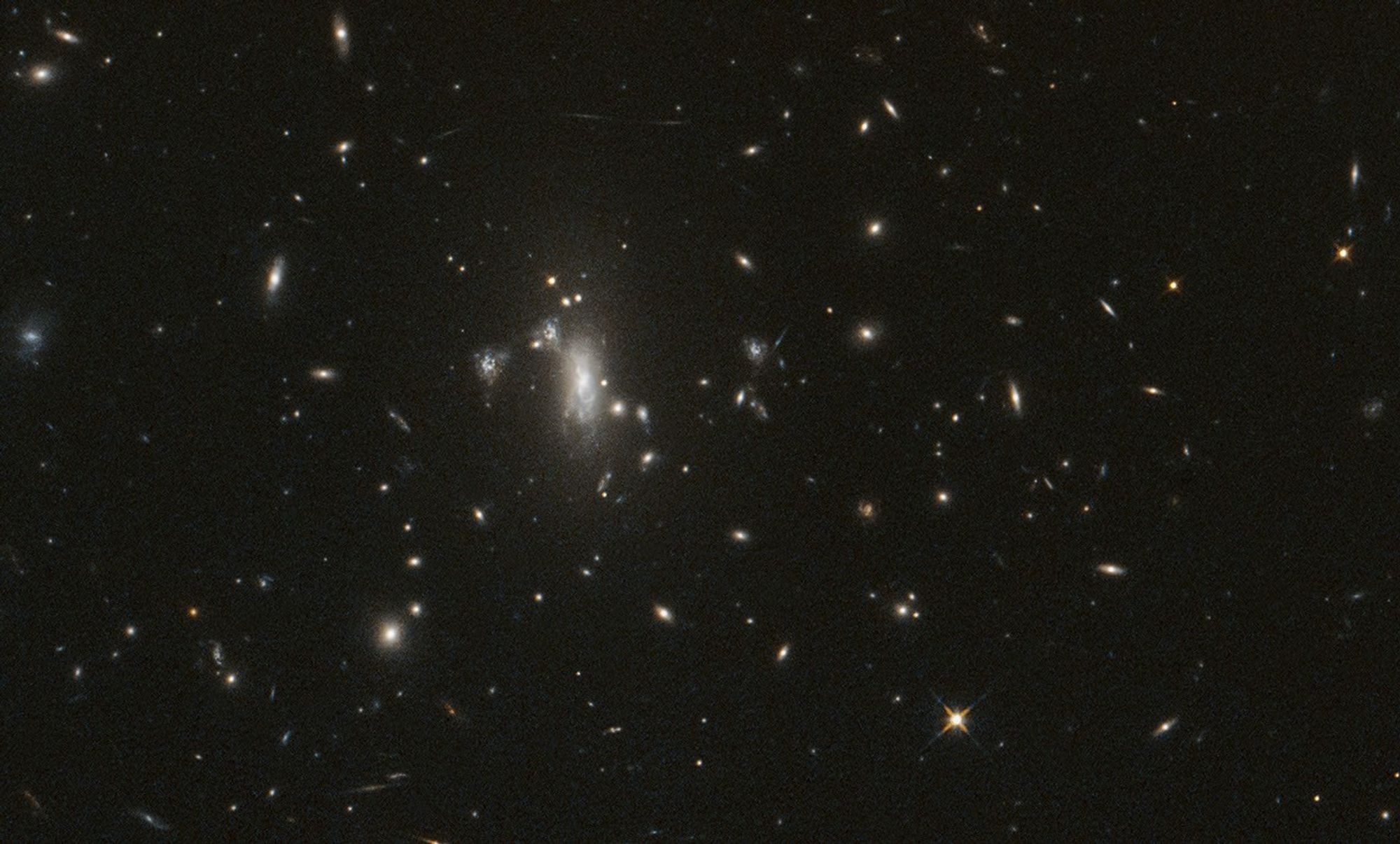
*The full trail of galaxies, with an inset image of DF9 taken by the Hubble Space Telescope. Credit: Keim et al. (2026)/DECaLS/HST*](https://www.universetoday.com/article_images/YN_DF9-drak-galaxy_20260630_213243.jpg)
A rare kind of galaxy may be less of a one-off than scientists hoped
Astronomers have identified what appears to be the third known galaxy with little or no dark matter, a finding that deepens one of the more uncomfortable anomalies in modern cosmology. The object, known as DF9, joins two earlier outliers, DF2 and DF4, and all three are part of the same linear arrangement of galaxies about 45 million light-years from Earth.
The discovery was made by a Yale-led team using observations from the W. M. Keck Observatory and was reported in a study published June 16 in The Astrophysical Journal. By measuring the motions of stars within DF9, the researchers estimated the galaxy’s total mass at roughly 100 million times the mass of the Sun. According to the report, that figure can be explained entirely by its visible matter, without the large hidden mass that standard models would normally predict.
That is why the result stands out. In the prevailing picture of galaxy formation, dark matter is not a side note or an optional ingredient. It is the scaffolding. Galaxies are generally thought to form within dark-matter halos that provide most of the gravitational mass. Visible matter such as stars, gas, and dust settles into those halos. If a galaxy truly lacks dark matter, either its history was highly unusual or some part of the broader framework needs refinement.
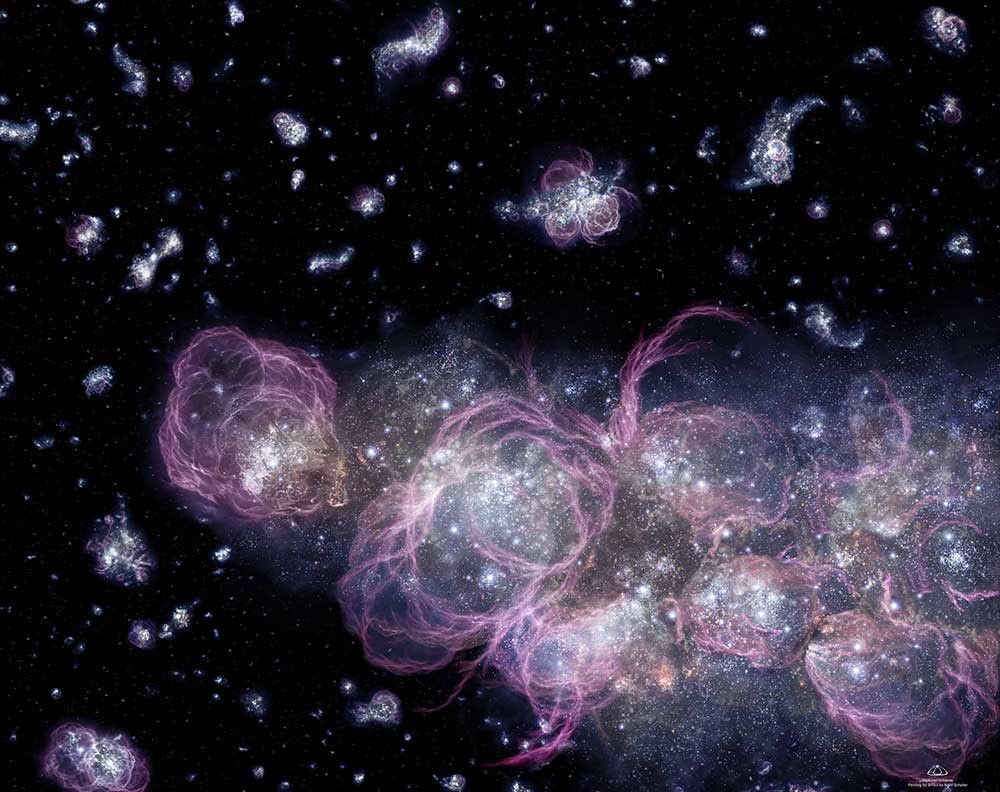
DF9 does not arrive as an isolated curiosity. Its importance lies in its company. DF2 and DF4 had already raised eyebrows because they also appeared to be deficient in dark matter. With DF9 now added to the same structure, the case for a shared origin becomes harder to dismiss. The report describes a linear structure of seven galaxies that may have formed in a single violent event, potentially a collision between galaxies.
Why this matters for dark matter research
Dark matter remains one of the central unseen components of the universe in mainstream cosmology. It does not emit or absorb light in ways telescopes can directly detect, but its effects are inferred from gravitational behavior, including galaxy rotation, gravitational lensing, and the way large-scale cosmic structure holds together. The candidate’s source text notes that dark matter is estimated to account for about 85% of the universe’s total mass.
Against that backdrop, a galaxy with no apparent dark matter is not just unusual. It creates a stress test for the theory. If most galaxies require dark matter halos to form, then a confirmed population that formed without them would imply that multiple formation channels may exist. That would not erase the dark matter paradigm, but it would narrow the confidence scientists can place in one-size-fits-all models of galaxy assembly.
The DF9 measurement is presented as especially compelling because the amount of mass inferred from stellar motion matches visible matter alone. According to the report, if dark matter were present in the way standard expectations suggest, the total mass would be about 100 times larger. Instead, the motions of stars appear consistent with an object whose gravity comes only from ordinary matter.
That conclusion will draw scrutiny, as earlier claims involving dark-matter-poor galaxies have done. Distance estimates, dynamical assumptions, and observational limitations can all affect mass calculations. But the significance here is cumulative. A third object in the same apparent chain makes it more difficult to frame the earlier cases as singular measurement quirks.
A possible clue: violent formation rather than ordinary assembly
The most intriguing implication is not simply that DF9 lacks dark matter, but that it may have formed through a process different from the one thought to build most galaxies. The report points to the idea that the linear structure could be the result of a violent galactic collision. In that scenario, matter stripped out during the event might have condensed into dwarf galaxies with little or no dark matter bound to them.
That would help explain why DF9, DF2, and DF4 sit along the same larger structure. It would also make these galaxies useful laboratories. If they formed through an extreme event, astronomers may be able to compare them with more conventional dwarf galaxies and better separate which galactic properties depend on dark matter halos and which can arise from baryonic matter alone.
There is also a broader strategic value. Dark matter research often advances by studying places where theory works well and places where it struggles. Galaxies that seem to be missing dark matter are valuable precisely because they are awkward. If they are real and if their origin can be reconstructed, they offer a way to test how robust current formation models are under unusual conditions.
The finding therefore does not prove dark matter is absent from the universe, nor does it overturn decades of evidence from other systems. What it does is sharpen a narrower question: under what circumstances can a galaxy exist without the dominant mass component that most models treat as essential?
What comes next
Further observations will be needed to confirm the mass estimate, refine the structure’s history, and determine whether similar systems exist elsewhere. If astronomers find more galaxies like DF9, especially in related geometric arrangements, the argument for an uncommon but repeatable formation mechanism will become stronger.
For now, DF9 appears to be one of the clearest examples yet of a galaxy whose mass can be accounted for by ordinary matter alone. That makes it more than a novelty. It is a data point that presses on a foundational assumption in astrophysics: that galaxies and dark matter halos are effectively inseparable.
Sometimes the most consequential discoveries are not the ones that confirm a theory, but the ones that reveal where it may be incomplete. DF9 does not settle the dark matter debate. It does, however, make the puzzle harder to ignore.
This article is based on reporting by Universe Today. Read the original article.

Originally published on universetoday.com