A comet, a star cluster, and a useful astronomical contrast
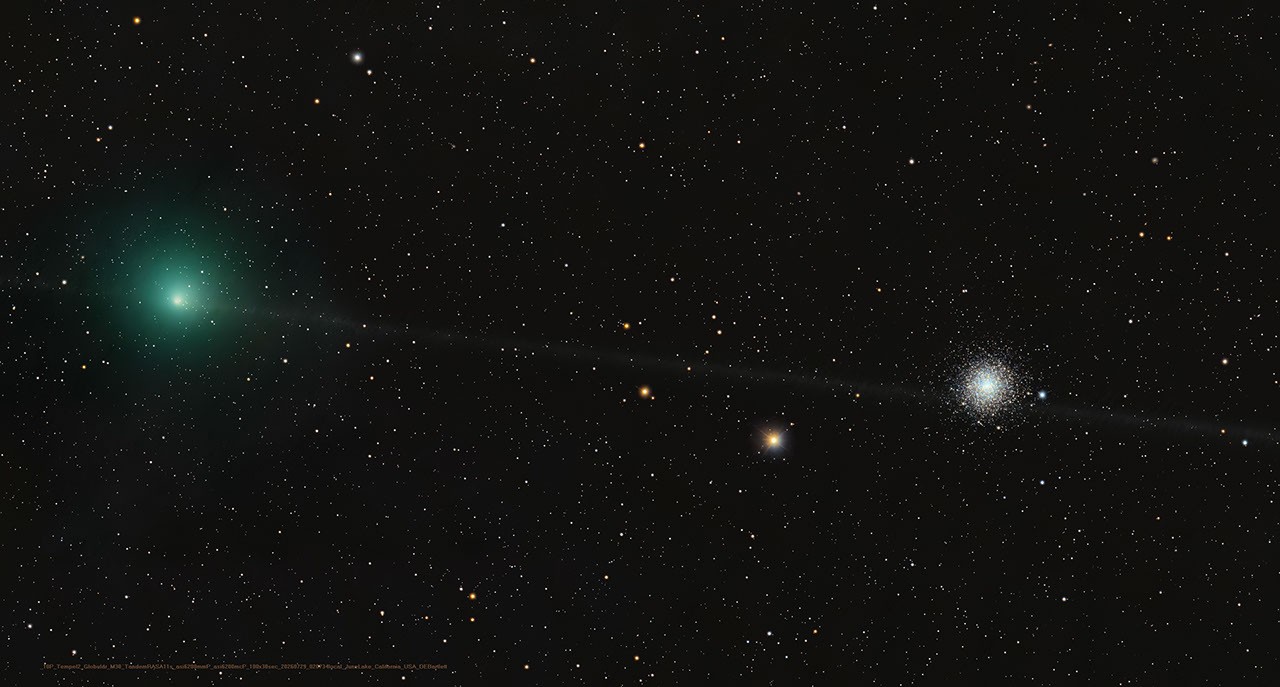
NASA’s Astronomy Picture of the Day for August 8 features a scene that is visually elegant and scientifically instructive: periodic comet 10P/Tempel 2 appearing close on the sky to the globular star cluster Messier 30. The image, recorded on July 29 and credited to Dan Bartlett, captures two faint, fuzzy-looking objects that might seem similar at first glance but are fundamentally different in nature, distance, and behavior.
In the frame, Tempel 2 appears on the left with a diffuse greenish coma. On the right is Messier 30, also known as M30, a globular star cluster that is the 30th object in Charles Messier’s famous catalog. NASA’s explanation turns that pairing into a simple question: which object is not a comet? The answer is M30.
That prompt reflects the historical reason the Messier catalog exists at all. Charles Messier was an 18th-century comet hunter, and he compiled a list of hazy celestial objects that did not move night to night against the background stars. Those fixed objects could otherwise be mistaken for comets during observation. In that sense, the Tempel 2 and M30 pairing is more than a photogenic coincidence. It recreates exactly the sort of visual puzzle that shaped observational astronomy centuries ago.
Why the image works so well
What makes the scene compelling is the contrast between apparent similarity and physical difference. Through a telescope, both the comet and the globular cluster can present themselves as soft, unresolved patches of light. Yet one is a relatively nearby Solar System object following a repeating orbit around the Sun, while the other is a vast, ancient grouping of stars far beyond the Solar System.
NASA notes that Tempel 2 was only about 3.5 light-minutes away when the image was made. Messier 30, by contrast, is about 28,000 light-years distant. That gap is so extreme that it turns the image into a lesson in perspective. Two objects can seem adjacent in the night sky while being separated by distances so large they belong to entirely different cosmic contexts.
The comet also shows a faint, narrow dust trail that appears to pierce the star cluster in the image. This is a line-of-sight effect, not a physical interaction. Tempel 2 is passing across our view of the distant cluster, creating a layered composition that is visually dramatic precisely because the objects are unrelated except from Earth’s vantage point.
This is one of the recurring strengths of skywatching imagery: it reveals how much astronomy depends on interpreting projection. The sky looks like a flat dome from the ground, but every frame is really a map of depth, motion, and timescale compressed into two dimensions.

Tempel 2 and the logic of periodic comets
NASA identifies the comet in the image as periodic comet 10P/Tempel 2. A periodic comet is one that returns on a regular orbit, unlike long-period comets that may not revisit the inner Solar System for thousands of years or more. Periodic comets are especially valuable because astronomers can observe them repeatedly, compare their behavior across appearances, and study how they evolve over time.
The visible coma around Tempel 2 is produced as solar heating causes volatile materials in the comet to escape from the nucleus, carrying dust with them. That creates the diffuse glow seen in telescopic images. In the APOD frame, the greenish appearance of the coma adds to the visual separation between comet and star cluster, even though both would historically have counted as faint and fuzzy sights to early observers.
NASA’s note does not go into a full physical profile of Tempel 2, but the image itself demonstrates the observational character of a comet in motion: a compact nucleus hidden within an extended atmosphere and associated dust features, all set against the stable background of deep-sky objects.
The historical role of Messier 30
Messier 30 serves a different educational purpose in the image. Globular clusters are dense, spherical swarms of stars bound by gravity. M30 is one of the classic cataloged deep-sky objects visible to amateur astronomers, and its presence here echoes the cataloging work that Charles Messier undertook to avoid confusion while searching for comets.
That historical context gives the APOD unusual narrative precision. If an 18th-century comet hunter had seen both objects in a telescope, the fixed object would belong on the not-a-comet list, while the moving object would be the quarry. NASA’s explanation neatly ties the modern image to that legacy, reminding viewers that astronomical classification often begins with a practical observational question.
The framing also underscores how modern imaging can transform old observing challenges into public-facing science communication. What was once a source of confusion in the eyepiece becomes an opportunity to teach the difference between Solar System bodies and distant stellar systems.
Why this APOD stands out
Astronomy Picture of the Day entries vary widely, from spacecraft views and planetary landscapes to wide-field astrophotography and telescope studies. This August 8 selection stands out because it combines beauty, historical continuity, and a clean conceptual lesson in one frame. Viewers do not need specialized training to appreciate the picture, but the explanation rewards closer attention.
It also captures something essential about observational astronomy: seeing is only the start of understanding. The eye notices two smudges of light. Science asks what each one is, how far away it is, whether it moves, and why it looks the way it does. In this case, those questions lead from a comet only light-minutes away to a star cluster tens of thousands of light-years distant.
NASA’s APOD description ends with a simple factual anchor. The image was recorded on July 29, and the close apparent passage was brief. Moments like this are part of what makes comet watching and deep-sky imaging so appealing. They are temporary alignments that connect orbital mechanics, historical astronomy, and modern astrophotography in a single observation.
For skywatchers, Tempel 2 near M30 is a reminder that the night sky is full of false neighbors. Objects can appear side by side while belonging to entirely different scales of the universe. That tension between appearance and reality is not a flaw in astronomical viewing. It is one of its greatest sources of insight.
This article is based on reporting by science.nasa.gov. Read the original article.
Originally published on science.nasa.gov