A closing chapter for one of ULA’s signature rockets
United Launch Alliance is preparing to fly the final Atlas 5 rocket in its 551 configuration, a mission that marks both an operational milestone for Amazon’s broadband constellation and a symbolic turning point for a launch vehicle family that has been a mainstay of U.S. spaceflight. The mission, known as Leo Atlas 8 or LA-08, is scheduled to lift off from Space Launch Complex 41 at Cape Canaveral Space Force Station at 12:24 a.m. EDT on July 2, 2026, carrying 29 broadband internet satellites.
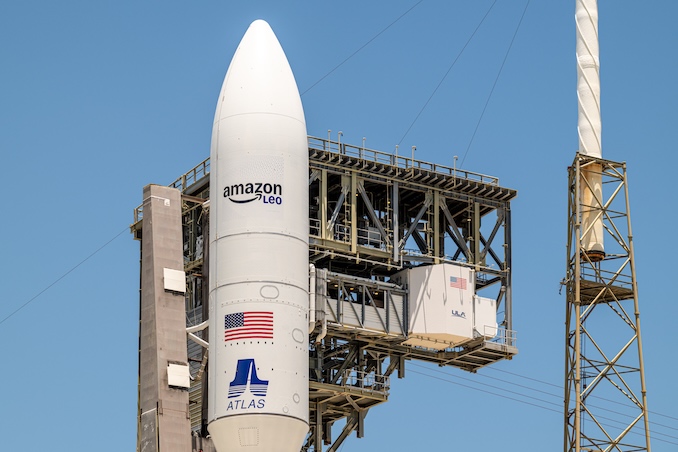
Even before ignition, the mission stands out for its place in launch history. According to the supplied source material, this will be the 110th Atlas 5 launch overall and the last use of the 551 configuration. In ULA’s naming system, that configuration refers to a five-meter payload fairing, five solid rocket boosters, and a single-engine Centaur upper stage. It is one of the more powerful versions of the Atlas 5, built for payloads that need extra lift off the pad.
That technical detail matters because it captures what the Atlas 5 has represented for years: a modular, highly configurable rocket that could be tailored to a wide range of civil, commercial, and national security missions. The end of the 551 variant is therefore more than a line item in a manifest. It is a visible sign that an older generation of launch operations is giving way to newer systems and new industrial priorities.
What the mission is carrying
The payload is part of Amazon’s low Earth orbit broadband network, identified in the source as the company’s Leo satellite constellation. The LA-08 mission will place 29 satellites into orbit, adding to the growing infrastructure behind Amazon’s push into space-based internet service.
Large constellation deployments have become one of the defining features of the current commercial space era. Instead of focusing solely on a few large spacecraft, companies are now building networks made up of many satellites that can collectively deliver communications and data services at global scale. For launch providers, those constellations create repeat business and demand reliable cadence. For satellite operators, they create a race to deploy enough hardware quickly enough to begin service and compete effectively.
That makes LA-08 notable on two fronts at once. It is a legacy-rocket farewell, but it is also part of a newer pattern in which launch systems are increasingly judged by how efficiently they can feed constellation buildouts. In practical terms, the Atlas 5 is helping enable a market transition even as one of its own configurations reaches retirement.

Countdown status and launch conditions
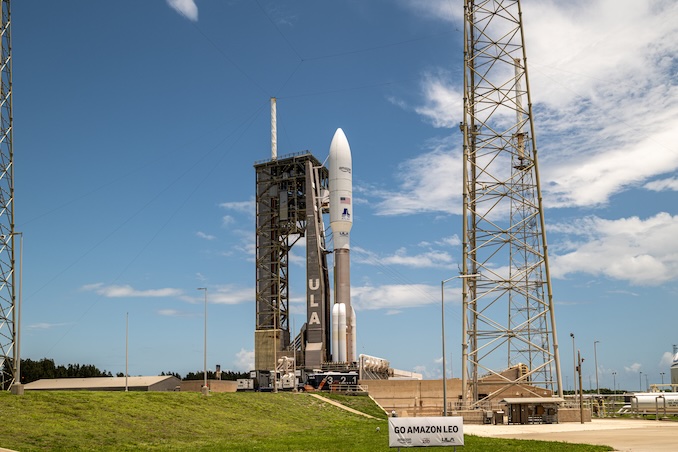
By the time of the report, launch preparations were well advanced. After a launch readiness review on Tuesday, the countdown began on Wednesday morning. Teams then rolled the 205-foot-tall rocket from the Vertical Integration Facility to the pad, moving it on its mobile launch platform along tracks to Space Launch Complex 41. The platform was set down on the launch pad piers at 11:11 a.m. EDT, establishing what the source describes as “hard down” status.
Ground crews then connected the needed umbilicals to the rocket and payload fairing, while fueling operations on the booster began later in the afternoon. The Atlas 5 first stage was loaded with RP-1, a rocket-grade kerosene, starting at about 2:30 p.m. EDT and finishing roughly an hour later. Those details underscore how much choreography is involved even before cryogenic loading and final countdown operations enter their most time-critical phase.
Weather also appeared broadly favorable. The 45th Weather Squadron forecast an 85 percent chance of acceptable conditions during the 29-minute launch window, with only a small possibility that cumulus clouds could interfere. For launch teams, that level of confidence does not remove risk, but it significantly reduces one of the most common causes of late schedule pressure.
Why the 551 variant matters
The 551 is not simply another Atlas 5 option. Its combination of a large fairing and five strap-on boosters made it a heavy-lift workhorse within the Atlas family. The source material notes that there had been 22 Atlas 5 551 launches before this mission. Ending that run closes the book on a configuration associated with some of the most demanding jobs the rocket could perform.
For ULA, the significance is institutional as well as technical. Rocket programs often outlast news cycles by decades, and configurations like the 551 embody accumulated lessons in manufacturing, integration, and mission assurance. Retiring one is less like discontinuing a product line and more like phasing out a proven operating system for access to orbit.
That does not imply decline. In the launch sector, retirement is usually tied to replacement, fleet evolution, or changing customer needs. But the Atlas 5’s long service record gives this mission extra weight. The final 551 launch is a reminder that even highly reliable platforms eventually become part of the industry’s handoff from one era to the next.

A mission shaped by transition
The broader context is a space economy moving simultaneously in several directions. Broadband constellations are expanding. Customers expect higher launch tempo. Providers are under pressure to balance reliability, cost, and vehicle availability. Against that backdrop, LA-08 captures a moment where an established rocket continues to do mission-critical work while nearing the end of a specific configuration’s life.
It also highlights how infrastructure transitions rarely happen cleanly. New markets are often built using older but trusted systems until replacement capacity is fully in place. That is the role the Atlas 5 is playing here. It is not the rocket of the future, but it remains a decisive part of the present.
If the launch proceeds on schedule, the mission will add another tranche of satellites to Amazon’s network and draw a clear line under one of the Atlas 5’s best-known variants. Even before liftoff, that combination makes LA-08 more than a routine overnight launch. It is a commercially important deployment and a carefully staged farewell to a configuration that helped define ULA’s launch portfolio.
- ULA plans to launch 29 Amazon broadband satellites on the Leo Atlas 8 mission.
- The flight is scheduled for July 2, 2026, and is the final Atlas 5 launch in the 551 configuration.
- Weather was forecast to be 85 percent favorable during the 29-minute launch window.
This article is based on reporting by Spaceflight Now. Read the original article.
Originally published on spaceflightnow.com