Introduction
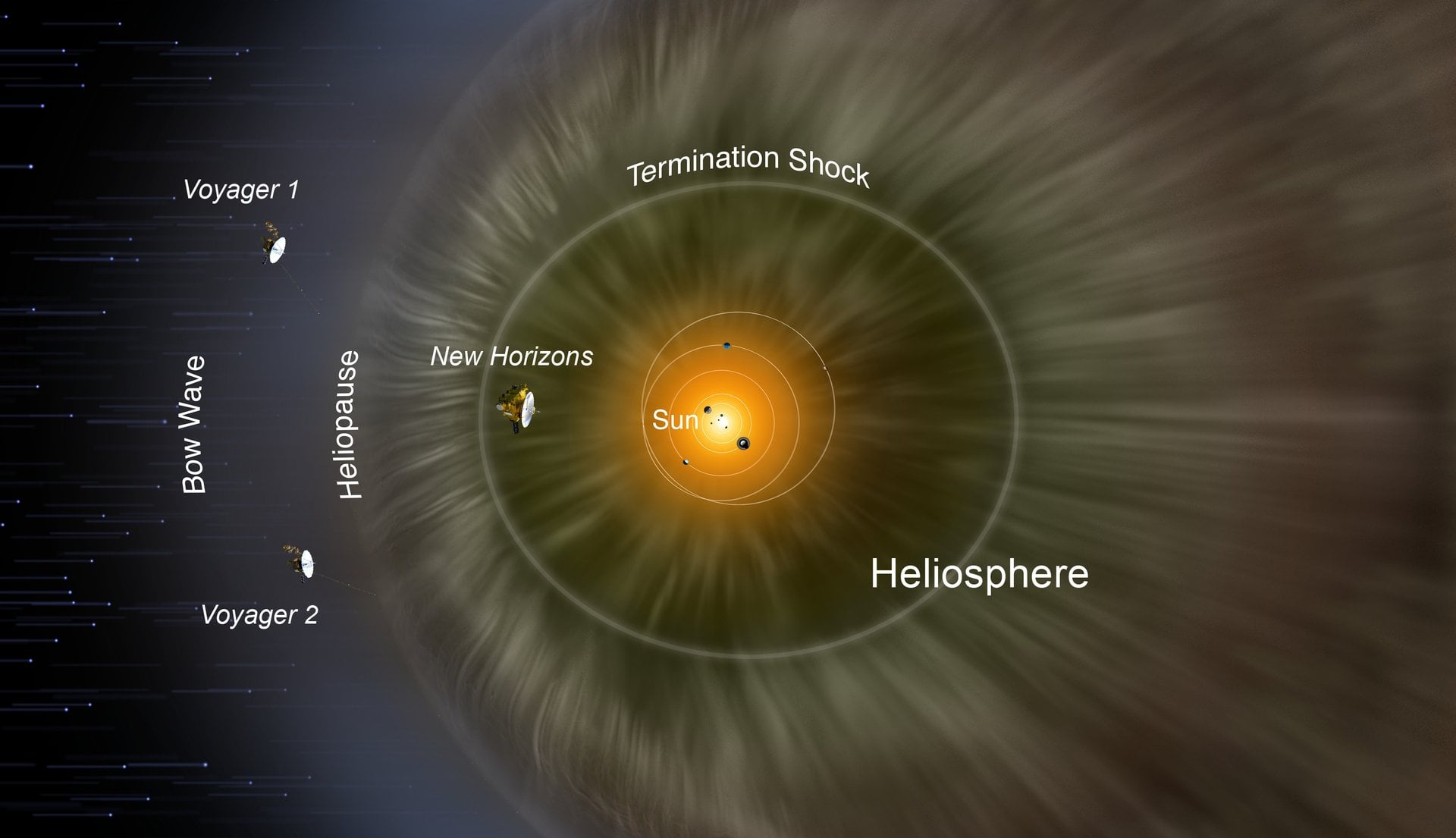
The Solar System is enveloped by a vast bubble of plasma known as the heliosphere, created by the solar wind streaming outward from the Sun. This protective shield deflects most cosmic radiation from the interstellar medium, safeguarding the planets within. As our Solar System orbits the Milky Way, the heliosphere develops a rounded 'nose' in the direction of motion and a 'tail' trailing behind. Scientists debate its shape—some envision a comet-like form, others a croissant-shaped profile. The heliosphere's boundaries are dynamic, expanding during solar maximum and contracting at solar minimum in response to changing solar conditions.
Researchers at the Southwest Research Institute (SwRI) are developing predictive models to determine the location of the termination shock—the heliosphere's outer boundary—along the trajectory of NASA's New Horizons spacecraft. This work, presented in two papers in The Astrophysical Journal and Advances in Space Research, aims to forecast when New Horizons will cross this critical boundary and enter interstellar space, following the historic journeys of Voyager 1 and 2.
The Heliosphere and Its Boundaries
The heliosphere is a magnetic and plasma bubble inflated by the solar wind, which flows supersonically from the Sun until it meets the interstellar medium. The termination shock is where the solar wind slows from supersonic to subsonic speeds, marking the first plasma boundary of the outer heliosphere. Beyond lies the heliosheath, a turbulent region, and finally the heliopause, where the solar wind gives way to interstellar plasma. Understanding these boundaries is crucial for space exploration and for studying the interaction between our star and the galaxy.
SwRI's research combines a solar wind forecasting method with analytical and numerical heliosphere models to predict the location of the termination shock in the direction New Horizons is traveling. This approach leverages data from spacecraft like the Interstellar Boundary Explorer (IBEX) and the Solar and Heliospheric Observatory (SOHO) to monitor solar wind conditions and model their propagation to the outer heliosphere.

New Horizons' Journey Beyond Pluto
After its historic flyby of Pluto in 2015, New Horizons became the first spacecraft to explore a Kuiper Belt Object (KBO), Arrokoth, on January 1, 2019. The study of this contact binary provided invaluable data about the early Solar System. Since then, the probe has continued outward, following in the footsteps of Pioneer 10, Pioneer 11, Voyager 1, and Voyager 2—the only human-made objects to have entered interstellar space. New Horizons is now on a trajectory to cross the termination shock, and researchers are eager to prepare for that milestone.
Dr. Jonathan Gasser, a SwRI post-doctoral researcher and lead author of the studies, emphasized the importance of timing: 'We want to understand when the spacecraft will reach the termination shock to prepare to take measurements.' The solar wind forecasting method allows the team to predict solar wind pressure variations years in advance, which directly influence the heliosphere's shape and the shock's location.
Methodology: Forecasting Solar Wind and Modeling the Heliosphere
The SwRI team developed a technique that uses solar wind data from near-Earth spacecraft to forecast conditions at the outer heliosphere. By analyzing periodic patterns in solar wind speed and density, they can predict pressure variations that propagate outward. These forecasts are then fed into analytical and numerical models of the heliosphere, which simulate the interaction between the solar wind and the interstellar medium.
The analytical model provides a simplified but fast estimate of the termination shock distance, while the numerical model offers a more detailed, three-dimensional simulation. Combining both allows the researchers to cross-check predictions and improve accuracy. The models account for the solar cycle, which causes the heliosphere to expand and contract over an 11-year period. During solar maximum, increased solar wind pressure pushes the termination shock farther out; during solar minimum, it moves inward.
Implications for Future Missions
This research not only benefits New Horizons but also future missions designed to explore the heliosphere and interstellar medium. Proposed missions like the Interstellar Probe would travel even farther, providing direct measurements of the boundary regions. Accurate forecasting of the termination shock location is essential for planning observations and ensuring that instruments are calibrated and ready to capture the transition.
Moreover, understanding the heliosphere's dynamics has implications for astrobiology and planetary science. The heliosphere shields the Solar System from galactic cosmic rays, which can affect planetary atmospheres and potential life. By studying how the heliosphere changes over time, scientists can better assess the habitability of exoplanets around other stars.
Conclusion
SwRI's development of a solar wind forecasting method marks a significant step toward predicting the exact moment when New Horizons will cross into interstellar space. By combining observational data with advanced models, researchers are unraveling the mysteries of the heliosphere's outermost boundaries. As New Horizons continues its epic journey, it promises to deliver unprecedented insights into the frontier between our Solar System and the galaxy beyond.
This article is based on reporting by Universe Today. Read the original article.
Originally published on universetoday.com