A Celestial Backdrop Over a Geothermal Marvel
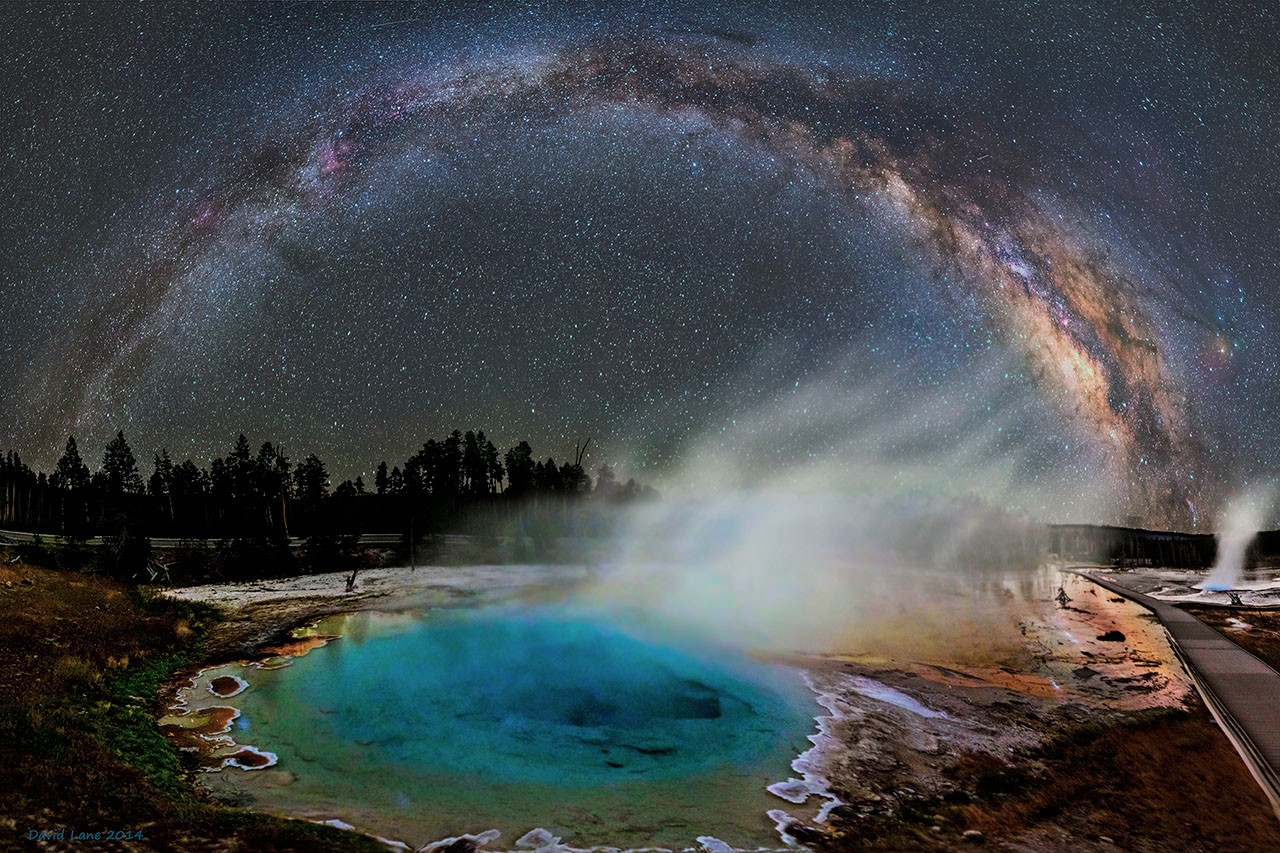
NASA's Astronomy Picture of the Day (APOD) for August 16, 2026, showcases a breathtaking panorama that juxtaposes the grandeur of the Milky Way with the otherworldly landscape of Yellowstone National Park. The image, captured in 2014 by photographer Dave Lane, presents a 16-image mosaic that reveals the galaxy's central band arching high above the colorful Silex Spring. This composition not only highlights the beauty of the cosmos but also underscores the unique geological forces at play beneath our feet.
The Silex Spring: A Palette of Microbial Life
At the foreground of the image lies Silex Spring, a hot spring approximately 10 meters across, located in the heart of Yellowstone. The spring's vivid colors are not the result of mineral deposits alone; rather, they stem from layers of thermophilic bacteria that thrive in the scalding waters. These microorganisms, adapted to extreme temperatures, create a natural palette ranging from deep oranges and reds to greens and blues, depending on the water temperature and chemical composition. The artificial illumination in the photograph enhances these hues, making the spring appear almost surreal against the darkening sky.
Steam rises from the spring, a visible reminder of the geothermal activity that fuels Yellowstone's famous features. This heat originates from the Yellowstone Hotspot, a mantle plume that has driven volcanic activity in the region for millions of years. The hotspot is responsible for the park's geysers, fumaroles, and hot springs, and it continues to shape the landscape in dramatic ways.
The Milky Way: A Distant Galactic Band
Far above the steaming spring, the Milky Way stretches across the sky, a luminous band composed of billions of stars. This central band, which is the galactic plane of our spiral galaxy, appears as a hazy river of light to the naked eye, but in long-exposure photography, it reveals intricate structures of dust, gas, and star clusters. The panorama captures the galaxy in stunning detail, offering viewers a glimpse of the vastness of our cosmic home.
The juxtaposition of the Milky Way and the geothermal spring is both aesthetically striking and scientifically meaningful. It reminds us that Earth is but a tiny speck in a universe teeming with phenomena, yet it also highlights the intricate connections between the geological and the astronomical. The same processes that heat Yellowstone's springs—radioactive decay and gravitational energy—are at play in the formation of stars and galaxies, albeit on vastly different scales.
The Yellowstone Hotspot: A Sleeping Giant
The image also serves as a reminder of the powerful forces that lie beneath Yellowstone. The hotspot that heats Silex Spring is part of a larger volcanic system that has produced some of the most explosive eruptions in Earth's history. Approximately 640,000 years ago, a supervolcanic eruption from the Yellowstone Caldera ejected massive amounts of ash and debris, covering much of North America in a thick layer of volcanic material. Such an event today would have catastrophic consequences, affecting agriculture, climate, and infrastructure across the continent.
While the likelihood of another supereruption in the near future is low, scientists continuously monitor the region for signs of unrest, including seismic activity, ground deformation, and changes in geothermal output. The APOD image, while beautiful, serves as a subtle reminder of the dynamic and potentially hazardous nature of our planet.

Capturing the Panorama: Technical Feats
Creating a panorama of this scale requires careful planning and technical skill. The 16-image mosaic was likely captured using a wide-angle lens and a tracking mount to compensate for Earth's rotation, ensuring that the stars remain sharp. The photographer had to contend with the bright artificial lights illuminating the spring, which can easily overwhelm the faint glow of the Milky Way. By blending multiple exposures and using post-processing techniques, Lane was able to balance the foreground and background, producing a seamless image that reveals both the subtle details of the spring and the grandeur of the galaxy.
This image is part of NASA's long-running APOD series, which has been publishing a daily astronomy picture since 1995. The series, curated by professional astronomers, aims to educate the public about the universe while showcasing stunning visuals. The August 16, 2026, entry is a prime example of how APOD combines science and art to inspire wonder.
Broader Implications: From Hot Springs to Exoplanets
The study of extremophiles, such as the bacteria in Silex Spring, has profound implications for astrobiology. These organisms thrive in environments once thought inhospitable to life, suggesting that life might exist in similar niches elsewhere in the solar system, such as in the subsurface oceans of Europa or the methane lakes of Titan. By understanding how life adapts to extreme conditions on Earth, scientists can better target their search for life beyond our planet.
Moreover, the Milky Way's appearance in the image serves as a reminder of our place in the galaxy. The central band we see is the result of our perspective from within the galactic disk, and its study has revealed a supermassive black hole at the galaxy's core, as well as billions of stars and countless planets. The image thus bridges the microscopic world of bacteria and the macroscopic world of galaxies, illustrating the interconnectedness of all scales of existence.
Conclusion
NASA's APOD for August 16, 2026, is more than just a pretty picture; it is a testament to the beauty and complexity of our universe. By capturing the Milky Way over Yellowstone's Silex Spring, the image invites us to contemplate both the geological forces that shape our planet and the cosmic processes that govern the stars. It is a reminder that even in a single frame, we can find connections between the Earth and the heavens, and that there is always more to discover.
For those inspired by this image, NASA's APOD archive offers a wealth of similar photographs and explanations, each providing a unique window into the cosmos. Whether you are a seasoned astronomer or a casual observer, the daily images serve as a gentle nudge to look up and wonder.
This article is based on reporting by science.nasa.gov. Read the original article.
Originally published on science.nasa.gov