NASA’s ESCAPADE mission has cleared a critical milestone on its unusual route to Mars. The mission’s two small spacecraft, known as Blue and Gold, completed closely timed powered flybys of Earth and are now on trajectories toward the Red Planet.
The maneuver marks the first time NASA has used a powered Earth flyby to send a spacecraft toward Mars. Instead of relying on a conventional direct launch during a narrow planetary alignment window, ESCAPADE used Earth’s gravity and engine burns to gain the energy needed for the interplanetary journey.
Two flybys in two days
Gold passed Earth at about 6 a.m. Eastern on Nov. 9, coming within roughly 1,050 kilometers of the planet. That event followed a similar flyby by Blue a little more than 48 hours earlier, at an altitude of about 1,600 kilometers.
During each pass, the Rocket Lab-built spacecraft fired its engine. The timing made use of the Oberth effect, in which a burn performed while a spacecraft is moving rapidly near a massive body can yield more propulsion benefit than the same burn elsewhere in its trajectory.
NASA said both maneuvers were executed successfully. Asal Naseri, acting associate flight director in NASA’s heliophysics division, described the pair of operations as the agency’s first powered Earth flybys used to propel spacecraft toward Mars.
The burns were especially consequential because they were not minor course corrections. Rob Lillis, ESCAPADE’s principal investigator, compared their importance to a Mars orbit-insertion burn: if a spacecraft’s main engine operation at that stage fails, the mission can be lost. The successful flybys placed both spacecraft on their planned Mars-bound paths.

A route designed to loosen Mars launch constraints
Missions to Mars commonly launch during windows that open about every two years, when the relative positions of Earth and Mars make a direct transfer practical. ESCAPADE is demonstrating a different approach developed by Advanced Space.
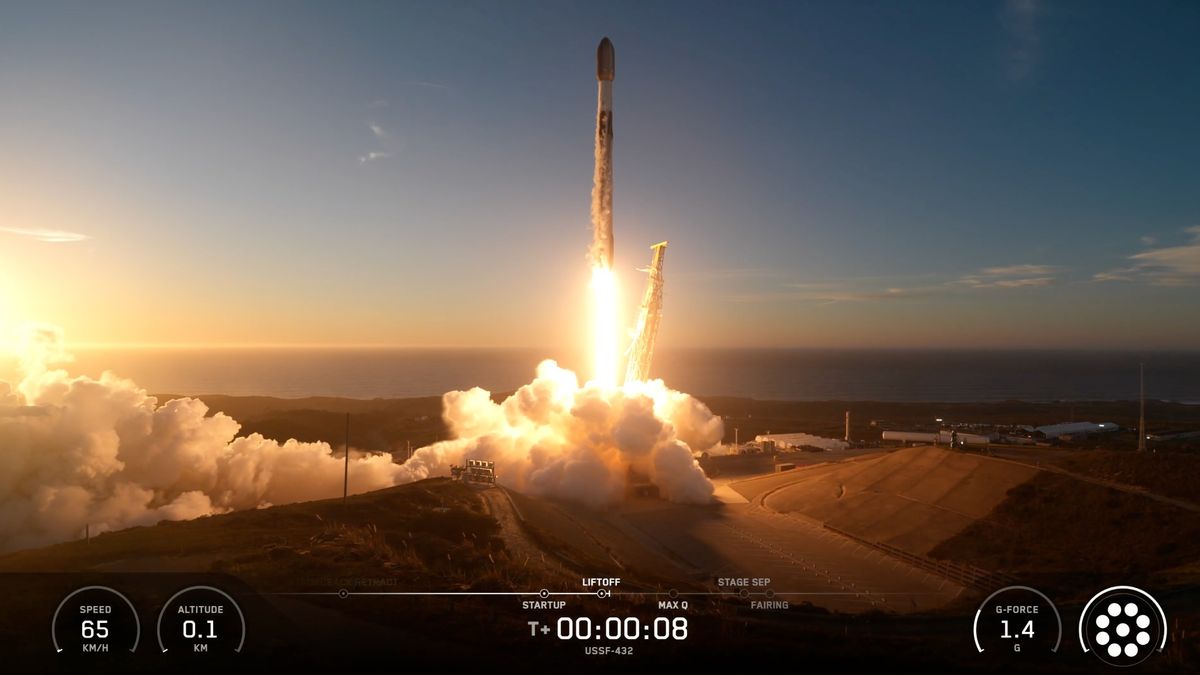
The mission launched in November 2025 on the second flight of Blue Origin’s New Glenn rocket. Rather than depart immediately for Mars, the two spacecraft spent nearly a year near the Earth-Sun L-2 Lagrange point. They then returned for their Earth encounters, which supplied the final gravitational and propulsion-assisted push outward.
According to Advanced Space, this approach could allow Mars missions to launch at times outside the traditional direct-transfer opportunities, then use a later Earth flyby to build the necessary trajectory. That flexibility could matter for smaller missions, rideshare opportunities, and mission planners seeking options beyond a single biennial launch period.

It also shifts complexity into trajectory design and spacecraft operations. The flybys required precise navigation, a correctly timed main-engine burn, and a trajectory that carried the spacecraft from the L-2 region back to Earth before sending them outward again. ESCAPADE’s two successful maneuvers offer a real-world test of that architecture.
Arrival planned for September 2027
Blue and Gold are expected to arrive at Mars two days apart in September 2027. Each will then conduct an approximately 11-minute main-engine burn to enter orbit around the planet. After additional maneuvers, the spacecraft will move into their science orbits.
ESCAPADE, short for Escape and Plasma Acceleration and Dynamics Explorers, is a heliophysics mission focused on the environment around Mars. The twin spacecraft are intended to study space weather there, including how the solar wind interacts with the planet’s magnetosphere and atmosphere.
The mission’s two-spacecraft design is central to that goal. Initially, the vehicles will observe from the same orbit while separated by as much as 30 minutes. That arrangement is designed to help distinguish changes over time in the Martian space-weather environment. Later, they will move into separate orbits, allowing the mission to examine different regions of the system.
Mars does not have a global magnetic field like Earth’s, but it does have an induced magnetosphere and localized crustal magnetic fields. Studying how the solar wind affects that environment can help researchers better understand the processes that shape the upper atmosphere and surrounding space at Mars.

A small mission with a large operational demonstration
ESCAPADE’s progress is significant both for its science goals and for the operational method now demonstrated in flight. The mission has shown that a pair of small spacecraft can wait near the Earth-Sun L-2 region, return to Earth, and use tightly controlled powered flybys to start a Mars transfer.
The next major milestones are still ahead: the long cruise to Mars, orbital insertion, deployment into the science configuration, and the coordinated measurements that require both spacecraft to operate successfully. But the Earth flybys removed one of the mission’s most demanding early risks.
For NASA and its partners, the result is an important proof point for more flexible interplanetary mission design. For ESCAPADE itself, it is the start of a journey that will culminate in a paired investigation of the solar wind’s effects at Mars.
This article is based on reporting by SpaceNews. Read the original article.
Originally published on spacenews.com