A Rare Golden Glow
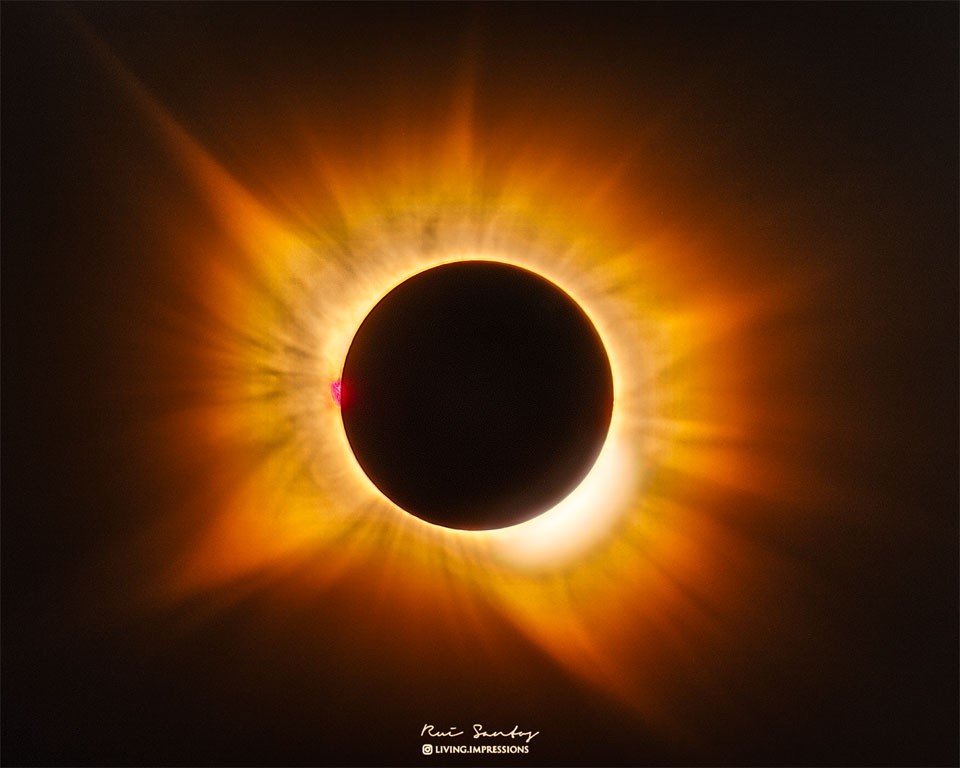
When the Moon slid perfectly in front of the Sun on August 12, 2026, skywatchers across Spain were treated to a total solar eclipse. But this was no ordinary eclipse. As totality darkened the sky, the Sun's corona—the ethereal outer atmosphere—appeared not in its usual pearly white, but in a striking golden hue. The sight was so unusual that it caught the attention of astronomers and photographers alike, leading to a featured image on NASA's Astronomy Picture of the Day.
The golden corona was not an illusion or a trick of the camera. It was a real phenomenon, born from a combination of geometry and atmospheric conditions. To understand why, we need to look at the path of the eclipse and the state of the air on that day.
The Science of Color
The corona is normally white because it emits light across the entire visible spectrum. But when that light passes through Earth's atmosphere, it can be altered. On August 12, observers in Spain experienced totality when the Sun was very low on the horizon—near sunset. At such a low angle, sunlight must travel through a much thicker layer of air than when the Sun is overhead. This longer path causes the atmosphere to scatter shorter wavelengths of light, particularly blue and violet, away from the line of sight. This is the same reason sunsets appear red or orange: the blue light is scattered out, leaving the warmer tones.
In this case, the scattering was even more pronounced. The region had been affected by nearby forest fires, which filled the air with smoke particles. These tiny aerosols acted as an additional filter, further removing the remaining blue tones and deepening the golden color. The result was a corona that looked like it had been dipped in liquid gold.

Capturing the Moment
The featured image, captured by photographer Rui Santos from Benavente, Spain, is a masterpiece of high dynamic range (HDR) processing. By combining multiple exposures, Santos was able to reveal the intricate details of the corona, from the delicate streamers extending outward to the bright inner region. The image also shows a pink prominence—a loop of hydrogen gas—hovering over the Sun's left edge. Unlike the corona, this prominence retained its original color, a vivid pink that stands out against the golden backdrop.
The image is not just beautiful; it's scientifically valuable. By studying the color and structure of the corona, astronomers can learn more about the Sun's magnetic field, the temperature of the corona, and the processes that drive solar activity. The golden hue, while unusual, provides a unique opportunity to study how atmospheric conditions affect our observations of celestial events.
A Global Spectacle
The 2026 total solar eclipse was a major event for skywatchers, with the path of totality crossing parts of Europe, including Spain. Thousands of people gathered in the path to witness the brief moments of darkness, and many captured their own images. The eclipse was also a reminder of the Sun's dynamic nature, with the corona revealing the complex structure of the Sun's outer atmosphere.
For those who missed it, the images and videos from the event serve as a lasting record. The golden corona, in particular, has become a talking point, sparking discussions about the interplay between celestial events and Earth's atmosphere.
Why It Matters
This event highlights the importance of atmospheric science in astronomy. The same principles that make sunsets red and skies blue also affect how we see eclipses. By understanding these effects, scientists can better interpret observations and even correct for atmospheric interference in astronomical data.
Moreover, the golden corona is a reminder of the fragility of our view of the universe. Smoke from wildfires, a growing concern in many parts of the world, can dramatically alter what we see. While this eclipse was a visual treat, it also serves as a subtle warning about the impact of environmental changes on our ability to observe the cosmos.
Looking Ahead
As we await the next total solar eclipse, astronomers will continue to study the data from this one. The images, like Santos's, will be analyzed for years to come, providing insights into the Sun's behavior and the Earth's atmosphere. For the rest of us, the golden corona is a beautiful memory—and a reminder of the wonders that await when we look up.
For more stunning images and detailed explanations, visit NASA's Astronomy Picture of the Day archive, where this image is featured.
This article is based on reporting by science.nasa.gov. Read the original article.

Originally published on science.nasa.gov