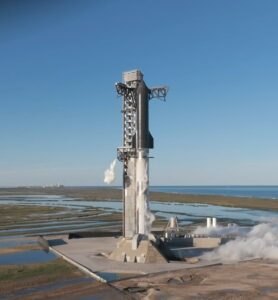
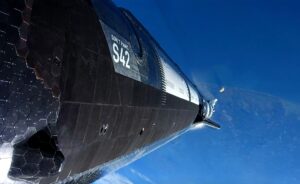
SpaceX has caught a Starship upper stage at its Starbase launch tower in Texas after a 14-orbit test mission, a major step toward the company’s goal of operating a fully reusable orbital launch system.
The flight, designated Integrated Flight Test 15, lifted off at 5:47 p.m. Eastern time on November 13. After circling Earth 14 times, the spacecraft returned to Starbase on November 14 and was captured by the tower’s mechanical arms, commonly called “Mechazilla” or “chopsticks.”
A first for the Starship upper stage
SpaceX had previously recovered three Super Heavy boosters at the tower shortly after launch, during Integrated Flight Tests 5, 7 and 8. IFT-15 was the first attempt to recover the second stage, known as Starship, after an orbital mission.
The distinction matters because the full Starship system consists of two reusable elements: the Super Heavy first-stage booster and the Starship upper stage. The upper stage is the spacecraft intended to reach orbit, reenter the atmosphere and eventually fly again. Recovering it at the launch site could eliminate the need to discard or splash down a vehicle after a mission.
The IFT-15 outcome goes beyond the prior IFT-14 mission, which took place two months earlier. That flight was the first of the two to place Starship into orbit and was largely successful, but its vehicle was not recovered. It splashed down in the northern Pacific after a little more than three hours and nearly two orbits.
Reusable spacecraft, with a remaining gap
SpaceX describes Starship as a system designed for full reusability and rapid turnaround. The company’s chief executive, Elon Musk, has envisioned thousands of Starship launches annually from at least three locations: Starbase; Kennedy Space Center in Florida; and a newly announced site in Vermilion Parish, Louisiana.
IFT-15 did not complete a full recovery of both stages. The Super Heavy booster did not return to the tower as planned. Its guidance, navigation and control system determined that the booster was not in the correct position, so it automatically diverted the vehicle to a splashdown in the Gulf.
That decision illustrates the flight’s mixed but consequential nature. The upper-stage capture demonstrated an approach SpaceX had not previously attempted after orbital flight. At the same time, the first-stage diversion means the company has not yet demonstrated a mission in which both major elements return to the launch site for recovery.
Why the catch is significant
Conventional orbital launch vehicles are typically expended, while reusable systems have generally recovered only part of the launch stack. NASA’s Space Shuttle is the closest historical comparison cited for reusable orbital operations. Across 30 years, its five orbiters returned from orbit 133 times and landed on runways. Its solid rocket boosters were also reused, but its core stage was not.
Starship’s architecture is intended to extend reuse to both the booster and the orbital spacecraft. Capturing the upper stage directly at the tower is central to that concept. A tower catch is meant to support rapid reuse by bringing the vehicle back to the launch infrastructure rather than requiring a runway landing or recovery at sea.
The 14-orbit mission also represented a substantially longer orbital operation than IFT-14. That duration gave the vehicle an opportunity to complete an orbital flight before reentry and return to Texas, rather than making a controlled Pacific splashdown after only a small number of orbits.

The next test objective
The IFT-15 result provides SpaceX with evidence that Starship can return from orbit and be captured by the launch tower. The next major milestone is to combine that capability with a successful Super Heavy return, demonstrating recovery of both stages on the same mission.
For now, the test establishes a new benchmark: an upper-stage Starship completed 14 Earth orbits and returned to the launch site for a tower capture. The booster diversion also underscored that the system’s full-reuse objective remains a work in progress, even as SpaceX advances toward it.
This article is based on reporting by spacepolicyonline.com. Read the original article.
Originally published on spacepolicyonline.com