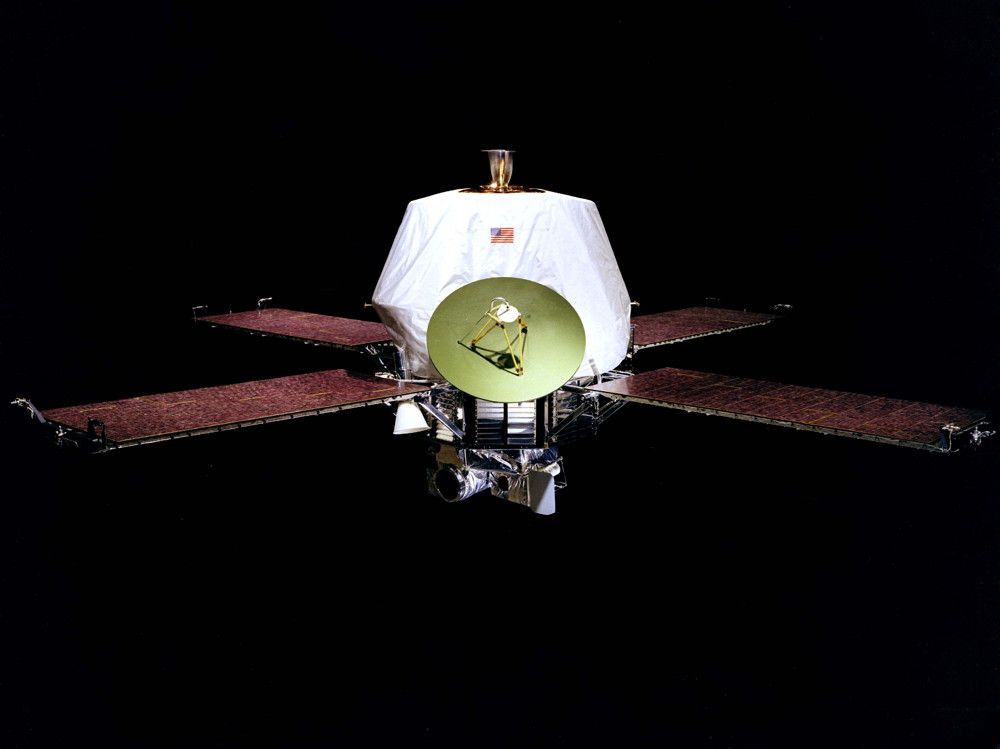
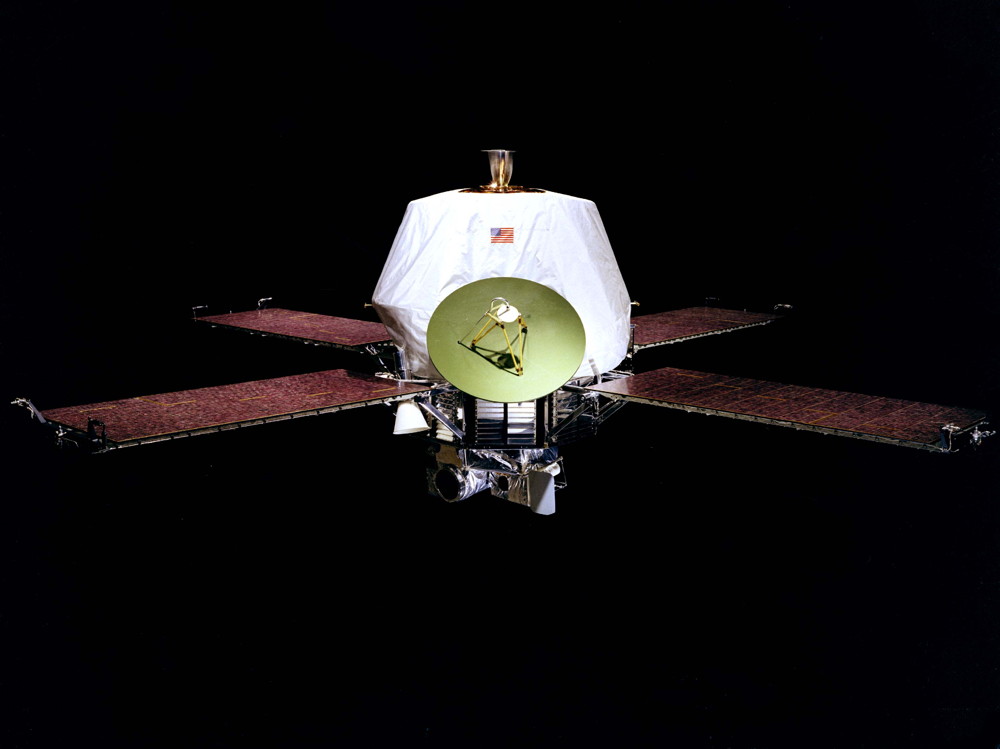
NASA’s Mariner 9 entered orbit around Mars on Nov. 13, 1971, becoming the first human-built spacecraft to orbit another planet. The mission arrived at a moment when Mars was still poorly understood and helped replace an image of the Red Planet as a largely moon-like, cratered world with a far more complex planetary picture.
Its achievement was not simply getting to Mars. Mariner 9 showed why orbit matters. Earlier missions had flown past the planet, offering only brief opportunities to gather data. An orbiter could remain at Mars, wait through changing conditions and build a much more complete view of the surface below. Mariner 9 operated for a year before it ran out of gas and NASA shut it down.
An arrival in the middle of a dust storm
Mariner 9 reached Mars during a dust storm. At first, the spacecraft could see tall structures protruding through the clouds. When the dust settled, images from the mission revealed that those structures were the tops of enormous volcanoes.
Among them was Olympus Mons, identified in the account as the tallest volcano in the solar system. The spacecraft also observed Valles Marineris, an immense canyon system described as five times longer than Arizona’s Grand Canyon. Together, those features made clear that Mars was not merely a heavily cratered body resembling the moon.
That shift in perspective is the core of Mariner 9’s legacy. Before the mission, NASA had conducted several Mars flybys. Those earlier encounters had shown a cratered surface, leading some scientists to think Mars looked much like the moon. Mariner 9’s observations challenged that limited view with evidence of immense volcanic and canyon landscapes.
Beating a rival spacecraft to orbit
The mission also unfolded during an era of intense Soviet-US competition in planetary exploration. NASA said Mariner 9 reached Mars orbit before the Soviet Mars 2 spacecraft, despite Mars 2 having an 11-day head start on the journey to the Red Planet.
Mars 2 would later become the first human-built craft to impact Mars when it crashed into the surface. Mariner 9, by contrast, established orbit and carried out sustained observations. The two missions underscore how the objective of reaching Mars can encompass very different technical outcomes: a craft may arrive, impact, land, fly by or remain in orbit. Mariner 9’s orbital success gave it time to observe the planet through changing conditions.
Being first did not make the mission important by itself. The significance came from what the spacecraft did with that position. Its images helped transform Mars from a distant and mysterious target into a world with dramatic large-scale landforms available for human study and future exploration.
Why the mission changed Mars exploration
Mariner 9 demonstrated the scientific value of persistence at another world. A flyby can provide a snapshot. An orbiter can observe over time, including after a temporary obstruction such as a dust storm. In Mariner 9’s case, the early view was limited by the storm, but the mission continued long enough for the atmosphere to clear and for the surface features to emerge.
This is a simple but consequential lesson in robotic exploration. The environment being studied can interfere with instruments at the very moment a spacecraft arrives. Long-lived missions can turn an initially disappointing observation window into a major discovery opportunity.

The mission’s year in orbit also showed that Mars is a destination for systematic investigation rather than a one-time encounter. Once enormous volcanoes and the giant canyon system were visible, Mars could no longer be summarized by the cratered terrain seen in early flybys. The planet’s surface became a record of geologic processes on a vastly different scale from anything previously revealed in close images of Mars.
Mariner 9 remains especially notable because the landmarks it brought into view are so recognizable. Olympus Mons and Valles Marineris have since become central reference points in public understanding of Mars: one represents extreme volcanism, and the other a canyon system of extraordinary scale. Their visibility in Mariner 9 imagery gave scientists and the public a more tangible sense that Mars is a distinct world with its own history and terrain.
A foundation for later missions
NASA shut Mariner 9 down when it ran out of gas, but the spacecraft remains one of the best-known Mars missions because it changed the questions that later exploration could ask. The mission made clear that Mars contained major surface structures worthy of closer investigation. It also established orbiting Mars as a powerful strategy for gathering planetary science.
Its influence can be understood without overstating what the mission alone accomplished. Mariner 9 did not resolve every question about Mars, and the available account does not claim that it did. Its contribution was more fundamental: it revealed a planetary surface whose scale and diversity had been hidden from the earlier, brief flyby views.
On the anniversary of its arrival, Mariner 9 is a useful reminder that exploration often advances through a combination of technical endurance and patience. The spacecraft encountered a dust-obscured Mars, remained in place, and eventually delivered views that altered scientific expectations. Its lasting importance lies in that transition—from a poorly known red target to a world of towering volcanoes and a vast canyon system, ready for continued exploration.
This article is based on reporting by Space.com. Read the original article.
Originally published on space.com