
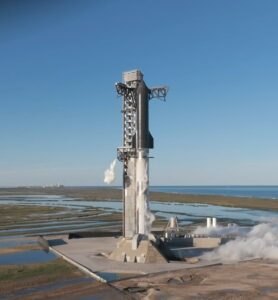
Starship launches from Starbase
SpaceX’s Starship vehicle lifted off from Starbase in Texas at 4:48 p.m. Central Standard Time on November 13, or 5:48 p.m. Eastern Standard Time and 2248 UTC, according to Spaceflight Now’s launch coverage. The mission reached orbit ahead of a planned attempt to recover the booster, but the booster diverted to an explosive splashdown rather than completing the intended catch.
The flight was described as Starship Flight 15 and was framed as an attempt to recover the full vehicle through a double launch-pad catch. The available mission update establishes two central outcomes: the Starship vehicle achieved orbit, and the booster did not complete the planned recovery profile.
Starship’s launch from the Texas site was therefore a mixed mission result. Reaching orbit is a major flight milestone within the stated mission sequence. The booster diversion shows that the recovery objective encountered a condition that changed the planned ending for that part of the vehicle.
A mission with two distinct objectives
The launch involved more than a single ascent. The source coverage described a recovery attempt for the full vehicle, with the booster expected to return toward the launch site for a catch. That goal placed recovery performance alongside the orbital portion of the mission.
Instead, the booster diverted to an explosive splashdown. The supplied source material does not explain the condition that prompted the diversion, identify a specific failure mode or provide a detailed timeline of the booster’s return. It therefore would be premature to assign a cause or characterize the diversion beyond what the launch report states.
What is clear is that the mission had separate measures of success. The vehicle’s arrival in orbit marked progress in the ascent phase, while the change in the booster’s recovery path meant the planned catch did not occur. Those outcomes should be considered independently rather than reduced to a simple success-or-failure label.

Why recovery was central to the flight
The planned double launch-pad catch made recovery a prominent part of the mission. A catch attempt is an operational objective distinct from launching a vehicle and reaching orbit. It requires the returning booster to follow its planned path closely enough to complete the recovery sequence at the launch site.
The reported splashdown diversion instead removed that vehicle from the intended catch sequence. Although the source does not say whether the diversion was initiated as a precaution, after an identified anomaly or for another reason, the outcome demonstrates the difference between placing a spacecraft on its planned trajectory and returning a large launch stage through a highly specific recovery operation.
For launch observers, the flight also underscores why mission summaries need to separate verified facts from assumptions. The available report supports the launch time, the orbital result and the booster’s diversion. It does not supply technical data about the diversion or a broader assessment of vehicle performance, so those details remain unconfirmed here.
The reported flight sequence
- Liftoff occurred from Starbase, Texas, at 4:48 p.m. CST on November 13.
- The corresponding times were 5:48 p.m. EST and 2248 UTC.
- The Starship vehicle reached orbit.
- The booster was intended for a catch attempt.
- The booster diverted to an explosive splashdown instead of completing that recovery goal.
Spaceflight Now’s coverage also noted that the Ship could return to a landing at Starbase on Saturday. That wording indicated a later recovery possibility for the Ship, separate from the booster’s completed diversion. The supplied material does not provide a final result for that potential Ship landing, and it should not be treated as confirmed from the available update.
What comes next
The immediate record from the flight is clear enough to define the story: Starship launched, reached orbit and proceeded through a mission that included an unsuccessful booster-catch outcome. Any fuller account will depend on subsequent official information or detailed mission reporting that explains the booster’s diversion and reports the status of the Ship’s planned return.
Until then, the launch offers a precise example of how test flights can produce meaningful progress alongside incomplete objectives. Orbital flight and recovery are related but different technical challenges. This mission achieved the former while the latter changed course at the end of the booster’s return.
That combination is the key development from Flight 15. The orbital milestone remains part of the mission record, while the explosive splashdown marks the boundary of what the booster recovery attempt accomplished on this flight.
This article is based on reporting by Spaceflight Now. Read the original article.
Originally published on spaceflightnow.com