A Historic Anniversary on the Red Planet
This week marks a significant milestone in space exploration as NASA's Curiosity rover celebrates its 14th landing anniversary on Mars. Since touching down on August 6, 2012, the car-sized rover has been tirelessly exploring the Martian surface, sending back invaluable data that has reshaped our understanding of the Red Planet. The anniversary is not just a moment of reflection for the mission team but also a testament to the rover's enduring legacy and the scientific discoveries that continue to emerge.
Curiosity's journey began with a dramatic sky-crane landing in Gale Crater, a technique that was both innovative and risky. The successful touchdown was a triumph of engineering and marked the beginning of an extended mission that was originally planned to last just two years. Fourteen years later, Curiosity remains operational, climbing the slopes of Mount Sharp, a 5.5-kilometer-high mountain that rises from the crater's center. The rover's longevity is a tribute to the meticulous planning and robust design that have allowed it to withstand the harsh Martian environment, including extreme temperatures, dust storms, and radiation.
Reflecting on the Landing: A Personal Perspective
For many team members, the anniversary is a time to relive the tension and excitement of the landing. Susanne P. Schwenzer, Professor of Planetary Mineralogy at The Open University, UK, recalls watching the buildup to the entry phase on NASA's interactive tool 'Eyes on the Solar System.' She admits to being so tense and nervous that she barely remembers the moments leading up to the confirmation of a safe landing. The jubilant celebrations in the control room after the successful touchdown are memories she cherishes, and she often revisits the iconic 'Curiosity Has Landed' video to re-experience that historic moment.
The anniversary also provides an opportunity to reflect on the mission's achievements. Over the past 14 years, Curiosity has made numerous groundbreaking discoveries, including evidence of ancient habitable environments, organic molecules, and dynamic geological processes. The rover has drilled into rocks, analyzed soil samples, and sent back stunning images that have captivated the public and scientists alike. Each year, the team celebrates another Earth year on Mars, marking the passage of time and the accumulation of knowledge.

What Was Curiosity Doing at the Exact Moment of Landing?
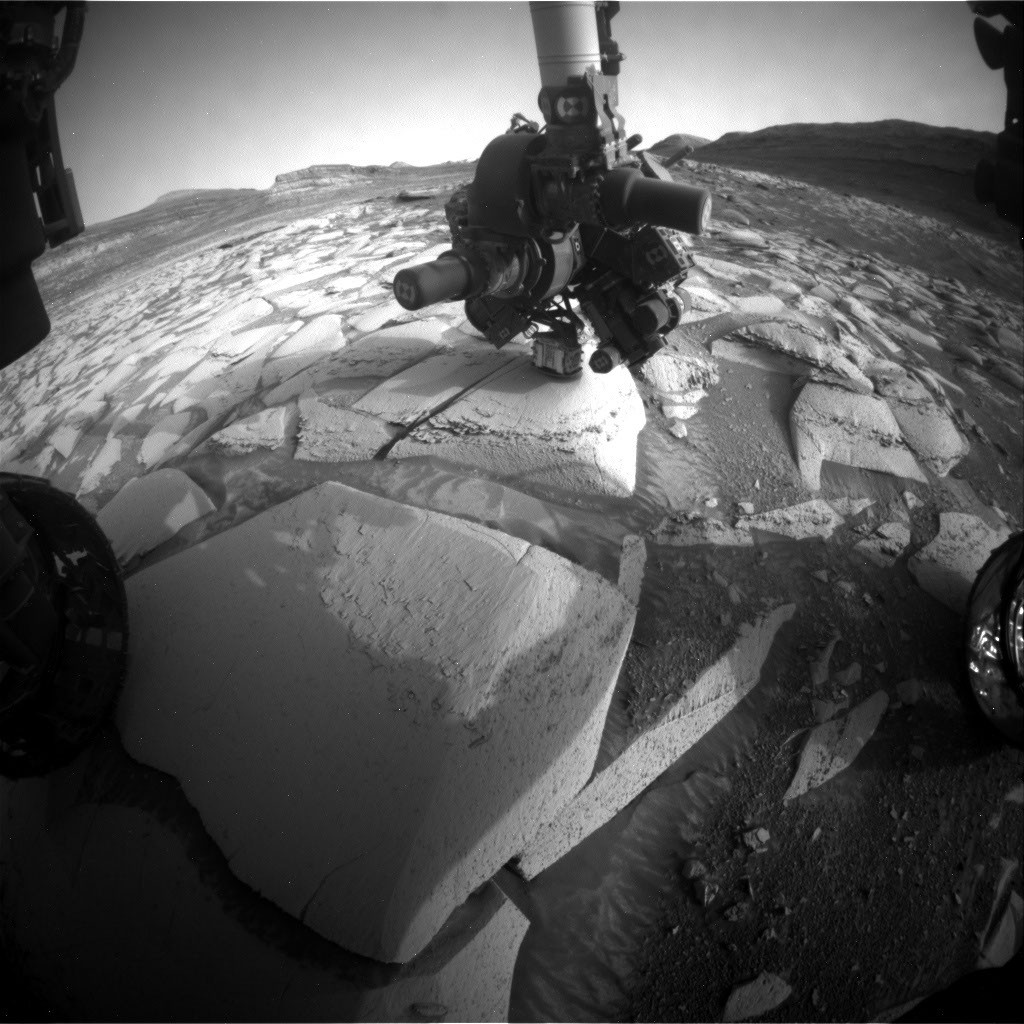
To commemorate the anniversary, the science and engineering team at NASA's Jet Propulsion Laboratory (JPL) in Pasadena, California, provided a fascinating detail: at the exact moment that marked the landing anniversary (Sol 4976 at 19:47 LMST on Mars), the rover was in the middle of a scientific operation. Its robotic arm was deployed at a target named 'Tunas Khasa,' conducting an APXS (Alpha Particle X-ray Spectrometer) measurement. This instrument is used to determine the elemental composition of rocks and soils, providing crucial insights into the geological history of the area.
This detail underscores the rover's relentless work ethic. Even as the team on Earth celebrated, Curiosity continued its mission, autonomously executing commands and gathering data. The image captured by the rover's Front Hazard Avoidance Camera (Front Hazcam) on Sol 4976 shows the APXS instrument in action, a fitting snapshot of the rover's ongoing dedication to scientific exploration.
Continuing the Ascent of Mount Sharp
Curiosity's primary mission is to investigate the habitability of ancient Mars, and its ascent of Mount Sharp is central to that goal. The mountain's layers of rock represent a chronological record of Martian environmental conditions, and by studying them, scientists can piece together the planet's climatic evolution. The rover has been climbing steadily, and the terrain has become increasingly steep and challenging. The team plans each drive carefully, using orbital imagery and onboard hazard avoidance systems to navigate safely.
In the week leading up to the anniversary, Curiosity continued its climb, encountering steep slopes that required careful maneuvering. The rover's route is carefully planned to maximize scientific return while minimizing risk. Each stop allows for contact science, where the rover uses its instruments to analyze rocks in detail, and remote sensing, where it uses its mast-mounted cameras and spectrometers to study the surrounding landscape.
Scientific Highlights and Discoveries
Over its 14-year mission, Curiosity has delivered a wealth of scientific findings. One of the most significant discoveries was the detection of organic molecules in ancient mudstones, suggesting that the building blocks of life may have been present on Mars. The rover also found evidence of ancient lakes and rivers, indicating that Gale Crater once hosted a habitable environment. These findings have profound implications for the search for past life on Mars and have informed the design of future missions, such as the Perseverance rover and the Mars Sample Return campaign.
Curiosity's instruments have also revealed the presence of a variety of minerals, including clays and sulfates, which form in different environmental conditions. By analyzing the distribution of these minerals along Mount Sharp, scientists can reconstruct the history of water on Mars and how the climate changed over time. The rover's weather station has provided daily meteorological data, helping scientists understand Martian weather patterns and dust dynamics.
Looking Ahead: The Future of Curiosity
As Curiosity enters its 15th year on Mars, the mission continues to push the boundaries of exploration. The rover's health is generally good, though it has experienced some wear and tear, including wheel damage and occasional computer glitches. The team has adapted to these challenges, implementing innovative driving techniques and software updates to extend the rover's lifespan. The science team is eager to explore higher elevations of Mount Sharp, where they expect to find rocks that may hold clues to the transition from a wetter to a drier Martian climate.
The anniversary is also a moment to acknowledge the broader Mars exploration program. Curiosity's success has paved the way for Perseverance, which landed in Jezero Crater in 2021, and for future missions that aim to return samples to Earth. The data collected by Curiosity will be invaluable for interpreting the samples collected by Perseverance and for planning human exploration of Mars. As we celebrate this milestone, we look forward to many more years of discovery from this remarkable rover.
How to Relive the Landing
For those who wish to relive the excitement of the landing, NASA's interactive tool 'Eyes on the Solar System' allows users to simulate the journey of the Mars Science Laboratory spacecraft from launch to landing. By selecting the Mars Science Laboratory Rover from the list of spacecraft, users can wind back the clock to November 26, 2011, when Curiosity launched, and follow its trajectory as it traveled to Mars. The tool provides a real-time visualization of the spacecraft's position and speed, culminating in the dramatic landing on August 6, 2012. Additionally, the video 'Curiosity Has Landed' captures the joy and relief of the mission control team, a moment that remains a highlight in the history of space exploration.
The 14th anniversary of Curiosity's landing is a celebration of human ingenuity and the spirit of exploration. As the rover continues its journey up Mount Sharp, it carries with it the hopes and dreams of scientists and space enthusiasts around the world. Happy anniversary, Curiosity, and here's to many more years of discovery on the Red Planet.
This article is based on reporting by science.nasa.gov. Read the original article.
Originally published on science.nasa.gov