Capturing the Cosmos: A Night of Meteors and Reflections
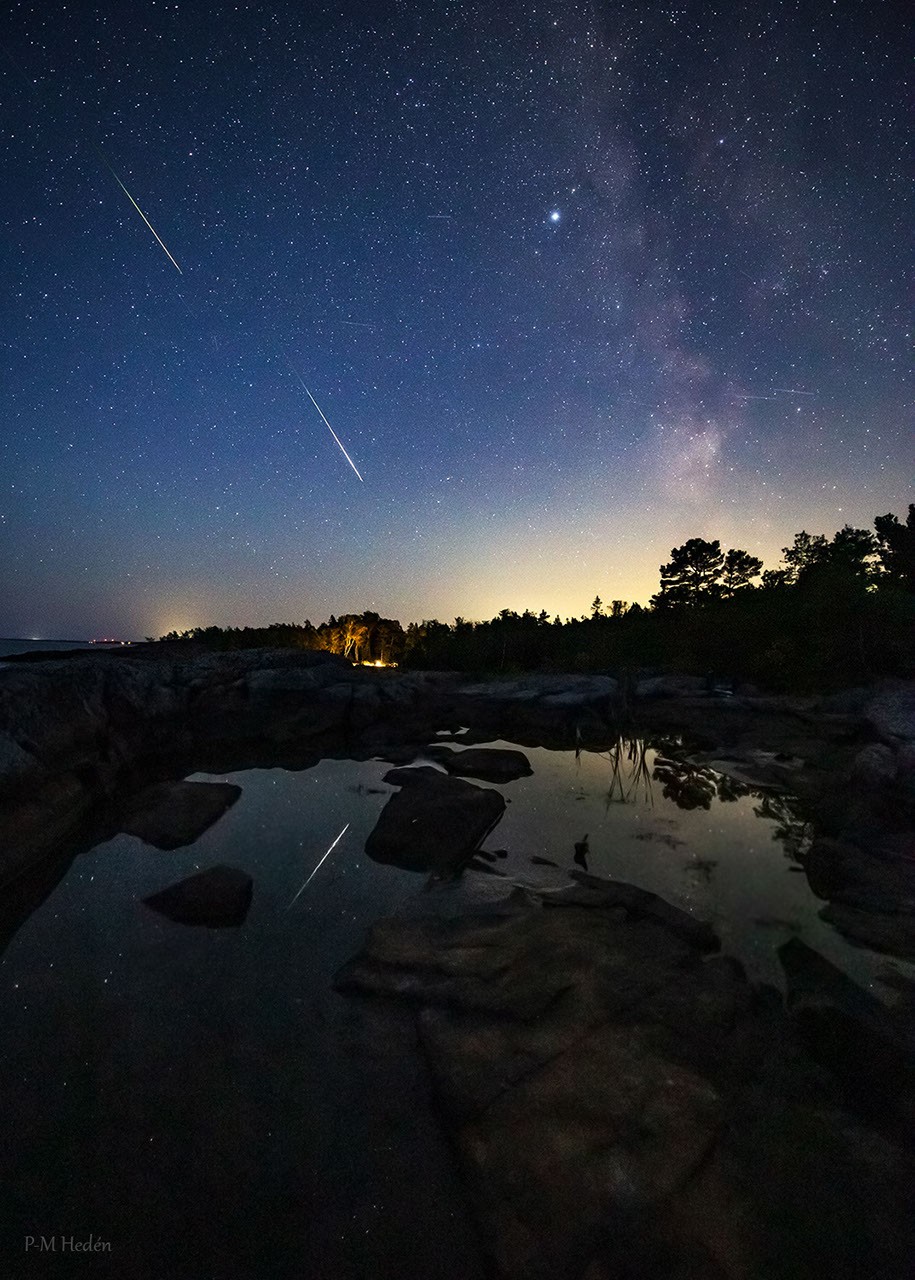
On the night of August 12, 2026, the skies above the coastal village of Grisslehamn, Sweden, put on a celestial show that photographers and skywatchers dream of. The annual Perseid Meteor Shower, known for its bright and fast meteors, reached its peak, offering a spectacular display of shooting stars. A composite image taken from this location not only recorded two brilliant Perseid meteors but also captured a rare watery reflection of one meteor, adding an artistic twist to the scientific observation.
The image, featured as NASA's Astronomy Picture of the Day (APOD) on August 15, 2026, was captured by P-M Hedén, a photographer associated with Clear Skies and The World At Night (TWAN). The composite combines multiple exposures to reveal the meteors streaking across the sky, alongside the faint, diffuse glow of the Milky Way. The scene is further enhanced by the presence of Altair, one of the brightest stars in the night sky, which serves as a reference point for the meteors' brightness.
The Science Behind the Perseids
The Perseid Meteor Shower is an annual event that occurs when Earth passes through the debris trail left by the periodic comet 109P/Swift-Tuttle. As these tiny grains of dust, some no larger than a grain of sand, enter Earth's atmosphere at high speeds, they vaporize due to friction with air molecules, creating brief but brilliant streaks of light. The shower's radiant point lies in the constellation Perseus, which gives the shower its name.
This year, the Perseids were particularly favorable for observation due to the timing of the New Moon. The absence of moonlight meant that even the faintest meteors were visible, and the sky was dark enough to reveal the full glory of the Milky Way. The peak activity on August 12 coincided with a New Moon, providing ideal conditions for meteor watching and photography.
A Unique Composite: Combining Art and Science
The composite image from Grisslehamn is a testament to the skill of astrophotographers in capturing transient celestial events. By layering multiple exposures, the photographer was able to show the meteors' paths in a single frame, along with the static background of stars and the Milky Way. The watery reflection of one meteor adds a unique element, as the calm waters of the Baltic Sea provided a mirror-like surface that doubled the visual impact.
Such composites are not only aesthetically pleasing but also scientifically valuable. They allow astronomers to study the brightness, trajectory, and color of meteors, providing insights into the composition of the debris left by comets. The Perseids, in particular, are known for their bright, fast meteors that often leave persistent trains, making them a favorite subject for both amateur and professional observers.
Viewing Conditions and the Solar Eclipse Connection
For many skywatchers, the night of bright Perseids was a prelude to an even more anticipated event: a total solar eclipse that occurred on August 12, 2026. The New Moon that darkened the skies for the meteor shower was the same New Moon that would later align with the Sun to create a total solar eclipse, visible from parts of Greenland and other northern regions. This cosmic coincidence added an extra layer of excitement to an already memorable night.
The image from Sweden was taken near the shower's peak, and the photographer was fortunate to have clear skies and dark conditions. The location near Grisslehamn, a small coastal village, offered an unobstructed view of the horizon and minimal light pollution, making it an ideal spot for astrophotography.
The Role of NASA's Astronomy Picture of the Day
NASA's APOD has been a beloved feature for space enthusiasts since 1995. Each day, a different image or photograph of the universe is featured, accompanied by a brief explanation written by a professional astronomer. The program aims to bring the wonders of the cosmos to a wider audience, inspiring curiosity and education. The August 15, 2026, APOD highlights the beauty of the Perseids and serves as a reminder of the dynamic nature of our solar system.
The image's inclusion in APOD also underscores the collaborative effort between NASA, the Goddard Space Flight Center, and Michigan Technological University, which together produce the daily feature. The authors and editors, Jerry Bonnell, Cecilia Chirenti, Robert Nemiroff, and Keighley Rockcliffe, curate a diverse range of astronomical imagery, from deep-space galaxies to meteor showers.
How to Observe the Perseids
For those inspired by this image, the Perseid Meteor Shower occurs every year from mid-July to late August, with peak activity typically around August 12-13. To observe the Perseids, find a dark location away from city lights, allow your eyes to adapt to the dark for at least 20 minutes, and look toward the constellation Perseus in the northeastern sky. Meteors can appear anywhere in the sky, but tracing their paths back will point to the radiant.
While the 2026 shower has passed, the Perseids return every year, and the next peak will offer another chance to witness this celestial spectacle. With the New Moon providing dark skies, 2026 was a particularly good year, but even with moonlight, the brighter Perseids can still be seen.
The Cultural and Scientific Significance
The Perseids have been observed for centuries, with records dating back to ancient Chinese and Japanese astronomers. The shower is associated with the hero Perseus from Greek mythology, who is often depicted holding the head of Medusa. The meteors are sometimes called the "Tears of St. Lawrence" because their peak coincides with the feast day of the Christian martyr.
From a scientific perspective, studying meteor showers helps researchers understand the composition and structure of comets. The dust grains that create meteors are remnants from the formation of the solar system, providing clues about its early history. By analyzing the light spectra of meteors, scientists can determine their chemical makeup, which varies depending on the parent comet.

Conclusion
The composite image of bright Perseids from Sweden is a stunning example of how art and science can come together to capture the beauty of the universe. It not only documents a natural phenomenon but also inspires wonder and curiosity about the cosmos. As NASA's APOD, this image reaches a global audience, encouraging people to look up at the night sky and appreciate the celestial events that occur above us.
Whether you are an avid astronomer or a casual skywatcher, the Perseid Meteor Shower is a reminder of the dynamic and ever-changing universe we inhabit. The 2026 display, with its New Moon conditions and the added bonus of a solar eclipse, was a special event that will be remembered for years to come. And thanks to photographers like P-M Hedén, we can all share in the experience.
This article is based on reporting by science.nasa.gov. Read the original article.
Originally published on science.nasa.gov