A Celestial Spectacle Over the Arctic
On August 12, 2026, the Moon's shadow swept across the Earth, tracing a narrow path of totality that began in the Arctic Ocean and moved across Greenland, Iceland, the Atlantic, Portugal, and northern Spain. For observers fortunate enough to have clear skies, the event offered a breathtaking display of nature's precision—a total solar eclipse. While many chased the shadow across Europe, one photographer's journey to the remote east coast of Greenland produced a remarkable image that may be among the first unobstructed views of the fully eclipsed Sun.
The Photographer's Quest
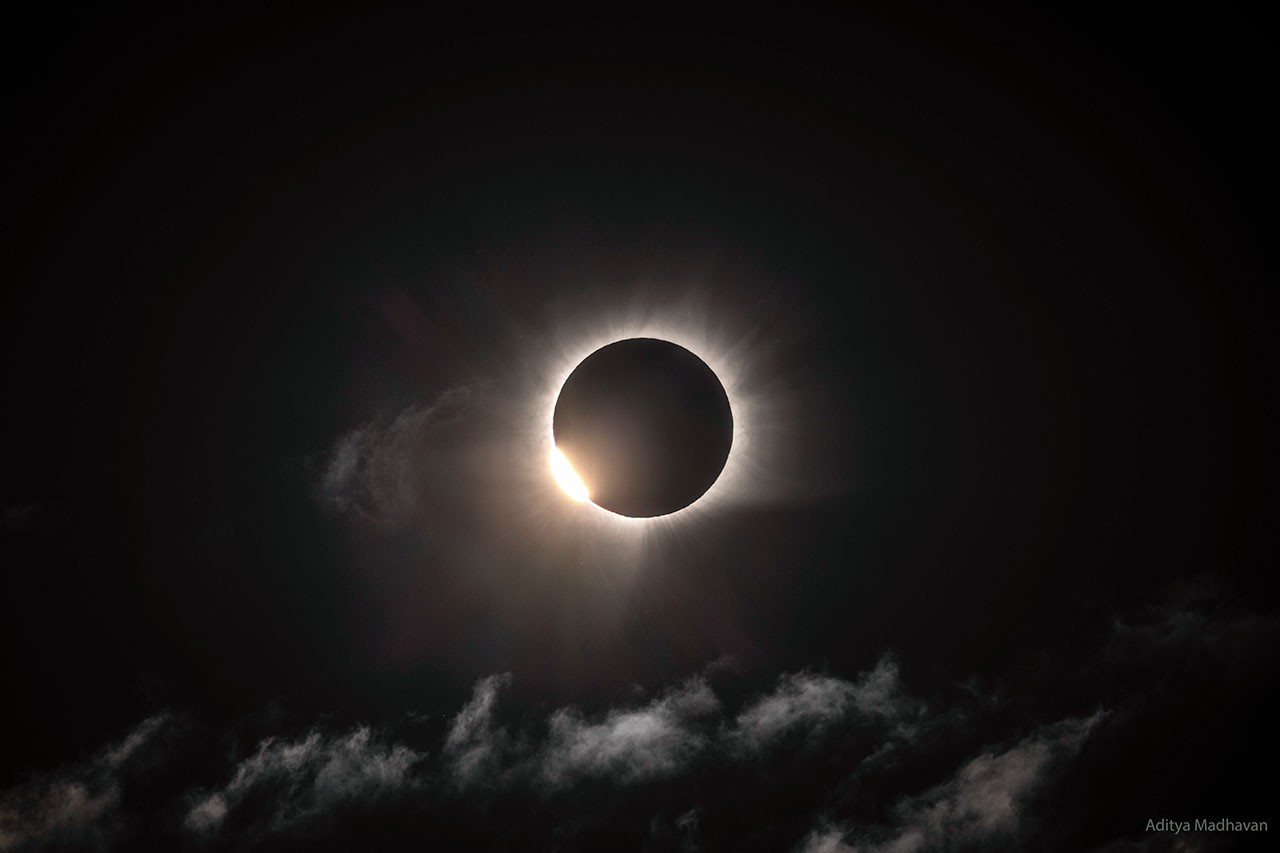
Capturing a total solar eclipse is never easy, but doing so in the Arctic presents unique challenges. The photographer, Aditya Madhavan, had to contend with unpredictable weather, treacherous seas, and the region's notoriously fickle cloud cover. After dodging storms by sea, Madhavan made a landing along Rype Fjord on Greenland's east coast, at coordinates 71.07055N, 27.71252W. The location was chosen for its potential to offer a break in the clouds at the critical moment—a gamble that paid off.
At 17:33:26 UTC, with the eclipse already underway, the skies parted just enough to reveal the totally eclipsed Sun. The image captured not only the magnificent solar corona but also one of the eclipse's transient diamond rings—a brilliant flash of sunlight that occurs just before and after totality. This fleeting effect, combined with the corona's ethereal glow, makes the photograph a stunning testament to the rewards of perseverance.

Scientific and Cultural Significance
Total solar eclipses have long fascinated scientists and the public alike. For astronomers, they provide a rare opportunity to study the Sun's corona—the outer atmosphere that is normally hidden by the Sun's bright surface. The corona's structure, temperature, and dynamics hold clues to fundamental questions about solar physics, including why it is millions of degrees hotter than the Sun's surface. Eclipses also offer a natural laboratory for testing theories of gravity and for observing the behavior of the Sun's magnetic field.
Culturally, eclipses have inspired awe and wonder across civilizations. From ancient myths to modern-day tourism, these celestial events unite people in a shared experience of the cosmos. The 2026 eclipse was no exception, drawing skywatchers from around the world to the path of totality. For those who missed it, the image from Greenland serves as a reminder of the beauty that awaits those who venture to the ends of the Earth.
The Art of Eclipse Photography
Capturing a total solar eclipse requires careful planning and technical skill. Photographers must balance exposure settings to capture both the faint corona and the bright diamond ring, often using multiple exposures and specialized filters. The fleeting nature of totality—lasting only a few minutes—adds to the challenge. In this case, the photographer had to work quickly as clouds threatened to obscure the view, making the successful shot even more impressive.
The image from Rype Fjord stands out not only for its scientific value but also for its artistic merit. The juxtaposition of the dark lunar silhouette against the pearly corona, with the diamond ring sparkling at the edge, creates a composition that is both dramatic and delicate. It is a reminder that science and art are often intertwined in the pursuit of understanding our universe.

Looking Ahead: Future Eclipses
While the August 12 eclipse has passed, skywatchers are already looking forward to the next opportunities. Total solar eclipses occur roughly every 18 months somewhere on Earth, but each one offers a unique vantage point and set of challenges. The next major eclipse is expected to cross parts of North Africa and the Middle East in 2027, followed by one in Australia and New Zealand in 2028. For those inspired by the Greenland image, these future events may be worth planning for.
As technology improves, so too does our ability to capture and share these cosmic events. High-resolution cameras, drones, and even spacecraft are providing new perspectives on eclipses, from the ground and from orbit. Yet, as the Greenland photograph demonstrates, there is still something irreplaceable about a human being standing in the shadow of the Moon, camera in hand, waiting for the clouds to part.
Conclusion
The total solar eclipse of August 12, 2026, will be remembered not only for its path across the Arctic and Europe but also for the stunning images it produced. The photograph taken from Greenland's Rype Fjord is a testament to the dedication of astronomers and photographers who go to great lengths to capture these fleeting moments. It offers a glimpse of the Sun's hidden beauty and reminds us of the dynamic universe we inhabit. As we continue to explore and document our cosmos, such images inspire curiosity and wonder, encouraging us to look up and appreciate the celestial dance above.
This article is based on reporting by science.nasa.gov. Read the original article.
Originally published on science.nasa.gov