Rocket Lab’s Neutron schedule is tightening as key tests loom
Rocket Lab is signaling that the first launch of its long-awaited Neutron rocket may move beyond 2026, a notable shift for a vehicle that sits at the center of the company’s push into medium-lift space transportation. In a filing ahead of its second-quarter 2026 earnings call, the company said production of the first-stage tank remains aligned with delivering Neutron to the launch pad in the fourth quarter of 2026, but it also made clear that the window for an end-of-year debut is getting smaller.
That wording matters. It does not amount to a formal delay announcement, but it does indicate that Rocket Lab is no longer presenting a late-2026 launch as a clean, high-confidence target. Instead, the company is framing the remaining timeline around the outcome of qualification work and other tests scheduled for later this year. In practice, that puts the first flight at risk of slipping into 2027 if any major subsystem needs additional work.
For Rocket Lab, Neutron is more than a new rocket. It is the vehicle meant to move the company beyond the small-launch niche it built with Electron and into a more competitive part of the launch market, where customers want larger payload capacity, regular flight opportunities, and eventually lower costs through reusability. That strategic importance is why even a modest schedule shift carries weight with investors, customers, and launch competitors.
Rocket Lab is emphasizing readiness over a symbolic first launch
The company’s latest comments suggest management is trying to avoid a familiar trap in launch development: rushing to fly once, then spending months or years reworking hardware before a serviceable cadence is possible. Rocket Lab founder and chief executive Peter Beck said on the earnings call that the company is thinking not only about getting to flight one, but about reaching flight ten as quickly as possible. That distinction is important because it shows Rocket Lab is treating first launch as one milestone in a broader operational ramp, not as the end point.
Beck tied that approach directly to reusability. Neutron is designed as a reusable, liquid methane-fueled launch vehicle with a first stage that returns for reuse and a distinctive fairing approach in which the fairing halves remain attached to the booster after upper-stage separation. For Rocket Lab, making that system work reliably is not just an engineering objective. It is the feature that could determine whether Neutron becomes a commercially meaningful launcher rather than a technically interesting one.
The company’s current tradeoff appears straightforward: preserve schedule where possible, but not by under-qualifying systems that would later have to be redesigned or retested before higher flight rates are achievable. That may disappoint observers who expected a clearer countdown to launch, yet it also reflects a more mature reading of how difficult new launch vehicles are to bring online.
A January tank failure still hangs over the program
The narrowing launch window comes after a setback earlier this year. On Jan. 21, Rocket Lab’s first-stage fuel tank ruptured during a hydrostatic pressure trial, a water-loading test used to validate structural performance. That failure already pushed the expected debut from mid-2026 to late 2026. The new language suggests the company has not fully absorbed the schedule consequences of that event, or at minimum is leaving room for more movement depending on how downstream testing unfolds.
Development programs often look linear from the outside, but large launch vehicles rarely progress that way. A tank rupture can affect more than one item on a calendar. It can force redesign checks, change validation sequences, consume test hardware, and compress the time available for later integrated milestones. Even when a company recovers quickly, the lost margin tends to show up near the end of the schedule, which is exactly what Rocket Lab is now describing.
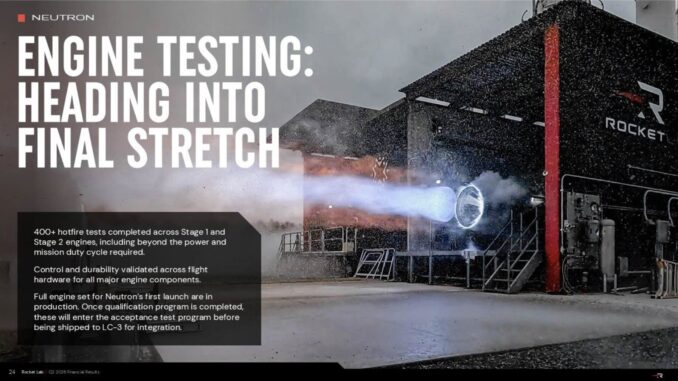
To its credit, Rocket Lab also said it has made significant milestones across the Neutron program, and a slide shared with investors highlighted progress in engine testing. That matters because Neutron is not a stalled program. It is moving forward, but under the kind of schedule pressure common to complex aerospace systems nearing first flight.
Why the market is watching closely
Neutron has been in development since Rocket Lab announced it in March 2021. Over that time, the company has built a reputation for reliable small-launch operations, spacecraft manufacturing, and a disciplined engineering culture. The next question is whether it can transfer that credibility into a larger-class rocket program, where development costs are higher and the commercial stakes are sharper.
If Neutron reaches service with a reusable first stage and dependable turnaround, Rocket Lab would gain a stronger position in national security, civil, and commercial missions that require more lift than Electron can provide. It would also give the company a more complete product stack, letting it compete for a wider range of contracts while keeping more mission value in-house.
But timing matters. A slip from late 2026 into 2027 would not automatically damage the program, yet it would delay revenue opportunities and extend the period in which Rocket Lab is funding development without operational return. It could also test customer patience if manifest planning depends on Neutron’s availability.
At the same time, the company appears to be making a deliberate argument: a slightly later first flight may be preferable to an early launch that produces a vehicle unready for full-scale production and frequent operations. That is not an unusual stance in launch development, but it is one that only pays off if the extra time clearly improves readiness and reduces later disruption.
The next milestones will define whether 2026 holds
Rocket Lab’s own wording points to the decisive variables. First-stage qualification and other critical tests later in 2026 will determine whether the company can preserve a year-end launch attempt. If those tests proceed cleanly, Neutron could still reach the pad in time for a debut before the calendar turns. If not, the most plausible outcome is a first launch in 2027.
That puts the program in a narrow but familiar phase: major enough progress to keep the target alive, but not enough remaining schedule margin to absorb much additional trouble. For Rocket Lab, the challenge now is not only technical execution. It is demonstrating that its development discipline can produce a launch system built for repeated operations, not just a one-off milestone flight.
The result will shape how the company is judged in its next chapter. Electron proved Rocket Lab could build and operate rockets. Neutron is the program that will test whether it can scale that model into a larger, reusable launch business.
This article is based on reporting by Spaceflight Now. Read the original article.
Originally published on spaceflightnow.com