Even after MAVEN’s end, Mars is still giving up new secrets
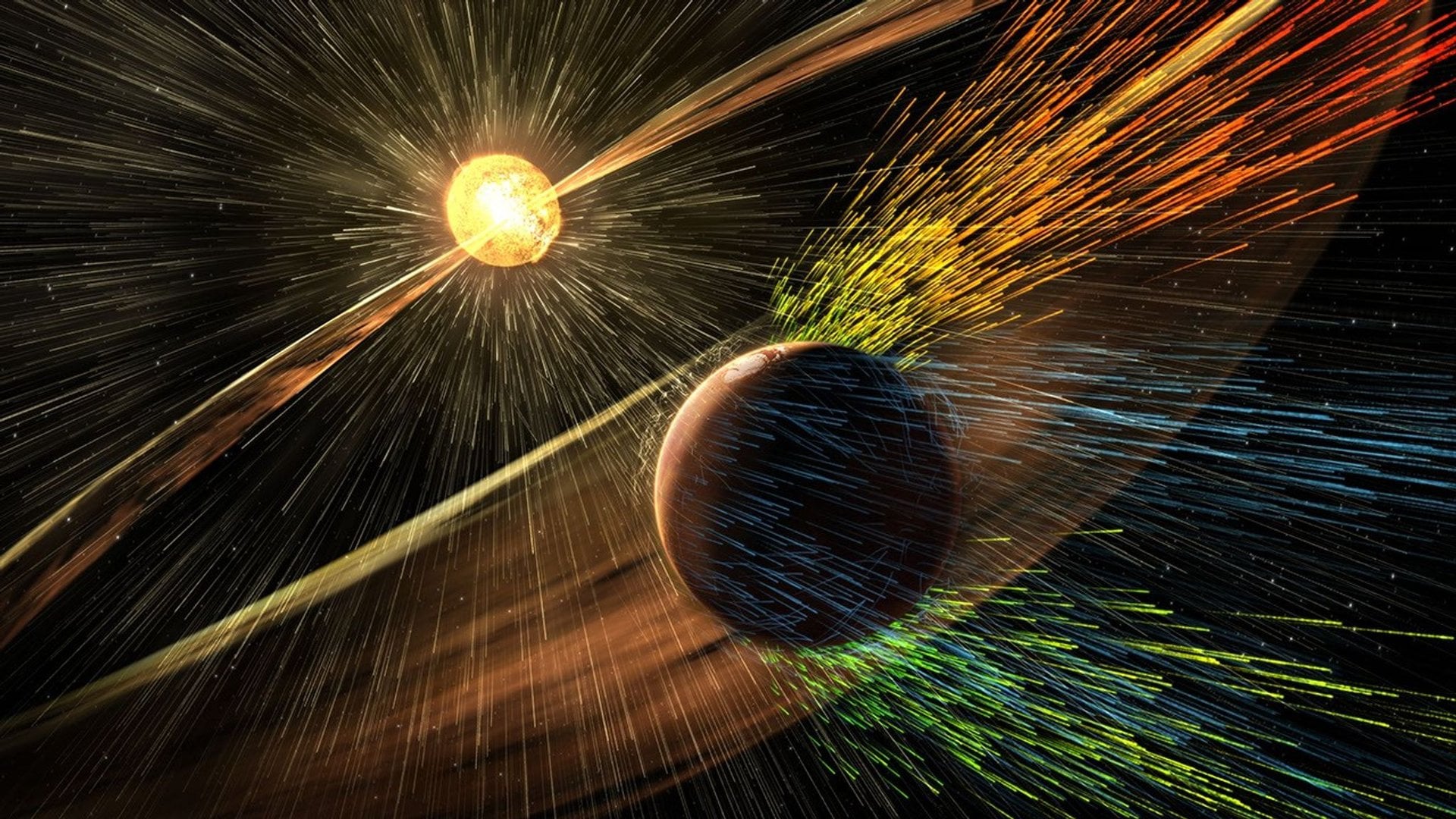
NASA’s MAVEN mission has officially ended, but the spacecraft’s scientific legacy continues to expand. A new study based on MAVEN observations reports that some auroras on Mars form through a process similar to the one that drives auroras at Earth, offering a sharper picture of how solar particles interact with the Red Planet’s fragmented magnetic environment.
The finding comes from a paper published July 23, 2026, in Nature Communications, titled “Miniature Dungey-like cycle at Mars.” Researchers led by scientists at the University of California, Berkeley, used data from multiple MAVEN instruments to conclude that a Mars-scale version of the Dungey Cycle is taking place. On Earth, that cycle describes how magnetic reconnection and plasma circulation help route charged particles from the solar wind into the upper atmosphere, where they can trigger auroras.
The result matters because Mars is not supposed to behave like Earth in the obvious way. Earth has a global magnetic field that channels charged particles toward the poles. Mars does not. Its planet-wide magnetic dynamo shut down billions of years ago, leaving behind only localized crustal magnetic fields. Yet the new study indicates that at least some of the same underlying electrodynamic logic still applies, just at much smaller scales and within a much more patchy magnetic setting.
How auroras form on two very different worlds
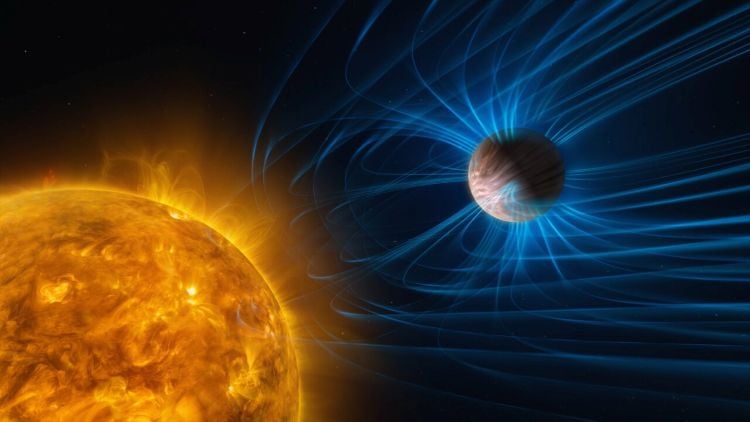
On Earth, auroras are tied to a large, global magnetosphere. When the Sun’s magnetic field encounters Earth’s, the field lines can reconnect. That process injects solar wind particles into the magnetosphere and magnetotail, helping drive electric currents and plasma circulation. Electrons can then be accelerated back into the atmosphere, where they collide with atmospheric constituents and generate the familiar polar lights.
The Dungey Cycle, first described by British space scientist James Dungey in 1961, is central to that picture. It explains the circulation of plasma in Earth’s magnetosphere and upper atmosphere and the pathways by which solar energy is converted into auroral displays.
Mars presents a much harder case. The planet no longer has a global magnetic shield. Instead, it retains only isolated magnetic regions associated with intensely magnetized sections of crust. These are remnants of an ancient field preserved in rock from a time when Mars was more geologically active. Because those crustal fields are scattered rather than global, any auroral process operating on Mars would be expected to look more fragmented and localized than Earth’s sweeping polar curtains.
That is exactly what the new analysis suggests. The mechanism appears to be similar in kind, but miniaturized in scale. Instead of a planet-wide magnetic engine channeling particles toward large polar zones, Mars uses small magnetic pockets that can still reconnect with the solar wind and create localized auroral events.
Why this matters beyond the light show
Auroras are visually striking, but for planetary scientists they are also diagnostics. They reveal how magnetic fields, charged particles, and atmospheres interact. On Mars, those interactions are especially important because the planet is steadily losing atmospheric particles to space.
MAVEN, short for Mars Atmosphere and Volatile Evolution, spent more than a decade studying exactly that problem. The mission examined how the solar wind strips away the Martian atmosphere and how the absence of a global magnetic field shapes that loss. Even though contact with the orbiter was lost in December 2025 and the mission officially ended on June 3, 2026, the accumulated data set remains rich enough to support new discoveries.
The aurora result fits squarely into that broader scientific goal. If researchers can map how solar particles are guided into the upper atmosphere, they gain a better handle on how Mars exchanges energy and charged matter with surrounding space. That, in turn, helps clarify how the planet’s climate and atmosphere evolved over geological time.
The new work also sharpens a recurring lesson in comparative planetology: a planet does not need to be a smaller or larger copy of Earth to share pieces of the same physics. Mars differs from Earth in major structural ways, yet the study suggests that magnetic reconnection and plasma circulation can still organize themselves into an Earth-like pattern under very different boundary conditions.
A miniature cycle, not a perfect copy
The study does not claim Mars has an Earth-style magnetosphere. The distinction is important. Earth’s magnetic field is generated by a still-active dynamo in its interior, involving motion in a molten outer core around a solid inner core. Mars lost that global field roughly 4 billion years ago as core activity waned. The crustal magnetic regions left behind are relics, not a functioning whole-planet shield.
That means the Martian version of the Dungey Cycle is necessarily partial and localized. The researchers describe it as miniature for good reason. What is being observed is not a scaled-down duplicate of Earth’s system, but a Dungey-like process operating within isolated magnetic structures. The analogy is powerful because it provides a familiar framework, yet the limits of the analogy are equally revealing. They show how robust some plasma processes are, even when the planetary setting changes dramatically.
In practical terms, that helps explain why Martian auroras can occur without the planetary magnetic architecture scientists usually associate with auroral activity. The crustal fields appear sufficient to create local magnetospheres that reconnect with incoming solar magnetic fields and drive auroral particle precipitation.
The afterlife of a spacecraft mission
There is also a quieter institutional story here. Space missions rarely end when spacecraft operations cease. Their data archives often outlive them by decades, and some of the most important scientific syntheses arrive only after teams have had years to compare measurements, refine methods, and revisit earlier assumptions.
MAVEN is now entering that phase. Its operational chapter has closed, but its observational record is still being mined for answers about atmospheric escape, solar-wind interaction, and Mars’ magnetic history. The new aurora study is a strong example of how mission value can continue after hardware is silent.
That matters for future Mars science as well. The better researchers understand the planet’s near-space environment, the better they can interpret surface history, atmospheric evolution, and the challenges facing future robotic or human exploration. Charged-particle behavior, solar storms, and atmospheric loss are not isolated topics. They are connected pieces of a larger story about how Mars changed from a more Earth-like early world into the cold, thin-aired planet seen today.
A clearer picture of a magnetic patchwork planet
The headline result is simple, but consequential: Mars can produce auroras through a mechanism that resembles the one operating at Earth. The difference is that Mars does so through a fractured magnetic patchwork rather than a unified global field.
That insight gives scientists a more coherent framework for understanding Martian auroras and a better tool for connecting those light displays to the planet’s broader atmospheric evolution. It also extends the scientific impact of MAVEN, a mission whose data continue to reshape understanding of Mars even after the spacecraft’s end.
- A study in Nature Communications reports a “miniature Dungey-like cycle” at Mars.
- The finding is based on data from NASA’s MAVEN mission, which officially ended on June 3, 2026.
- Researchers say some Martian auroras form through a process similar to the one that drives auroras on Earth, but on much smaller scales.
This article is based on reporting by Universe Today. Read the original article.
Originally published on universetoday.com