Public Webb data yields another possible window into the young universe
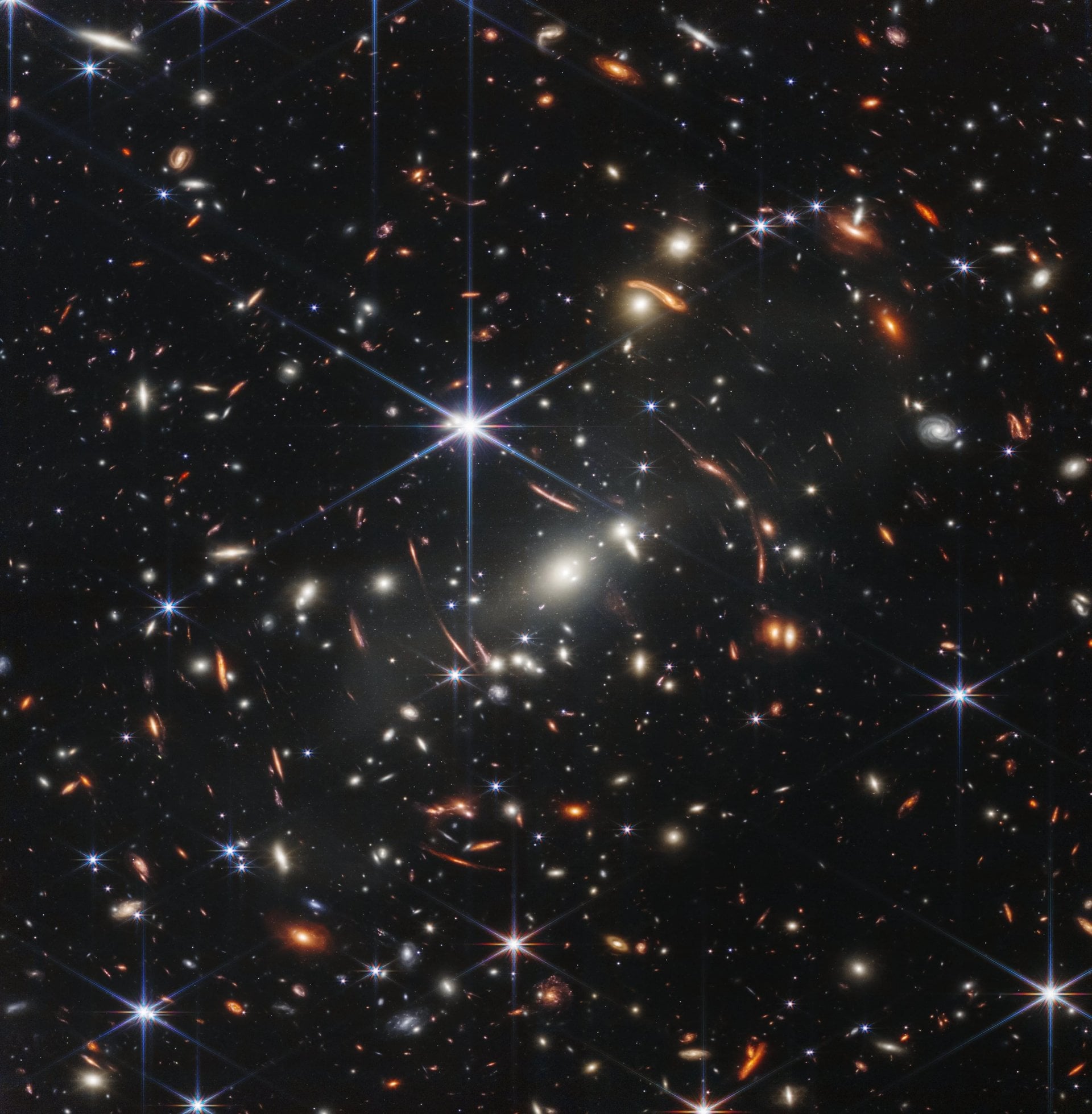
Astronomers continue to find new scientific value in the growing public archive of observations from the James Webb Space Telescope, and a newly reported gravitational arc candidate is the latest example. Working with archival data from Webb’s Near-Infrared Camera, astrophysicist Homer Dávila Gutierrez identified a candidate object in the galaxy cluster MACS J0308.9+2645 that may represent a distant young-universe galaxy whose light has been magnified and distorted by gravitational lensing.
The finding adds to the scientific importance of a field already known for showing how massive foreground structures can reveal far more distant objects. MACS J0308.9+2645 had previously been recognized as a rich target because its gravitational field bends and amplifies light from galaxies located much farther away. Those background sources can appear as stretched and curved arcs, giving researchers a method for spotting objects that would otherwise be too faint to study.
In this case, the candidate arc, labeled A1, emerged from a broad search through public observations rather than from a newly scheduled telescope campaign. That detail matters. It shows how major observatories now generate long-tail discoveries well after the first images are released, as researchers continue mining high-quality datasets for patterns that were missed the first time around.
Why gravitational arcs matter
Gravitational lensing is one of the most useful consequences of general relativity for observational astronomy. Massive objects curve spacetime, and light passing through that curved region follows the distortion. In practice, that means a galaxy cluster in the foreground can function like a natural cosmic lens, brightening and reshaping the appearance of a background source.
For astronomers trying to study the early universe, that effect is invaluable. Very distant galaxies are faint, small and often hard to separate from surrounding noise. A strong lens can magnify them enough to become visible, while also producing distinctive shapes that help flag them for further analysis.
MACS J0308.9+2645 is already known as one of these productive lensing environments. Earlier observations from Hubble and then Webb had revealed multiple gravitational lenses in the field, including distant galaxies dating back to a period when the universe was only about 1 billion years old. The new candidate suggests the cluster may still hold additional overlooked sources.

What made A1 stand out in the archive
According to the report, Gutierrez examined 54 public JWST/NIRCam fields and evaluated 1,591 possible candidates. Of that large set, only A1 was judged a robust gravitational arc candidate. That high rejection rate is part of what gives the result weight. The object did not emerge from a casual visual scan but from a process that compared many possibilities and narrowed them to one especially compelling case.
The candidate reportedly showed the kind of elongated, curved structure expected from a lensed source. The report highlights one specific characteristic: an extreme elongation, with an axis ratio of roughly 6.5, aligned tangentially in a way consistent with lensing geometry. In other words, the object’s shape is not merely unusual. Its morphology appears to match what astronomers would expect if the light were being stretched by the mass distribution of the foreground cluster.
That does not yet make A1 a confirmed early-universe galaxy. The current description is careful to call it a candidate. But candidate status is not trivial. In astronomy, especially when dealing with distant and faint sources, candidate identification is often the necessary first step toward more detailed follow-up work, modeling and confirmation.
The significance of finding one robust candidate out of many
One of the more interesting aspects of the report is methodological rather than visual. The search covered many public fields and a very large pool of possibilities, yet only one object was considered robust. That suggests two things at once.
First, genuinely strong lensing candidates may be rare even in powerful data from Webb. The telescope can reveal extraordinary detail, but not every elongated source is a meaningful arc. Careful filtering still matters. Second, public data remains fertile ground for patient, targeted analysis. Major discoveries do not always depend on exclusive access or brand-new observations. Increasingly, they can come from asking sharper questions of existing datasets.
This shift is helping reshape how astronomy is done. Public observatory archives are becoming research platforms in their own right, not just records of completed missions. A scientist with the right tools and persistence can revisit a known field and produce a new result that extends the value of the original observation.
What this says about Webb’s role in the post-Hubble era
Webb’s impact is often summarized in terms of sharper images and deeper infrared sensitivity, but the larger story is about scientific reach. The telescope is expanding the practical search space for early-universe studies by making faint, distant structures easier to detect and characterize. When those capabilities are combined with gravitational lensing, the result is an especially powerful way to probe epochs that are otherwise difficult to access.
The report also underscores continuity between space observatories rather than simple replacement. Hubble first helped establish the importance of the field. Webb, using improved instrumentation, has deepened that view and made fresh discoveries possible. The relationship is cumulative: older survey knowledge guides where to look, and newer capabilities improve what can be found.
What comes next
The immediate scientific question is whether A1 can be confirmed as a genuine lensed source from the early universe. That would require further analysis beyond the initial identification described in the report. Even so, the candidate already has value as a signal that well-studied cluster fields may still contain additional hidden structure.
More broadly, the discovery points to an increasingly important pattern in modern astronomy. The era of flagship observatories is also an era of archival science. Public access, high-resolution imaging and systematic reanalysis are combining to produce discoveries long after the first release cycle passes.
If A1 is confirmed, it would strengthen the case that MACS J0308.9+2645 remains a productive lensing laboratory for studying the young universe. Even before confirmation, the result shows that Webb’s archive is not static. It is an active frontier, and researchers are still learning how much information is waiting inside it.
This article is based on reporting by Universe Today. Read the original article.
Originally published on universetoday.com