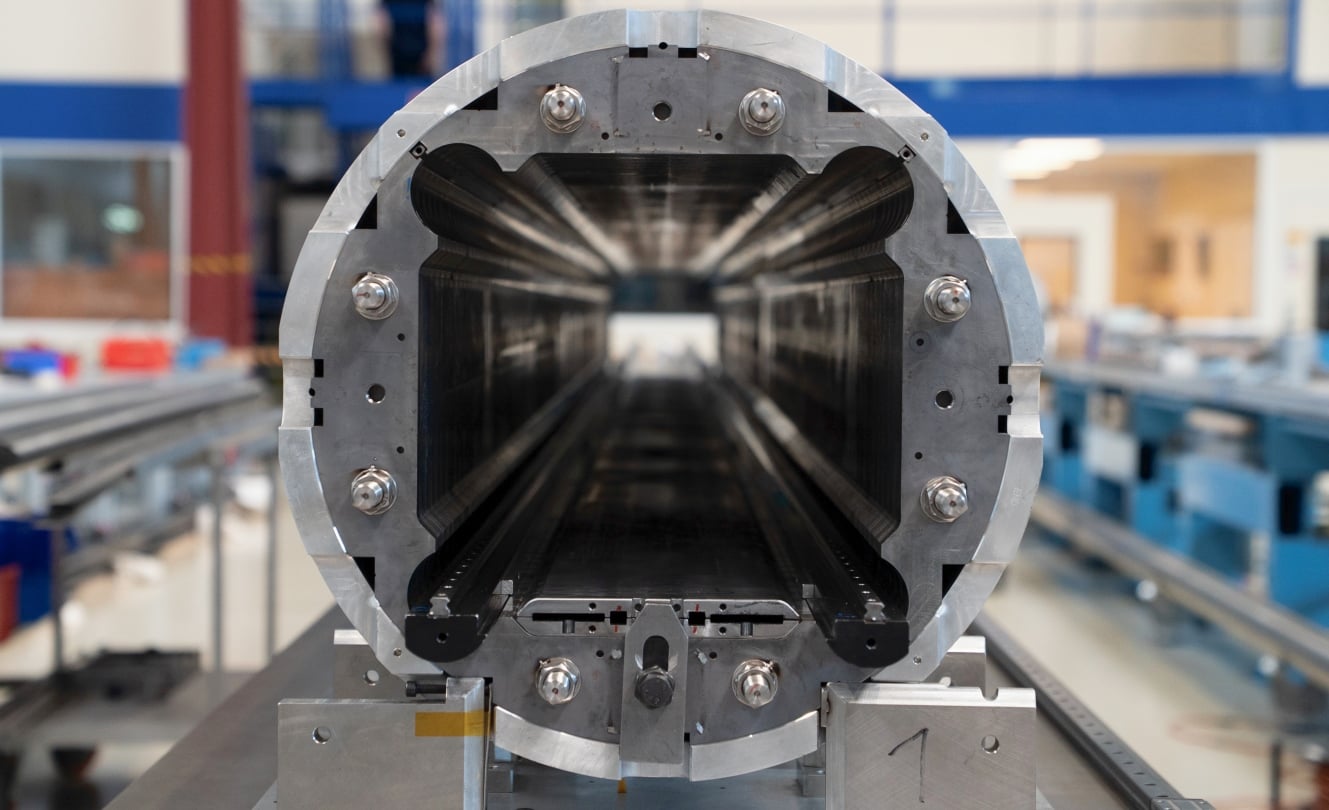
The world’s best-known particle collider is entering its next phase
CERN has shut down the Large Hadron Collider after nearly 18 years of operation, closing one chapter in modern physics while beginning a major rebuild intended to extend the machine’s scientific life well into the next decade. The collider is not being retired in the ordinary sense. Instead, it is being reworked into the High-Luminosity LHC, an upgraded version due to begin operations in 2030 with as much as 10 times the luminosity of the current machine.
That makes this shutdown less an ending than a strategic pause. CERN officials are framing the moment as a transition from the LHC as researchers have known it since 2008 to a substantially improved instrument that can generate far more particle collisions and capture far more data from them. For a machine that already played a central role in one of the century’s biggest scientific discoveries, that is a consequential handoff.
Why CERN is stopping now
The source text describes the move as a four-year upgrade period centered on an extensive hardware overhaul inside the collider’s existing 17-mile, or 27-kilometer, ring along the French-Swiss border. Workers will install next-generation magnets designed to sharpen the focus of the proton beams. The point of that change is to dramatically increase the collision rate, or luminosity, which in collider physics determines how many interactions experiments can observe over time.
Higher luminosity does not mean replacing the LHC with a completely different tunnel or entirely new site. The ring itself remains the same. What changes is the sophistication of the systems inside it and the detector infrastructure that must cope with a much denser stream of events. CERN officials are effectively rebuilding the machine’s performance envelope while preserving the broader architecture that made the original collider possible.
The upgrade also extends to the LHC’s major detectors. According to the source text, the ATLAS and CMS detectors will be rebuilt so they can monitor more than 5 billion interactions per second and select the most interesting collisions for deeper analysis. That step is essential because more collisions only become scientifically useful if the instruments can sort through the resulting flood of data quickly and reliably.

The legacy of the original LHC
The decision to halt operations lands with unusual symbolic weight because of what the LHC has already accomplished. Since first starting up in 2008, the collider has been one of the defining scientific instruments of the era. It gave physicists a way to explore matter under extreme conditions and at unprecedented energies, opening windows onto the behavior of subatomic particles and the early universe.
Its most famous achievement came in 2012, when scientists presented evidence for the Higgs boson. The Higgs had long been predicted by theory, but detecting it required the energy and precision that the LHC could provide. The discovery filled in the last missing fundamental particle predicted by the Standard Model of particle physics and helped confirm the mechanism associated with particle mass through the Higgs field.
That breakthrough turned the LHC into more than a high-profile research machine. It became a symbol of what large-scale international science can accomplish when governments and institutions sustain an ambitious project over decades. The source text also notes that the collider has been used to investigate phenomena including quark-gluon plasma, which is thought to resemble conditions just after the Big Bang, and the imbalance between matter and antimatter in the cosmos.
Those achievements explain why CERN’s announcement carries a note of ceremony. Oliver Bruning, CERN’s director for accelerators and technology, said the LHC had exceeded expectations and transformed understanding of the universe for nearly two decades. The message is both retrospective and forward-looking: the existing machine delivered on its promise, and the upgrade is meant to expand that scientific adventure rather than conclude it.
What high luminosity is supposed to unlock
The central promise of the High-Luminosity LHC is not a single guaranteed discovery but a much richer experimental environment. More collisions mean more chances to observe rare processes and to measure known phenomena with greater precision. In practice, that should allow physicists to deepen their study of the Higgs boson, which remains one of the most important entry points for testing where the Standard Model succeeds and where it may fall short.
The source text says scientists expect the upgraded collider to add substantially to their understanding of how the Higgs works. That alone would be significant. The Higgs boson may already have been discovered, but understanding its properties in detail is an ongoing project, and those details matter because deviations from theoretical expectations could point toward new physics.
Researchers are also hoping the High-Luminosity LHC will help expose evidence beyond the Standard Model. The source text specifically mentions the possibility of supersymmetry and exotic dark matter particles. Those are longstanding targets for particle physicists because the Standard Model, despite its predictive power, does not answer every major question. It does not fully account for dark matter, for example, nor does it provide a final explanation for several deeper structural features of the universe.
More luminosity improves the odds of catching extremely rare events that could illuminate those open problems. It also makes it easier to test subtle effects statistically by producing vastly larger datasets. In that sense, the upgrade is a wager that the next breakthroughs may come not from building an entirely different collider right now, but from pushing the current one much harder and much further.

A long pause with a long horizon
The four-year shutdown is substantial, and the 2030 target underscores how slowly big-science infrastructure moves. But that timescale is normal for an instrument of this complexity. Magnets, detectors, beam systems, and analysis pipelines all have to be redesigned and installed with extraordinary precision. The result is that the shutdown period is itself part of the experiment’s scientific arc, not merely downtime between runs.
For CERN, the challenge is to preserve public and political support through a stretch when the world’s most famous collider is not generating fresh collision data. The institution’s answer is to cast the pause as preparation for a more capable successor inhabiting the same ring. The High-Luminosity LHC is therefore being presented almost as a new machine, even though it grows directly out of the old one.
That framing is persuasive because the scientific jump appears meaningful. A collider operating with up to 10 times the luminosity of the original is not a minor refresh. It is a deliberate attempt to turn an already historic instrument into a sharper, more productive probe of fundamental physics.
What comes next
The original Large Hadron Collider helped confirm the Higgs boson and broadened humanity’s ability to test the subatomic structure of reality. The next version is being built to go further: to capture more collisions, measure more precisely, and perhaps expose phenomena the current machine could not cleanly resolve. Whether it finds entirely new particles or simply constrains theories more tightly, the upgraded collider will shape particle physics through the 2030s.
For now, CERN’s message is simple. The LHC as the scientific world has known it since 2008 is done. In its place, engineers and physicists are preparing a high-luminosity successor designed to extract much more from the same ring. If the original machine’s legacy was discovery, the next one’s mission will be depth.
This article is based on reporting by Universe Today. Read the original article.
Originally published on universetoday.com