A potential supernova remnant has emerged in one of the galaxy’s most extreme neighborhoods
Astronomers studying the center of the Milky Way have identified what may be a supernova remnant in Sagittarius C, a star-forming region near the galaxy’s supermassive black hole. If confirmed, the object would rank among the closest known supernova remnants to the black hole at the Milky Way’s center, placing it in one of the most dynamic and difficult-to-interpret environments in the galaxy.
The candidate object was identified using X-ray observations from NASA’s Chandra X-ray Observatory alongside data from the European Space Agency’s XMM-Newton mission. Researchers also drew on radio observations from MeerKAT in South Africa and optical observations from Pan-STARRS in Hawaii to build a broader picture of the region.
Why Sagittarius C matters
Sagittarius C sits on the western edge of the central molecular zone, a dense and active region near the galactic center. This part of the Milky Way is packed with massive stars, gas clouds, and unusual magnetic structures. It is also scientifically valuable because the conditions there differ sharply from the more familiar environments astronomers study elsewhere in the galaxy.
That context makes any possible supernova remnant especially interesting. Supernova remnants are not just the leftovers of stellar explosions. They are also chemical engines that distribute heavy elements such as iron, oxygen, and silicon into surrounding space. Those elements later become part of new stars, planets, and, ultimately, the material conditions needed for life.
Finding such a remnant near the galactic center could therefore help researchers understand both stellar death in an extreme environment and the way matter cycles through one of the Milky Way’s most active regions.
What the observatories saw
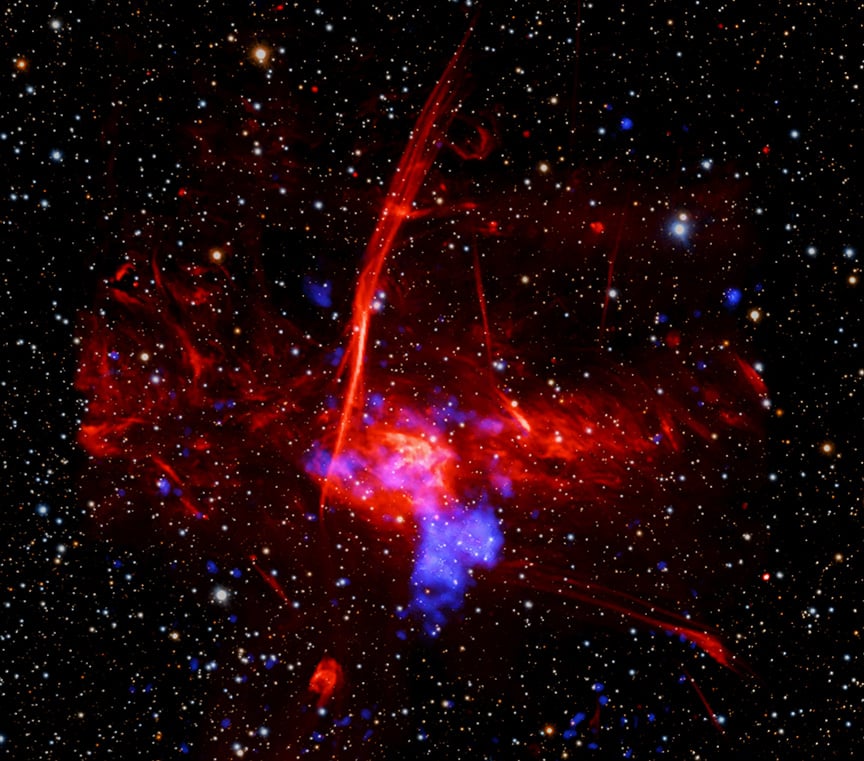
The supplied source text describes a composite image combining X-ray, radio, and optical data. In that image, a large blue area of X-ray emission appears as a blob that researchers believe may be evidence of the suspected supernova. The candidate remnant is associated with Sagittarius C, which is also described as a bubble of ionized hydrogen surrounding a massive, young star.
That ionized hydrogen region, known as an H II region, glows brightly in radio wavelengths because radiation from the young star strips electrons from surrounding hydrogen atoms. Against that already complex backdrop, astronomers are trying to determine whether the observed X-ray structure represents the remains of a supernova explosion.
The same composite image includes long radio filaments caused by energetic particles moving along magnetic field lines. One especially notable bundle stretches perpendicular to the Milky Way’s plane, underscoring how magnetically unusual the galactic center can be.
Earlier clues came from an expanding gas shell
The new X-ray evidence did not emerge in isolation. Previous observations with NASA’s now-retired Stratospheric Observatory for Infrared Astronomy, or SOFIA, had already suggested that an expanding gas shell surrounds Sagittarius C. That shell provided an earlier hint that a supernova may have occurred there.
The new study appears to build on that foundation by testing whether other classic signatures of a supernova remnant are present. In principle, a stellar explosion should leave behind not only an expanding structure but also chemical traces in the debris field.

Why confirmation is still difficult
The case is not closed. According to the supplied text, the team searched Chandra’s X-ray data for enhanced amounts of heavy elements, a common sign of supernova material, but did not find clear evidence of those elements. That absence might appear to weaken the interpretation, yet the researchers point to a plausible explanation: the debris may already have mixed with its surroundings.
That is a serious possibility in the galactic center, where turbulence, dense gas, and complex local conditions can rapidly blur the clean signatures astronomers often rely on. In calmer regions, a supernova remnant may stand out more clearly as an expanding shell enriched in heavy elements. Near the Milky Way’s central black hole, the environment is much messier.
As a result, the object remains a possible supernova remnant rather than a confirmed one. The distinction matters. The available evidence supports the interpretation, but it does not yet make it definitive.
What scientists could learn if it is confirmed
If the remnant is real, it could provide a rare laboratory for studying how supernova aftermath evolves near a supermassive black hole. That would be valuable because the X-ray properties of the region are described in the source text as not well understood.
Researchers could use the object to probe how shock waves move through dense molecular material, how stellar debris interacts with strong magnetic fields, and how feedback from dying stars shapes star-forming zones close to galactic centers. It may also help clarify whether supernova remnants look different in such environments than they do elsewhere in the Milky Way.
More broadly, the finding would add to astronomers’ efforts to understand the Galactic Center as a system. That region is not just the home of a black hole. It is a crowded ecosystem in which star formation, stellar death, gas dynamics, and magnetic structures all influence one another.
A cautious but meaningful result
Even in its current tentative form, the result is scientifically meaningful. The presence of a candidate remnant in Sagittarius C highlights how much remains unresolved in the inner Milky Way. It also shows the value of combining data across observatories and wavelengths, especially in places where no single instrument can tell the full story.
For now, the object remains a strong candidate rather than a settled discovery. But if future observations confirm that a supernova exploded near Sagittarius C, astronomers will have gained an unusually close view of how violent stellar events unfold in the shadow of the galaxy’s central black hole.
This article is based on reporting by Universe Today. Read the original article.
Originally published on universetoday.com