NASA narrows its lunar rover goal to speed up astronaut mobility on the Moon
NASA is reshaping one of the most practical parts of its Moon return plan: how astronauts will actually move around once they arrive. Two companies, Astrolab and Lunar Outpost, are now racing to deliver next-generation lunar terrain vehicles on a faster timetable after the agency selected them in late May to pursue simpler rover designs that could be deployed ahead of the Artemis 4 crewed mission.
The change matters because surface mobility is not a side project for the Artemis program. If NASA wants a sustained human presence near the Moon’s south pole, astronauts need a reliable way to travel between landing zones, work sites, and infrastructure. Rovers expand the radius of exploration, reduce the burden of moving equipment by hand, and make it more realistic to carry out repeated missions in a harsh environment where every hour and every kilogram counts.
According to the source report, NASA originally set up a competition in 2024 that would have led to one lunar terrain vehicle provider. That plan has now shifted. Rather than pressing immediately for a more durable vehicle designed to survive on the lunar surface for as long as a decade, NASA asked the companies to propose a simpler rover that could be ready sooner and delivered on a tighter schedule.
The new target is aggressive. NASA wants the vehicles delivered next year, with the companies aiming to support the first crewed Artemis lunar landing phase now scheduled for early 2028. In practical terms, this reflects a broader tradeoff inside the Artemis architecture: a less ambitious first operational rover may be preferable if it gets to the Moon in time to be useful for early crews.
Why NASA changed course
The revised plan appears to be driven by schedule realism and operational urgency. Building a rover that can endure a decade on the Moon is a different challenge from building one that can support nearer-term astronaut activity. Long-life systems require stronger protection against the lunar environment, more robust maintenance assumptions, and greater design complexity. A simpler vehicle reduces those demands and gives NASA a chance to field mobility capability sooner.
That timing could be especially important if Artemis surface missions are to do more than brief visits near the landing site. NASA officials said the rovers would be kept about 2 kilometers away when landers touch down in order to protect them from plume-surface interaction. From there, the vehicles would travel in to pick up crews, support missions of up to about 10 kilometers during a crewed period, and accumulate as much as 400 kilometers over their operating lifetime when uncrewed traverses are included.
Those numbers show how NASA is thinking about lunar operations as a logistics problem as much as an exploration challenge. The rover is not just transportation for astronauts. It is part of a wider system that has to survive landings nearby, move between assets, and keep working without constant human presence.

Two companies, two paths, one deadline
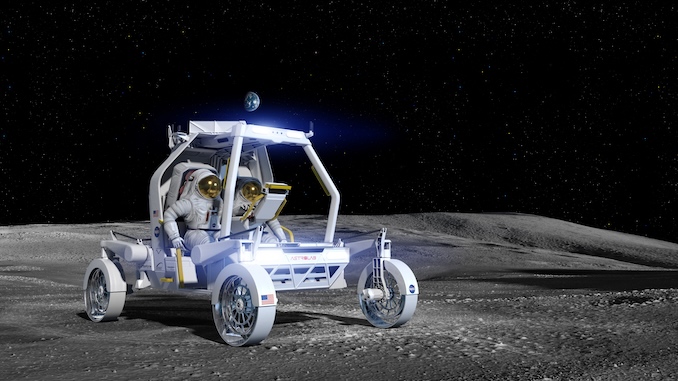
Astrolab’s entry is called the Crewed Lunar Vehicle, or CLV-1. The company is building on work it has already done on its Flexible Logistics & Exploration rover, known as FLEX, as well as a smaller vehicle called the FLEX Lunar Innovation Platform, or FLIP. That earlier work gives Astrolab a head start because several design elements were already intended to inform a future crewed rover.
Astrolab founder and chief executive Jaret Matthews said FLIP was always meant to function as a test bed for the lunar terrain vehicle effort. In the source report, he pointed to large tires, powerful wheel actuators, and large batteries as examples of hardware choices that were made with an eventual crew-capable rover in mind. Even with that foundation, he said there is still substantial work ahead.
That distinction is important. NASA is not selecting between paper concepts alone. It is leaning on companies that have already been pushing hardware toward flight or test readiness, which may improve the odds of meeting the schedule. At the same time, prior work does not remove the difficulty of adapting technology for human-rated lunar operations.
The source report also notes that FLIP is scheduled to fly on Astrobotic’s Griffin-1 mission later this year. Both the lander and the rover were said to be in final environmental testing before integration activities at Kennedy Space Center. If that mission proceeds as planned, it could provide useful operational and engineering experience that feeds directly into the crewed vehicle effort.
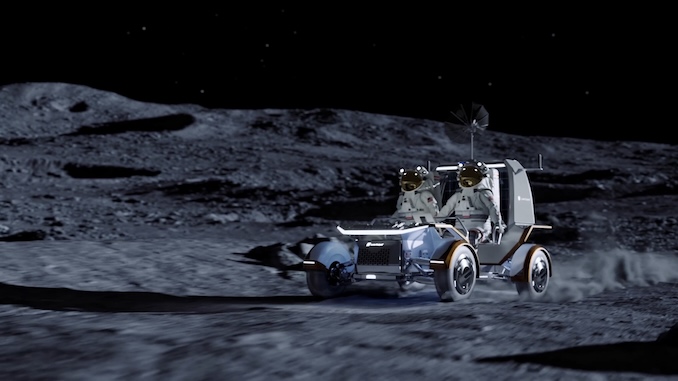
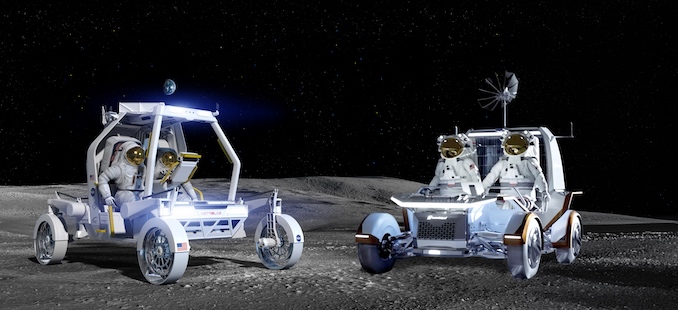
Lunar Outpost is the other company selected for this accelerated track, with its vehicle referred to as Pegasus in the report’s illustration caption. While the provided source text contains fewer technical details about Lunar Outpost’s approach, its inclusion underscores NASA’s desire to preserve competition while avoiding the risk of relying on a single supplier too early.
What this means for Artemis surface operations
The rover program highlights a central tension in Artemis planning. NASA’s long-term objective is expansive: a Moon Base near the lunar south pole supported by repeated missions and growing infrastructure. But the nearer-term mission set depends on a chain of capabilities arriving in the right order and at the right maturity level. A delayed rover would not necessarily end a crewed landing, but it could sharply limit what astronauts are able to accomplish once they are there.
By asking for vehicles that are simpler and faster to deploy, NASA is effectively prioritizing usable capability over maximal durability. That is a familiar decision in large space programs, where schedules slip when systems are asked to do too much too soon. A rover that can function through early Artemis missions, support crew pickup after landing, and extend astronaut traverses across the surface may be more valuable right now than a more ambitious design that arrives late.
The focus on distance and lifetime also suggests that NASA wants these vehicles to bridge the gap between short sortie-style missions and more persistent surface operations. Ten-kilometer mission ranges may not sound expansive by terrestrial standards, but on the Moon they can substantially widen the scientific and operational envelope around a landing zone. Over multiple missions, the ability to cover hundreds of kilometers without a human driver aboard could also improve site scouting, equipment repositioning, and pre-crew preparation.
Much still depends on whether either company can deliver on the compressed timeline. The provided report makes clear that the work is underway, but it also makes clear that significant development remains. For NASA, this is a calculated attempt to reduce complexity without giving up momentum. For the Artemis program, it is a reminder that sustainable lunar exploration will depend not only on rockets and landers, but on the quieter systems that make a surface campaign practical once the astronauts arrive.
This article is based on reporting by Spaceflight Now. Read the original article.

Originally published on spaceflightnow.com