Behind Artemis, a Specialist Focused on How Astronauts Will Work on the Moon
NASA on August 3 highlighted the work of Ike Theriot, a flight operations specialist whose role has centered on one of the least visible but most consequential parts of the Artemis effort: making sure astronauts can actually carry out lunar surface operations safely and effectively. The agency said Theriot has been serving as Flight Operations Surface Testing lead in the Exploration Extravehicular Activity Operations Branch within the EVA, Robotics, and Crew Operations Division at Johnson Space Center in Houston.
That position places him at the intersection of testing, procedure development, astronaut preparation, and mission planning. While public attention around lunar exploration often focuses on rockets, landers, and spacesuits, NASA’s account shows that successful moon missions also depend on disciplined rehearsal and careful operational design. Theriot’s job has been to help ensure crews and support teams have the data, procedures, and practical experience needed before astronauts attempt to live and work on the lunar surface.
Testing for the Moon Before the Mission Exists in Full
According to NASA, Theriot integrates flight-operations testing needs across the Artemis program. In practical terms, that means coordinating what needs to be tested, where those tests happen, what lessons are extracted, and how those lessons feed into astronaut training and mission execution. The agency quotes him as saying his work helps ensure NASA has both the testing needed to meet mission expectations and the knowledge required to train the astronaut corps for that mission.
That is a crucial distinction. Preparing for a Moon landing is not simply about proving hardware works in isolation. It is also about confirming that crews can move, collect samples, navigate terrain, use tools, follow timelines, and adapt to off-nominal situations. NASA’s description makes clear that Theriot’s role has been to translate those broad mission needs into repeated operational rehearsals.
He has helped develop and execute simulated moonwalks at Johnson Space Center and at field locations across the United States and internationally. Those exercises are intended to approximate the demands astronauts will face on the Moon, where communication delays, reduced gravity, altered visibility, bulky suits, and strict consumables management all shape how work gets done.
From the Pool to the Surface Systems
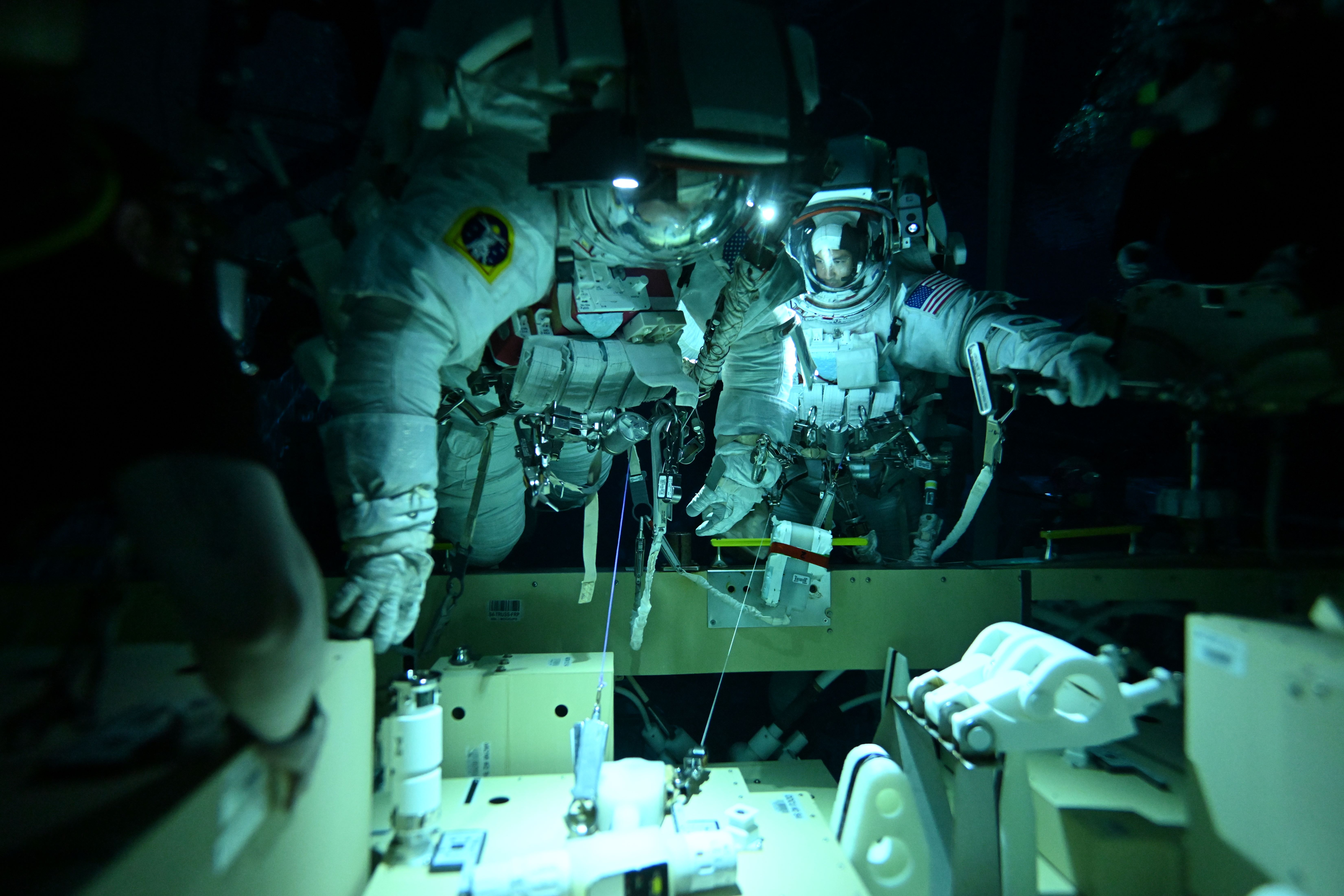
Much of that preparation takes place in specialized NASA facilities. The agency says Theriot plans and executes testing in locations including the Neutral Buoyancy Laboratory and the Space Vehicle Mockup Facility. In the Neutral Buoyancy Laboratory, NASA’s 40-foot-deep pool used to simulate microgravity conditions, he has supported both International Space Station spacewalk rehearsals and lunar surface testing.
Those sessions are not simple demonstrations. They are used to refine the procedures astronauts will eventually follow in orbit and on the Moon. A procedure that appears workable on paper can fail once a suited crew member must perform it in a constrained environment, manage tools with pressurized gloves, or navigate while carrying mission tasks. By repeatedly running tests in controlled but demanding conditions, teams can identify inefficiencies, safety issues, and workflow problems long before a crew reaches space.
NASA also says Theriot often serves as a suited test subject himself. That detail matters because operational leadership in human spaceflight is strongest when it is closely tied to firsthand experience. A test lead who has physically worked through suit constraints and task sequencing can often spot practical issues earlier and communicate fixes more effectively across engineering and flight-operations teams.
Mapping and Procedures for Human Operations on the Moon
One of the more concrete contributions cited by NASA is Theriot’s role in helping lead development of the Lunar Grid Reference System. The agency describes that system as being designed specifically for human operations on the Moon and says it has now been incorporated into flight control systems.
That is more significant than it may sound. Human surface exploration requires a consistent way to reference position, route planning, work zones, and mission events. A lunar grid adapted to operational needs can affect how crews communicate locations, how mission control tracks activity, and how different systems share a common map of the environment. NASA’s note indicates that the work has moved beyond concept status and into systems used by flight controllers, suggesting the agency is steadily building the operational backbone required for sustained lunar activity.
The same systems thinking appears in Theriot’s training role. NASA says he trains others to become test conductors and test leads, effectively helping build the next generation of surface-operations experts. That kind of institutional preparation is critical for Artemis because lunar exploration is not intended to be a one-off event. If NASA wants repeatable surface missions, it needs a workforce able to design, run, and improve complex field and facility testing over time.
Spacesuit Testing Across Multiple Architectures
NASA’s account also ties Theriot to testing of more than one spacesuit path. The agency says he has supported testing of NASA’s government reference exploration spacesuit design as well as Axiom Space’s lunar spacesuit, the Axiom Extravehicular Mobility Unit, or AxEMU. That matters because lunar operations depend heavily on suit capability, mobility, visibility, and task compatibility.
In NASA’s Active Response Gravity Offload System, known as ARGOS, Theriot practiced geologic sampling operations in the AxEMU, including examining and stowing a collected sample. The mention is brief, but it points to a larger objective: lunar exploration will depend on more than walking and working outside. Astronauts will need to conduct field science, handle samples carefully, and do so while wearing complex life-support systems in reduced gravity. Rehearsing those tasks is part of making surface exploration scientifically productive rather than merely symbolic.
A Transition Toward the Next Landing
NASA says Theriot is now transitioning from his current role to focus on mission development, astronaut training, and mission execution for the next lunar landing. That shift suggests his experience in test integration is being carried forward into later phases of Artemis preparation, where operational knowledge from simulations and suit testing can directly shape how a real mission is built and flown.
The agency’s profile is also a reminder that lunar exploration is being assembled through years of specialized work that rarely draws headlines on its own. Surface readiness depends on people who can connect hardware tests to crew procedures, navigation frameworks, science tasks, and training pipelines. NASA presented Theriot as one of those connective figures.
As Artemis advances, that kind of expertise may prove decisive. The Moon mission architecture will only work if astronauts can execute detailed surface operations under demanding conditions. NASA’s spotlight on Theriot shows the agency is still building that capability methodically, through simulations, suit trials, operational mapping, and repeated rehearsal long before the next crew heads lunarward.
This article is based on reporting by NASA. Read the original article.
Originally published on nasa.gov