The U.S. Air Force has recovered experimental cargo pods flown aboard SpaceX’s Starfall reentry capsule, marking a concrete test of whether rockets could one day move supplies rapidly to difficult-to-reach locations.
The Air Force Research Laboratory, or AFRL, said the pods were recovered after the capsule splashed down in the Pacific Ocean. Starfall had launched as part of SpaceX’s Bandwagon-5 rideshare mission from Cape Canaveral Space Force Station on October 20. The recovery was confirmed publicly by AFRL on October 26.
The test is significant because it moves the Pentagon’s long-discussed “rocket cargo” concept beyond launch and toward the harder operational questions: can cargo survive launch, atmospheric reentry and ocean recovery in a usable condition, and can the process support rapid delivery at global distances?
A test of point-to-point rocket cargo
AFRL describes the work as a point-to-point, or P2D, rocket cargo delivery test. Rather than using a rocket solely to put spacecraft or satellites into orbit, the approach treats launch and controlled return as part of a logistics chain.
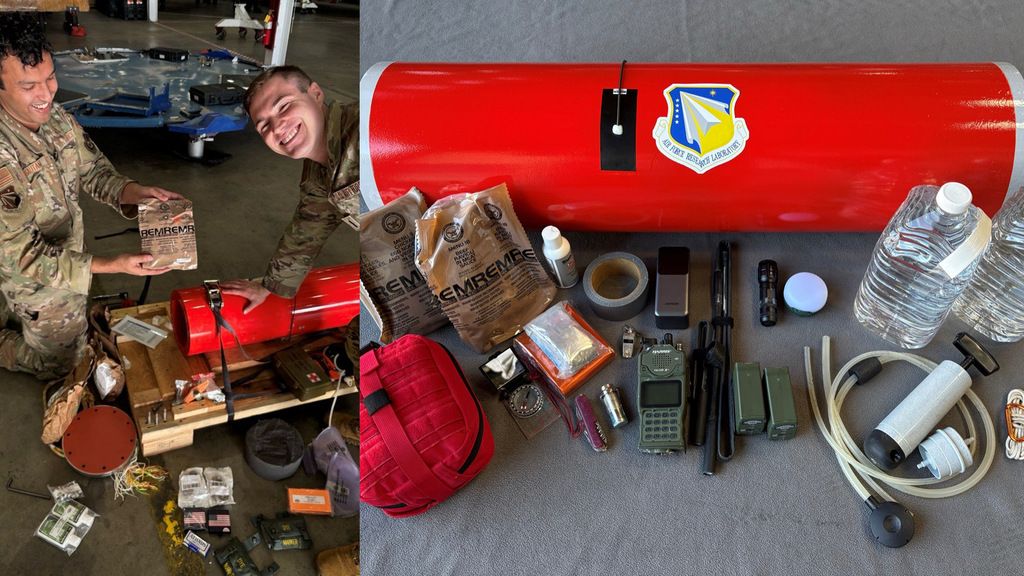
For this first Starfall cargo mission, AFRL packed its agile cargo pods with representative equipment. The items included medical equipment, food ration packs and other military kit that could be useful in an emergency where conventional transport is slow, unavailable or constrained.
That is a deliberately practical framing. The exercise was not a demonstration of a fully deployed delivery service, nor was it a public announcement that the Air Force can now send supplies anywhere by rocket. It was an effort to evaluate the physical handling of cargo during a demanding flight profile and to gather data that future missions can use.
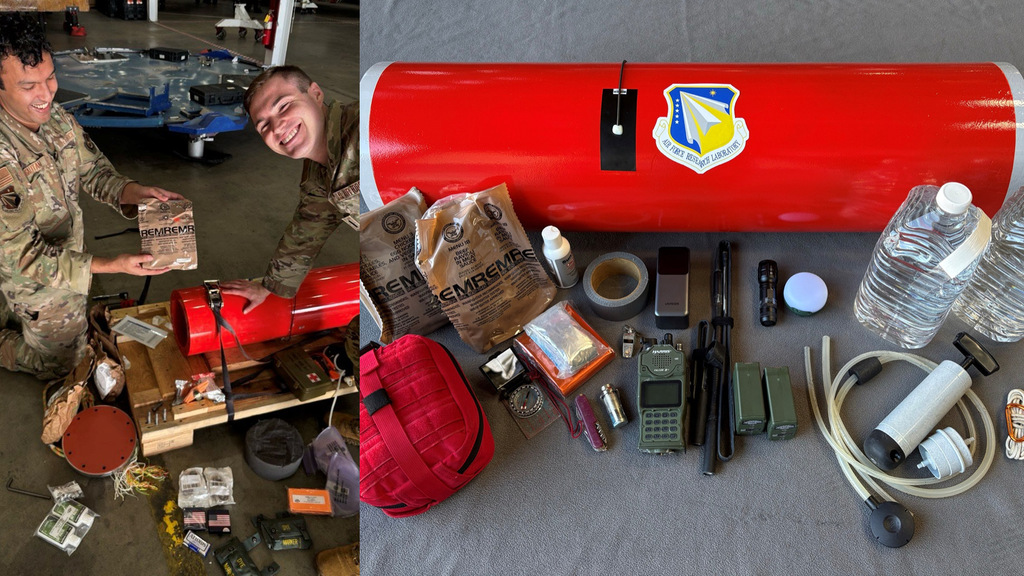
Each pod carried sensors designed to record temperature conditions during launch, reentry and splashdown. The sensors also measured shock and vibration forces acting on the cargo. Those measurements matter because a delivery system is only useful if its contents remain viable after the journey. A pod that reaches an intended recovery area but exposes medical supplies or other equipment to unacceptable forces would not meet the underlying logistics need.
Recovery is a key milestone
AFRL said the successful recovery of the pods is an important step in evaluating the viability of rocket cargo missions. In a statement associated with the mission, AFRL Technology Transition Office director Adam Remaly called it a critical achievement for demonstrating the potential of rocket cargo for point-to-point rapid global mobility.
The language is notable for its caution. The agency is demonstrating potential, not claiming an established capability. The test begins to answer a narrow but necessary question: whether the Air Force can retrieve instrumented cargo that has traveled through space and returned to Earth.
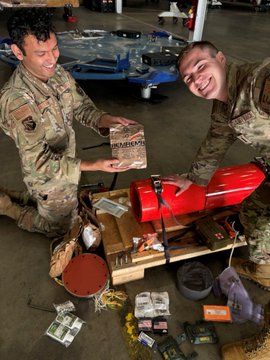
Photos shared by AFRL showed military personnel unpacking a recovered cargo pod for inspection. That post-recovery work is central to the experiment. The recorded environmental data can be compared with the condition of the representative cargo and with the design assumptions used to package it.
AFRL also performed a fit check involving a UNI-PAC III life raft inside Starfall. The raft could be included in later testing, according to the agency. That detail underscores the program’s focus on equipment that could support emergency response in places where existing lift capacity or surface access is limited.
Why the concept attracts military interest
Traditional logistics depends on aircraft, ships, ground transport, access agreements, weather and time. A rocket-based system would pursue a different trade-off: potentially very fast movement over long distances, with substantial complexity in launch, reentry, recovery and coordination.
The Starfall test does not resolve those trade-offs. It does, however, supply data from a real flight rather than a ground-only exercise. The mission exposed cargo pods to launch and reentry conditions, then enabled their recovery after splashdown. That chain is closer to the operational problem AFRL is trying to understand than a simple launch demonstration would be.
Starfall flew on a Falcon 9 rideshare mission, showing that an experimental cargo-return payload can be integrated into an existing launch opportunity. Whether a future rocket-cargo architecture would use rideshares, dedicated missions or another model remains an open question not answered by this test.
What comes next
The available information points to a program still in its experimental phase. The most immediate value is likely to be the sensor record: temperature, shock and vibration data collected across launch, reentry and splashdown. Those results can inform packaging, pod design, cargo selection and future recovery procedures.
The Air Force will also need to assess more than the survivability of the hardware. A viable delivery concept would have to demonstrate repeatability, predictable recovery, secure handling, useful payload capacity and a process that makes sense alongside other transport options.
For now, AFRL’s recovery of the Starfall cargo pods establishes a narrower but meaningful result. Experimental supplies and instruments were launched aboard the capsule, returned through reentry and were recovered for inspection. That gives the service a real-world data point in its effort to determine whether point-to-point rocket cargo can become a credible option for rapid global mobility.
This article is based on reporting by Space.com. Read the original article.
Originally published on space.com