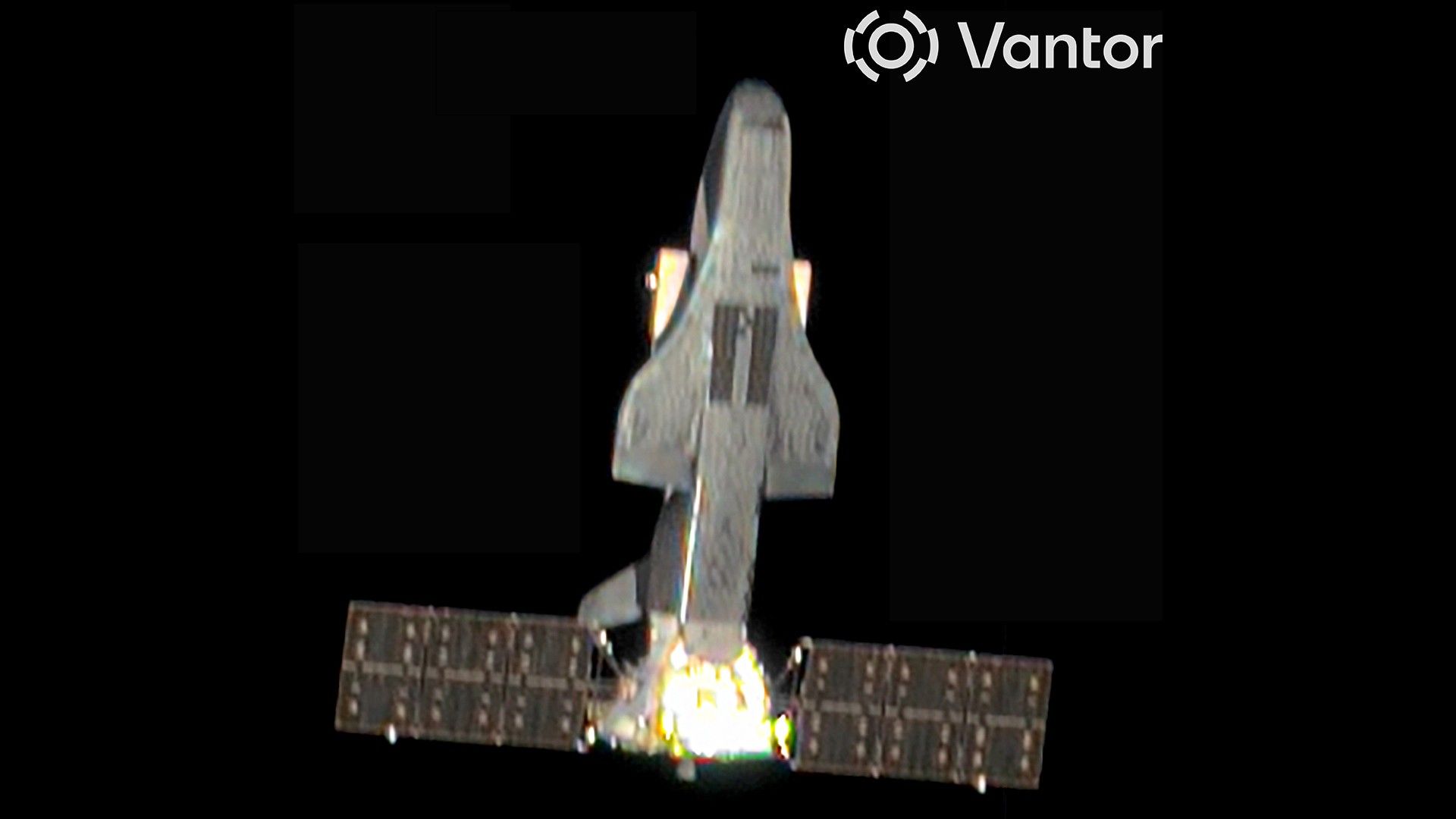
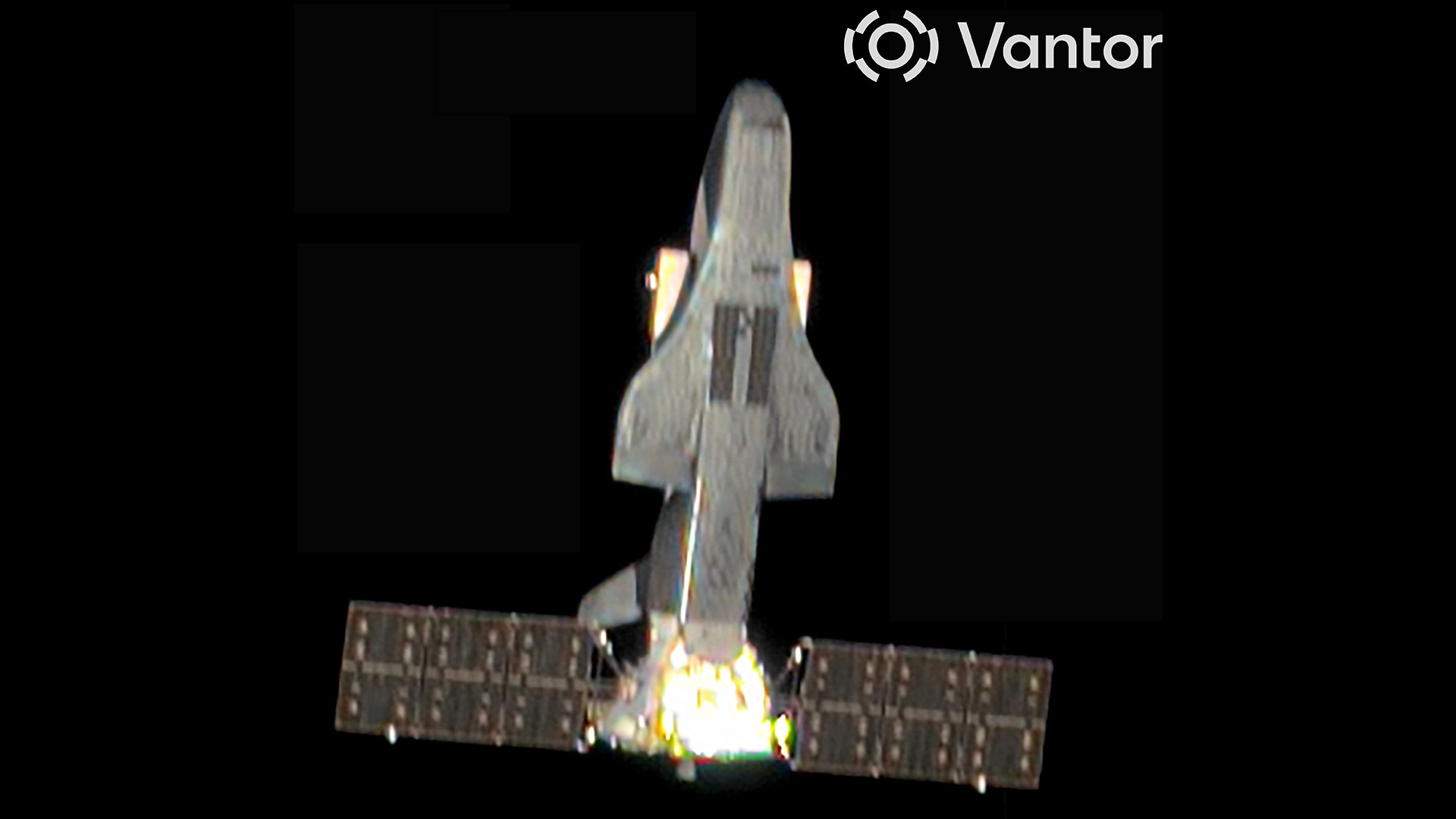
A newly released image has offered an unusually detailed view of China’s secretive reusable Shenlong space plane in orbit. The photograph, taken in 2024 by Vantor’s WorldView 3 satellite and released by a United States military intelligence agency, shows the robotic vehicle docked to another spacecraft whose solar panels are deployed.
The image does not resolve the most important unanswered question: what the second spacecraft is, or what the two vehicles were doing together. But it provides a rare look at an orbital operation involving Shenlong, a program China has described only in broad terms. It also shows the space plane’s payload-bay doors open, a visible detail that may be relevant to the vehicle’s activity during its missions.
An orbital view from 90 kilometers away
WorldView 3 captured the photograph from a distance of about 56 miles, or 90 kilometers. The resulting image has a stated resolution of 4.5 centimeters, or 1.8 inches, per pixel. Ground-based observers have photographed Shenlong in orbit before, but the new picture was taken from space and reveals the vehicle in greater clarity.
In the image, Shenlong appears alongside a satellite with deployed solar panels. The identity of that satellite is not known from the information released with the photo. That uncertainty is central to why the image is notable: it documents a docking configuration while leaving the purpose and duration of the operation unconfirmed.
The open payload doors add another visible clue. Payload bays on space planes can support a range of activities, from carrying equipment to deploying or receiving objects. The photo itself does not establish what occurred, and China has not publicly provided a detailed account of the vehicle’s mission activities. Still, the configuration gives outside observers a concrete image to compare with other reported events involving Shenlong.

Shenlong’s fourth mission
China’s current Shenlong mission launched in February 2026, its fourth known flight. Chinese authorities have said the program is testing technologies intended to support more convenient and affordable round-trip methods for the peaceful use of space in the future. That statement gives a general rationale for reusable spacecraft research, but it does not identify the vehicle’s payloads, its orbital activities or the purpose of the spacecraft seen with it in the newly released image.
The absence of detail has made Shenlong a closely watched program for commercial tracking companies and independent observers. Reusable space planes can conduct long-duration missions and return to Earth, potentially enabling repeated testing of spacecraft systems. Yet the publicly available information in this case remains limited, and conclusions about specific objectives would go beyond the evidence supplied by the image and official description.
What is clear is that the program is operating in an environment where orbiting objects can increasingly be observed by other satellites as well as from the ground. The WorldView 3 image illustrates that change directly: a commercial imaging satellite photographed another spacecraft from tens of kilometers away, giving analysts a view that previously would have been difficult to obtain publicly.
Reported deployments add context
Observers have also reported objects being released in Shenlong’s vicinity during earlier activity. In June 2026, the American space-intelligence company LeoLabs said it detected a new object near the Chinese space plane. After further observations through its global network and analysis platform, the company said it had independently cataloged the object and assessed with high confidence that it had been released from Shenlong.
LeoLabs described the event as consistent with sub-satellite deployments carried out during previous Shenlong missions. That reported activity provides context for why the open payload bay in the new image has attracted attention. It does not, however, identify the spacecraft now seen docked with Shenlong or prove that a deployment was occurring at the moment the image was taken.
The distinction is important in an area where imagery can reveal physical configuration without explaining intent. A photograph can show two vehicles in proximity and can reveal whether external structures such as solar arrays or payload-bay doors are open. It cannot by itself establish mission goals, payload function or operational plans.

A clearer picture, but persistent uncertainty
For spaceflight watchers, the release is significant because it moves Shenlong from distant observation to a detailed orbital portrait. The vehicle’s shape, open doors and connection with another spacecraft provide more information than a typical ground-based sighting. The picture is also a reminder that commercial remote sensing is becoming part of how space activity is documented and interpreted.
For policymakers and analysts, the image is likely to reinforce interest in transparency around reusable orbital systems. China’s public description emphasizes peaceful-use technology, while outside tracking has documented object-release activity associated with the spacecraft. Neither point alone fully characterizes the program. Together, they show why the mission continues to draw scrutiny.
The new photo therefore answers a narrow but consequential question: Shenlong has been observed docked to another solar-powered spacecraft, with its payload bay open. The larger questions remain unresolved. The identity of the companion satellite, the reason for the docking and the operational role of the payload bay have not been disclosed. As Shenlong’s fourth mission continues, those gaps will remain central to understanding one of the least publicly described reusable spacecraft programs now operating in orbit.
This article is based on reporting by Space.com. Read the original article.
Originally published on space.com