NASA’s focus on the Moon’s south pole has a clear rationale: permanently shadowed terrain there may preserve water ice, a potentially valuable resource for future exploration. But a new National Academies of Sciences, Engineering, and Medicine study argues that a durable human exploration program should not treat the south pole as the Moon’s only compelling destination.
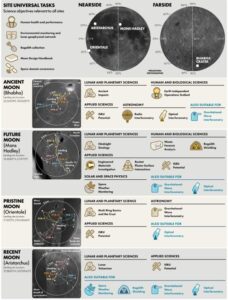
The NASA-requested report identifies four locations where human explorers could make distinct scientific contributions: Bhabha Crater, Mons Hadley, Orientale Basin and Aristarchus Plateau. The sites span the lunar farside, nearside and the western limb, and the committee describes them as opportunities to investigate the Moon’s ancient history, ongoing evolution, relatively pristine materials and more recent geological processes.
A broader map for human exploration
The study was designed to identify lunar destinations where people, rather than robotic spacecraft alone, could support investigations of the caliber expected from the National Academies’ decadal survey process. Its remit covered locations between 84 degrees north and 84 degrees south latitude and considered science across astrophysics, biological and physical sciences, Earth science, heliophysics and planetary science.
That framing matters because the Moon is not simply a destination for proving transportation systems or establishing a base. It is also a record of Solar System history, an environment for observing the universe and a place where samples and field observations can answer questions that cannot always be resolved remotely.
Human explorers can move across complex terrain, recognize unusual materials, make decisions in the field and adapt sampling plans as evidence emerges. The report does not dismiss robotic exploration; instead, it identifies places where the added capabilities of crews could produce unusually valuable returns.

Four sites, four scientific identities
The committee ranked Bhabha Crater first. Located on the lunar farside within the South Pole–Aitken Basin, it is associated with what the study calls the “Ancient Moon.” The basin is the Moon’s oldest impact basin, making it a potentially important setting for investigating early lunar history.
Bhabha Crater also has an astronomical dimension. Its farside location could support optical and radio astronomy away from interference caused by Earth’s light and radio emissions. That combination of planetary science and observation potential distinguishes it from destinations chosen solely for access to polar resources.
Mons Hadley, the second-ranked site, represents the “Future Moon” in the committee’s shorthand. It is on the nearside and is associated with questions about the processes that have shaped, and may continue to shape, the lunar surface. The label is meant to emphasize that exploration can address more than the Moon’s distant past.

Orientale Basin, on the western edge of the Moon and straddling regions visible from both the nearside and farside, is described as the “Pristine Moon.” Its relative scientific value lies in the opportunity to study material and structures that can illuminate the consequences of large impacts and the processes exposed by them.
The fourth location, Aristarchus Plateau, is the “Recent Moon.” The site offers a different window into lunar geology, one focused on comparatively recent activity and surface features. Taken together, the four locations are deliberately complementary rather than competing versions of the same mission.
What this means for Artemis planning
NASA intends to establish a Moon base at the south pole and, according to the report’s discussion, is planning to land astronauts there beginning in 2028. The south-polar strategy remains important, particularly because water ice is thought to be accessible in permanently shadowed regions. But the National Academies’ recommendations create a longer-term framework for what should come after an initial foothold.
The report arrives ahead of a NASA update on the Artemis program, which is intended to return US astronauts to the Moon for the first time since the Apollo era. Apollo’s six crewed landings, conducted between 1969 and 1972, all occurred on the nearside and comparatively near the equator. Artemis would therefore expand human operations into a very different lunar environment even if it remains concentrated near the south pole at first.
A broader destination strategy could also help prevent one operational priority from defining the entire scientific agenda. The Moon’s south pole may be central to testing long-duration operations and resource use, while other sites may be better suited to particular geological samples, basin studies or farside astronomy.

A choice between missions, not a verdict on one site
The report is not a call to abandon the south pole. It is a reminder that a program meant to last should retain options. Future mission planners may need to balance safety, landing constraints, communications, mobility, infrastructure and science goals. The four sites give them a structured set of alternatives when that balance shifts.
They also reinforce a basic point about lunar exploration: the Moon is geographically and scientifically diverse. A crewed program that visits only one region could establish vital capabilities, but it would leave major questions about the lunar environment unanswered.
For NASA and its partners, the practical implication is that landing-site decisions should be understood as part of a sequence rather than a single final choice. The south pole may be the opening chapter of sustained lunar exploration. The National Academies study sketches several candidates for what follows.
This article is based on reporting by spacepolicyonline.com. Read the original article.
Originally published on spacepolicyonline.com