NASA-backed student balloon campaign puts hands-on aerospace training into the field
At NASA’s Columbia Scientific Balloon Facility in Palestine, Texas, a long-running student program has once again sent experimental payloads toward the edge of space, giving participants direct experience with the kind of engineering, review discipline, and flight operations that shape real aerospace missions.
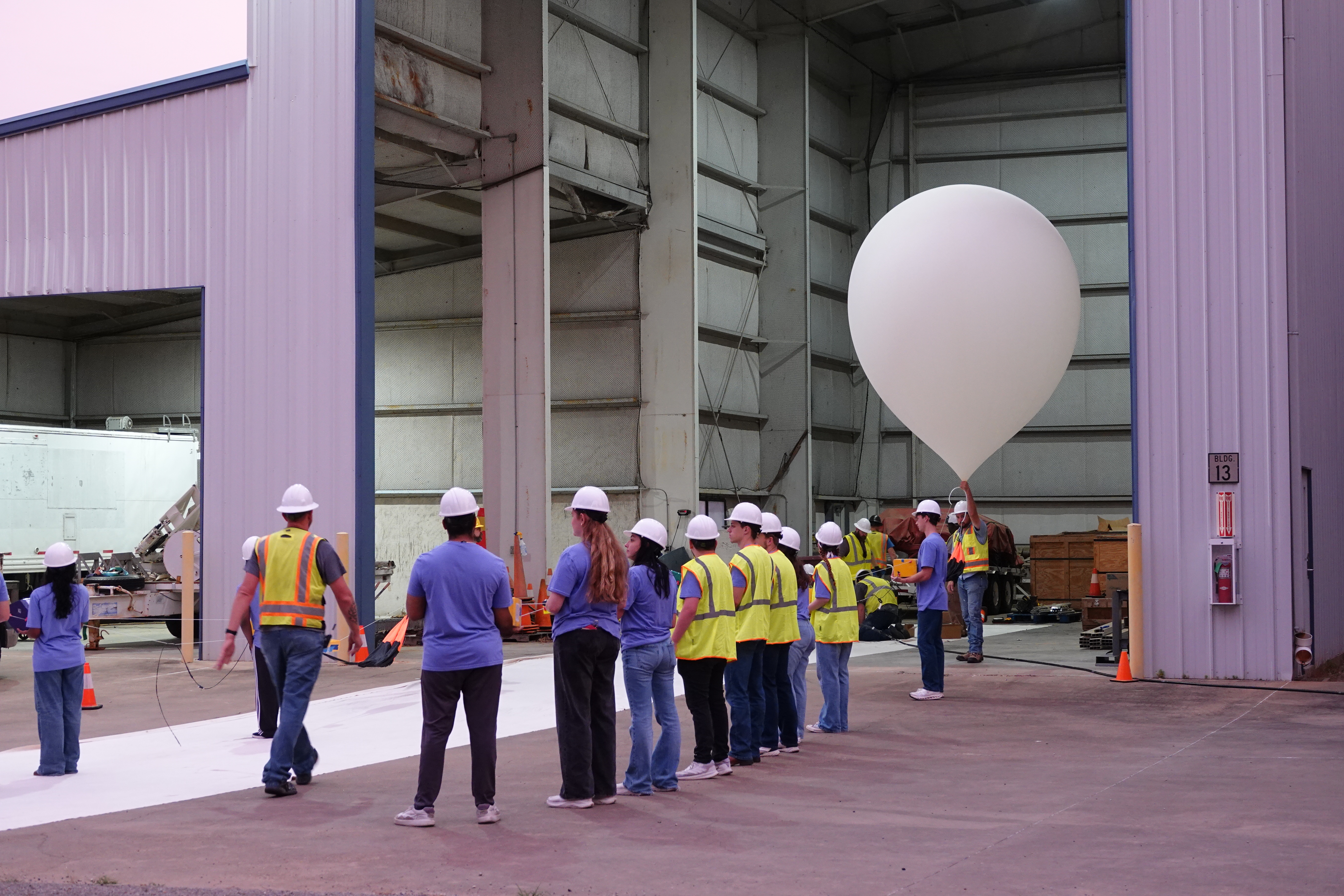
This year’s Louisiana Aerospace Catalyst Experiences for Students program, known as LaACES, logged its 74th and 75th launches on May 19 during the 2026 campaign. The event brought together student-built instruments, university teams, and NASA support crews for a week of near-space operations centered on scientific ballooning. While the launches themselves are educational in purpose, the structure described by NASA shows that the program is designed to do more than inspire interest. It aims to train students in the full lifecycle of mission development.
That distinction matters. In many education initiatives, students encounter isolated pieces of science or engineering. Here, they appear to move through a pipeline that resembles actual mission work, from early design decisions to flight readiness reviews and then live launch operations. The result is a model of workforce development rooted in practice rather than abstraction.
Eleven payloads, multiple institutions, one campaign
According to NASA, the 2026 LaACES campaign included 11 payloads designed and built by nine Louisiana university teams and one high school team. Participating institutions included Louisiana State University, Northwestern State, Southeastern Louisiana State, McNeese State, Loyola University, and Southern University, along with St. Joseph’s Academy.
The scientific goals covered a wide range of topics: atmospheric science, cosmic ray detection, thermal management, ultraviolet characterization, stratospheric wind analysis, and solar cell performance. That spread of objectives illustrates one of the strengths of scientific ballooning as a teaching platform. Near-space balloons can expose instruments to harsh environmental conditions, altitude-driven measurement opportunities, and real operational constraints without requiring the scale, budget, or complexity of an orbital mission.
For students, that means a project can still be ambitious while remaining achievable inside an academic calendar. A balloon payload has to be engineered, defended, integrated, launched, tracked, and recovered. Each step imposes demands that reward careful planning and expose weak assumptions. In educational terms, that is a far more rigorous exercise than a classroom simulation.
A NASA-style engineering process before launch day
NASA’s description of the program emphasizes the review structure leading into the campaign. Before arriving in Texas, student teams advanced their concepts through a sequence of design reviews modeled on NASA’s engineering lifecycle. From preliminary design through flight readiness, teams had to defend their technical choices, refine payload designs, and demonstrate that they were prepared for launch.
That process is one of the most significant parts of the story because it mirrors how aerospace organizations reduce risk and improve mission reliability. The value is not only in getting a payload airborne. It is also in learning how to justify design tradeoffs, respond to technical criticism, and revise a project under formal scrutiny. Those are professional habits as much as academic skills.
Once teams were cleared for flight by program directors Doug Granger and Aaron Ryan, operations shifted to the balloon facility in Palestine. There, NASA personnel supported the campaign with daily weather briefings, helium fills for latex balloons, and launch-line guidance intended to keep operations safe and effective.
That field support turns the event into a direct encounter with aerospace operations. Students are not merely handing over experiments to be flown by others. They are working in an environment where weather, launch timing, safety procedures, and hardware readiness all have to align. In practical terms, it is a lesson in how much coordination sits behind even relatively small scientific missions.
Why scientific ballooning remains a useful training ground
NASA frames student programs like LaACES as part of its broader commitment to developing future scientists and engineers. Scientific ballooning is especially well suited to that goal because it occupies a middle ground between lab work and spaceflight. It exposes students to authentic mission conditions without requiring the extraordinary cost and long lead times associated with satellites or crewed programs.
That balance helps explain why balloon campaigns have remained relevant even as the space sector grows more complex. A balloon flight can test sensors, validate concepts, and gather meaningful data while still allowing students to maintain visible ownership of the mission. They can see the hardware they built, observe launch preparations, and understand the operational decisions shaping the flight. The learning loop is immediate in a way that many larger programs cannot match.
The 2026 campaign also highlights the importance of regional partnerships. The collaboration between the Columbia Scientific Balloon Facility and the Louisiana Space Grant Consortium has now extended through 75 launches, indicating continuity rather than a one-off outreach effort. Long-running programs often matter most because they create repeatable pathways into technical fields. Students can enter a system that has institutional memory, defined standards, and a record of execution.
From launch experience to workforce pipeline
There is also a larger national context to this kind of activity. Aerospace, defense, climate science, and advanced energy systems all depend on a workforce that is comfortable with instrumentation, systems engineering, and mission operations. Programs like LaACES help build that workforce at an early stage by giving students experience that is concrete enough to influence career direction.
NASA’s account makes clear that participants were not just exposed to science in general terms. They handled payload development tied to specific technical objectives, then moved through reviews and launch support in an operational setting. That combination can narrow the gap between undergraduate education and the expectations of research institutions, government labs, and aerospace employers.
The inclusion of a high school team also expands the significance of the program. Reaching students before college can widen the pipeline into technical disciplines and give them an earlier understanding of what engineering work actually entails. Exposure at that stage may be especially valuable for students who have not yet had access to advanced laboratory or flight opportunities.
A small-scale launch model with durable value
The LaACES campaign is not a headline-grabbing planetary mission or a major commercial launch, and it does not need to be. Its importance lies in its function as a durable, repeatable training platform that connects students to real aerospace methods. The 2026 campaign’s 11 payloads, wide range of scientific objectives, and NASA-style review process show how educational programs can serve both learning and capability-building at the same time.
As space activity broadens across government, academia, and industry, programs that teach students how missions are conceived, challenged, and executed may become even more important. The launches in Texas illustrate that one of the most effective ways to prepare future engineers is not simply to lecture about space systems, but to place students in an environment where those systems have to work.
In that sense, the student balloon campaign is more than an outreach exercise. It is a small but practical example of how aerospace institutions build the next generation: by giving students real hardware, real constraints, and a real launch window.
This article is based on reporting by NASA. Read the original article.
Originally published on nasa.gov