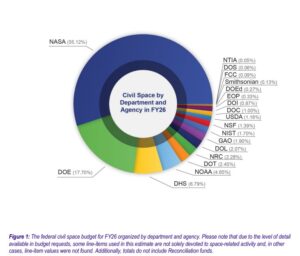
US government spending on civil space activities reached $42.6 billion in fiscal year 2026, according to a new analysis from The Aerospace Corporation’s Center for Space Policy and Strategy. The figure is a useful corrective to the common assumption that civil space spending is synonymous with NASA: the analysis identifies 19 non-defense agencies that receive funding to support, enable, or use space through direct and indirect means.
NASA remains the largest single component, accounting for 55% of the total. But the broader civil-space picture includes agencies and programs tied to energy, infrastructure, resilience, remote sensing, homeland security, telecommunications, science, and workforce development. The report’s conclusion is clear: civil space is a cross-government enterprise, and its budget is entering a period of significant uncertainty.
A broader definition of civil space
When civil space is discussed in public, NASA usually dominates the conversation. NOAA and the Department of Energy’s Office of Science may also come to mind. The new accounting takes a wider view. It tracks funding across non-defense agencies whose activities either directly operate in space, rely on space capabilities, or provide enabling support for them.
That approach found 19 agencies with such funding. After NASA, the Department of Energy is the next-largest share at 18%. The Department of Homeland Security accounts for 6.79%, while other agencies contribute smaller portions, down to the National Telecommunications and Information Administration at 0.05%.
The result is a map of civil space that extends well beyond rockets, planetary missions, and astronaut programs. Civil space includes applications and infrastructure that support public services, scientific research, environmental observation, energy-related work, national resilience, and the systems through which space-enabled services reach users.

Funding fell from the previous year
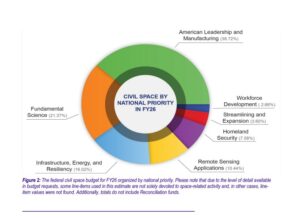
Although FY2026 spending totaled $42.6 billion, the level was $1.6 billion below FY2025. The analysis points to especially sharp pressure on infrastructure, energy, and resiliency activities. That category fell 29% from the prior fiscal year.
The decrease is important because the report organizes civil-space funding around seven national-priority areas rather than around individual agencies alone. Those areas are American Leadership and Manufacturing; Fundamental Science; Infrastructure, Energy and Resiliency; Remote Sensing Applications; Homeland Security; Streamlining and Expansion; and Workforce Development.
Looking through those categories makes it easier to see where budget choices may affect capabilities across departments. A change in civil-space funding is not only a change to a single mission line. It can affect research, technical capacity, data use, industrial activity, and the development of a workforce that supports multiple public-sector programs.
Congress and the White House remain out of sync
The FY2026 total emerged from a turbulent budget environment. The report says that Congress ultimately appropriated considerably more than the President’s Budget Request and added billions through a separate reconciliation measure, the One Big, Beautiful Bill Act, also known as the Working Families Tax Cut Act.
That divergence matters for anyone trying to interpret the headline total. Final appropriations are not simply a reflection of the executive branch’s initial priorities. They are also the product of congressional action and later legislative changes. In FY2026, those processes produced a civil-space budget higher than the original request, even though the final total still declined from FY2025.
The period also included the longest government shutdown in US history, according to the report. That backdrop reinforces the distinction between a final appropriated figure and a stable long-term outlook. Agencies can receive funding, but still face planning difficulties when appropriations, requests, and operating conditions are unsettled.

The FY2027 outlook is still unresolved
The uncertainty becomes more pronounced in the FY2027 request. The President’s Budget Request again calls for deep reductions in civil space, the analysis says. Every one of the report’s seven priority areas would face substantial cuts compared with FY2026 under that request.
Workforce Development would see the largest proposed reduction among the priority areas. The report does not present that outcome as settled. The federal government is operating under a continuing resolution through December 11, leaving the final FY2027 result unresolved.
That distinction is central. A budget request indicates the administration’s preferred direction, but it is not an appropriation. Congress may alter priorities, reject reductions, or adopt a different allocation as it finalizes spending. Until that process concludes, the FY2027 civil-space budget remains in limbo.
Why the full-government view matters
The $42.6 billion FY2026 figure changes the scale of the policy discussion. NASA is still the largest civil-space actor, but it is not the whole system. A large share of spending is distributed across agencies with different missions and different reasons for using or supporting space capabilities.
This means civil-space policy cannot be evaluated solely through the fortunes of major exploration programs. Cuts or increases may affect fundamental science, remote sensing applications, energy and resiliency work, homeland-security functions, telecommunications activity, and workforce development in different ways. The cross-agency structure also means that a disruption in one part of the budget can have effects beyond the agency most visibly associated with it.
The FY2026 analysis therefore offers both a snapshot and a warning. It shows a federal civil-space portfolio larger and more diverse than conventional accounts often suggest, while documenting a year-over-year decline and a FY2027 request that would reduce each of its seven priority areas. The eventual decisions will determine not only NASA’s direction, but also the breadth of the US government’s civilian role in space.
This article is based on reporting by spacepolicyonline.com. Read the original article.

Originally published on spacepolicyonline.com