Astronomers studying one of the Milky Way’s active stellar nurseries have mapped how gas moves through a cosmic supply network, offering a sharper picture of how stars gather the raw material they need to form.
The work focuses on Monoceros R2, a star-forming region about 2,700 light-years away, and examines how gas travels through a hub-filament system. In that kind of structure, long dense filaments converge on compact hubs where star formation is especially intense. The new observations show that the dense gas inside those filaments is not the whole story. Lower-density gas in the spaces between filaments is also feeding the system, moving sideways into the denser channels and helping replenish them.
The result adds detail to a fundamental problem in astrophysics. Stars are built from gas, but understanding exactly how gas is collected, concentrated, and delivered into star-forming zones remains difficult. The answer matters because star formation does not just produce stars. It shapes galaxies, regulates chemical enrichment, and determines how matter is recycled over cosmic time.
Why hub-filament systems matter
In many stellar nurseries, gas is not spread uniformly through a cloud. It organizes into long, narrow filaments with high aspect ratios. Where several of those filaments intersect, hubs form. These hubs contain larger gas column densities and are thought to play an important role in the birth of high-mass stars and star clusters.
Astronomers have long known that dense gas streams along filaments toward those hubs. That picture already made hub-filament systems central to theories of star formation. But there has been a gap in understanding what happens outside the main lanes of traffic. If filaments keep supplying hubs, what keeps supplying the filaments themselves?
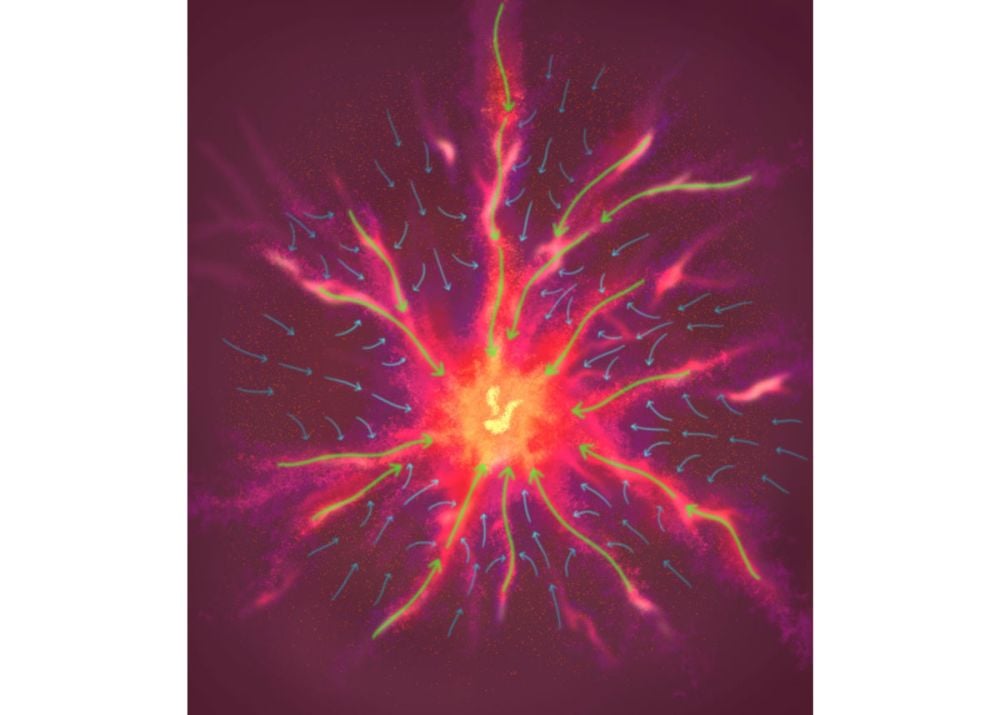
The Monoceros R2 observations help answer that question. According to the report, dense gas moves quickly along the filaments into the star-forming hub, while less dense gas in interfilament regions moves more slowly and laterally into the filaments. The effect is a two-stage supply chain: surrounding gas replenishes the filaments, and the filaments then funnel mass into the hub.

A more complete picture of how stars gather fuel
That layered flow matters because it suggests star-forming structures are not isolated pipelines drawing from a fixed reservoir. They are embedded in a broader environment that continuously refreshes them. If confirmed across other regions, the finding would support the idea that star formation depends on coordinated gas motion across multiple scales rather than on simple collapse inside a single dense structure.
The research was published in The Astrophysical Journal Letters in a paper titled From Interfilamentary Gas to Filaments and Hubs: Gas Flows in the Monoceros R2 Hub–Filament System. Lead author Jihye Hwang is an assistant professor at Kyushu University’s Institute for Advanced Study.
The team traced these motions using observations of carbon monoxide, a standard proxy for molecular gas in star-forming regions. Molecular hydrogen is the dominant ingredient in such clouds, but it is often harder to observe directly. Carbon monoxide emissions therefore give astronomers a practical way to map the behavior of the cold gas from which stars emerge.
Monoceros R2 is a useful target because it is relatively nearby in galactic terms and is already known to be undergoing active star formation. Infrared imaging has shown an illuminated molecular cloud rich in the gas that fuels stellar birth. That makes it a natural laboratory for testing how gas is organized and transported before new stars ignite.
Dense gas moves fast, diffuse gas supports the system
The striking part of the result is not simply that gas flows exist. Astronomers expected that. It is the differentiated role of gas at different densities. Dense filament gas appears to be the main conveyor into the hub and moves faster. The more diffuse interfilament gas is slower and does not head directly into the hub in the same way. Instead, it drifts sideways into the filaments, effectively refueling the structures that do the final delivery.
That distinction helps explain how star-forming hubs can continue drawing in material over time. Without replenishment, a filament would eventually exhaust the gas available in its immediate path. With replenishment from surrounding lower-density gas, the system behaves more like an actively maintained network.
The finding also reinforces a broader lesson in astronomy: structures that appear visually dominant are often sustained by less obvious components in their environment. In this case, the bright conceptual focus has been on dense filaments, but the surrounding gas may be essential for maintaining their throughput.
Implications for star and cluster formation
Hub-filament systems are considered especially important in the formation and evolution of massive stars and star clusters. Those objects require large amounts of material to accumulate in relatively compact regions. A replenished filament network offers a plausible route for concentrating enough gas quickly enough.
If hubs are continually supplied by multiple filaments, and those filaments are in turn resupplied by interfilament gas, then star formation can be sustained by nested inflows rather than by one-time collapse. That framework may help explain why some stellar nurseries remain productive and why certain hubs become preferred sites for clustered star birth.
It may also help theorists refine simulations. Models of molecular clouds often need to represent turbulence, gravity, magnetic fields, and feedback from young stars. Better observational constraints on actual gas-flow geometry can improve which physical processes are emphasized and how matter transport is parameterized.
- Dense gas appears to stream rapidly along filaments into a hub.
- Lower-density gas moves more slowly through interfilament regions.
- That diffuse gas seems to feed sideways into filaments, replenishing them.
- The result supports a multiscale view of how star-forming regions organize matter.
Why this is important beyond one cloud
Monoceros R2 is only one region, but the significance of the study lies in the possibility that it captures a common mechanism. The paper notes that hub-filament systems are widespread in star-forming environments. If the same replenishment pattern is found elsewhere, astronomers will have a stronger general model for how gas is routed into the densest sites of stellar birth.
That would matter well beyond a specialized corner of astrophysics. Star formation determines how galaxies convert gas into luminous structure. It influences the creation of heavy elements, the evolution of planetary systems, and the large-scale ecology of the universe. Even incremental gains in understanding the gas dynamics behind it can ripple outward into many branches of astronomy.
The Monoceros R2 result does not solve star formation in full. It does something more useful: it resolves one of the logistical steps in the process. Stars need fuel, hubs need supply, and supply lines need replenishment. The observations now suggest that the space between the filaments is not merely background. It is part of the machinery.
That is a meaningful shift in emphasis. In stellar nurseries, the empty-looking regions are not empty, and the obvious channels are not self-sustaining. The system works because material is moving through both.
This article is based on reporting by Universe Today. Read the original article.
Originally published on universetoday.com