NASA data shows a summer of repeated extremes
Western Europe’s 2026 summer has turned into a sustained test of climate resilience, and the latest evidence from NASA shows why. By mid-August, the region was in the grip of its fifth heat wave of the season, with temperatures rising above 40 degrees Celsius across a broad area. What began as an exceptional event in May has become a pattern, with extreme heat returning again and again over the same countries, stressing health systems, transport networks, water supplies, and power infrastructure.
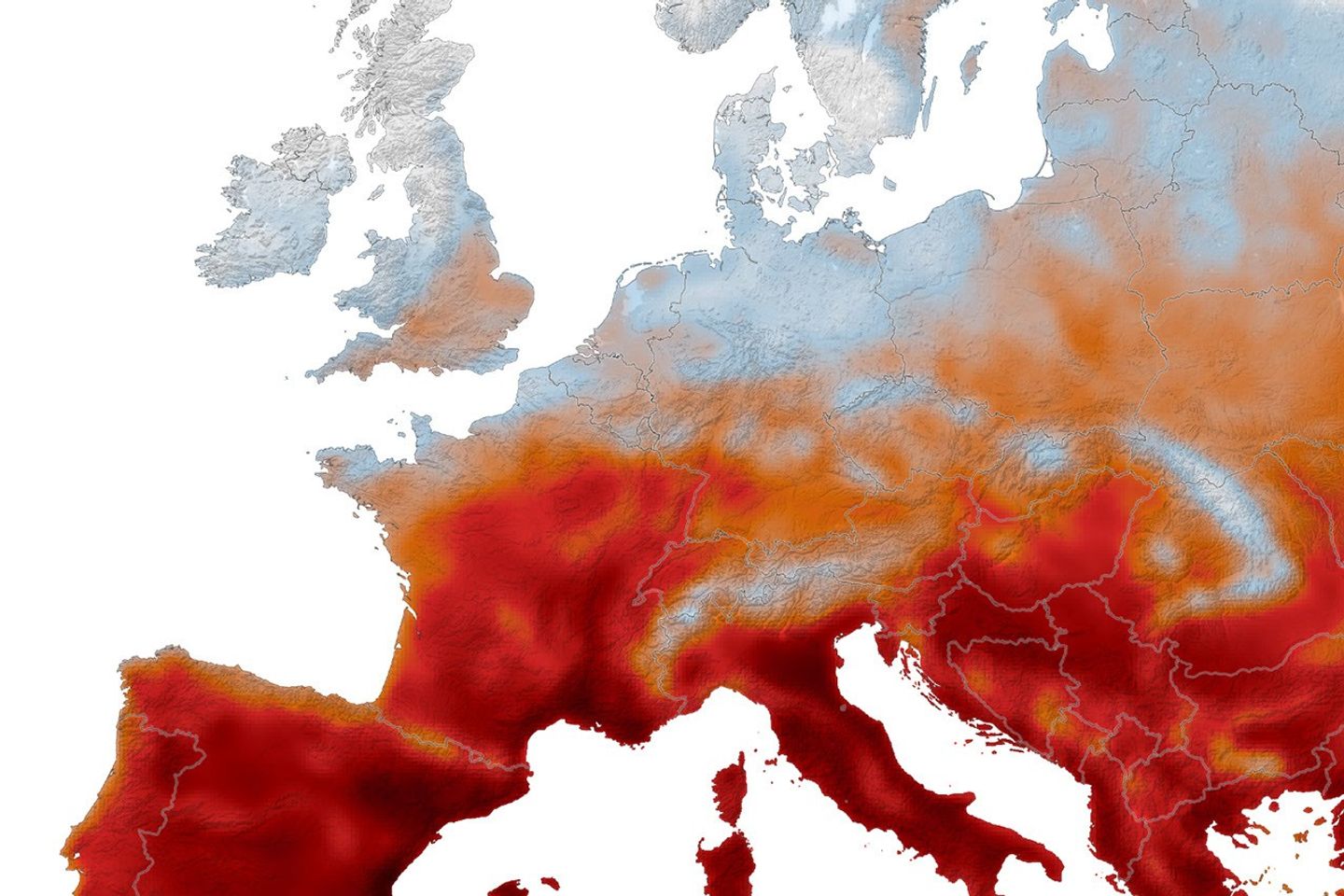
The NASA Earth Observatory article published August 21 presents an unusually clear picture of the scale and persistence of the event. Using output from NASA’s GEOS global model, combined with satellite observations, the agency mapped daily maximum surface air temperatures across Western Europe from May 1 through August 19. The result is not a snapshot of a single hot week. It is a season-long record of repeated temperature surges, with the darkest red areas indicating places that reached or exceeded 40 degrees Celsius.
That matters because the defining feature of this summer was not just peak temperature, but duration. According to the source material, high temperatures often lasted for several days and in some cases weeks, while overnight heat offered little relief. For populations and infrastructure adapted to more moderate summers, that persistence is what transformed heat from a weather event into a regional systems problem.
From early warning to cascading disruption
NASA traces the opening phase of the crisis to May 2026, when a heat dome helped shatter records in several countries. In hindsight, that event was not an isolated anomaly. It was an early warning of a hotter pattern that continued through the summer. By August, the fifth heat wave had reinforced how unusual the season had become: repeated surges of very high temperatures, stretched across months rather than days.
The consequences described in the source are broad and concrete. Hospitalizations and heat-related deaths rose. Roads and rail lines buckled under prolonged thermal stress, forcing closures and service disruptions. Wildfires expanded in areas where such destructive fire behavior has historically been less common. At the same time, the heat compounded a drought that had already gripped the region for months.
That interaction between heat and drought is especially important. Extreme temperatures do not act alone. They dry soils, reduce river flow, increase evaporation, and raise demand for water and electricity just as natural and built systems are becoming less capable of supplying them. NASA notes that the drought contributed to record-low river levels, with knock-on effects for transportation routes, agriculture, water supplies, and power systems. In other words, the heat wave was not just a public-health emergency. It was an amplifier of existing environmental and economic stress.

Why the NASA visualization matters
Heat waves are often described through national records or city-level headlines, but the NASA presentation highlights the regional continuity of the event. By showing daily maximum temperatures across Western Europe over more than three months, the model output makes visible the repeated spread of extreme heat over a connected geography. This kind of view is valuable because impacts do not stop at national borders. Rail disruptions, energy imbalances, river transport bottlenecks, and agricultural losses can quickly propagate through regional markets and supply chains.
The use of GEOS output also underscores how modern Earth observation blends direct measurement with predictive modeling. Satellite observations alone cannot provide every atmospheric detail at every moment. By combining them with a model that represents physical processes in the atmosphere, NASA can show how heat evolved over time and across space with more continuity than ground observations alone would allow. For policymakers and infrastructure operators, that kind of integrated monitoring is increasingly central to planning for compound events.
The article does not overstate causation beyond the data presented. It focuses on what the observed and modeled temperatures show and what the regional impacts have been. But even on that basis, the message is substantial: Western Europe experienced a summer in which extreme heat ceased to be episodic and instead became recurrent, prolonged, and structurally disruptive.
What this summer signals for Europe
The significance of the 2026 season lies in the accumulation of stress. A single heat wave can overwhelm emergency services for a week. Five heat waves across one summer can begin to expose deeper limits in infrastructure design, public-health readiness, land management, and water governance. The source text points to all of these weak points at once: health systems facing higher heat-related caseloads, transport assets physically deforming, wildfire risk spreading, drought worsening, and rivers falling to levels that interfere with commerce and utilities.
For Europe, that raises a practical question that goes beyond whether a temperature record fell in one city or another. The more consequential issue is whether infrastructure and policy still assume that such summers are rare exceptions. When extreme heat lingers overnight, returns repeatedly, and overlaps with drought and fire, traditional emergency-response framing becomes insufficient. The event starts to look less like a temporary shock and more like a recurring operational condition.
NASA’s contribution here is not political messaging but evidence. The imagery and model record give shape to what residents and institutions have been experiencing on the ground: a season defined by repeated thermal extremes. The visual progression from May to mid-August shows that the summer’s severity was not a single spike but a chain of heat episodes that built on one another.
That makes this more than an image-of-the-day story. It is a concise record of how climate stress now manifests at continental scale: not only through headline temperatures, but through persistence, recurrence, and the collision of heat with drought, fire, transport, and public health. Western Europe’s scorching summer, as NASA presents it, is a warning written in both maps and consequences.
This article is based on reporting by science.nasa.gov. Read the original article.
Originally published on science.nasa.gov