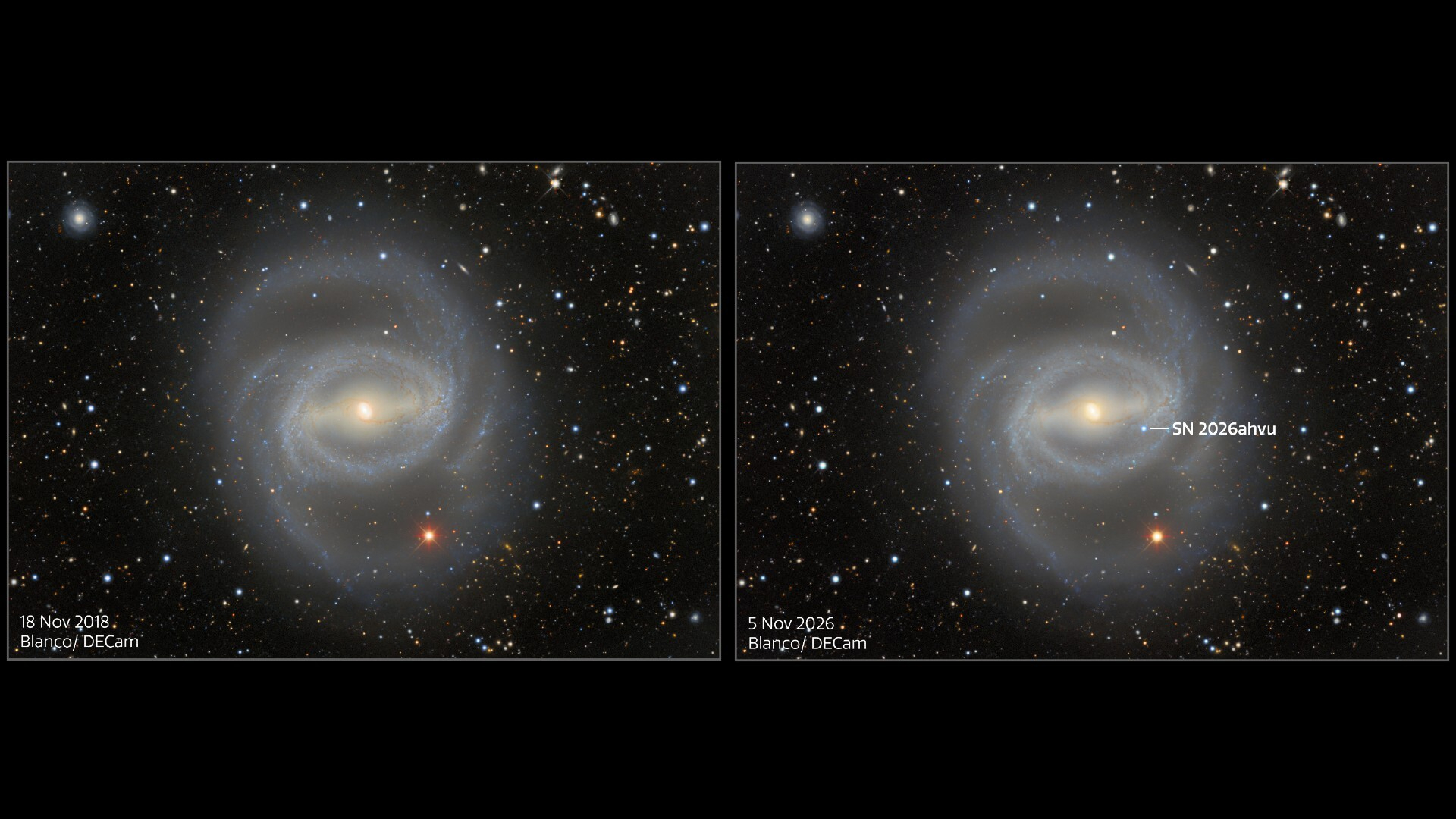
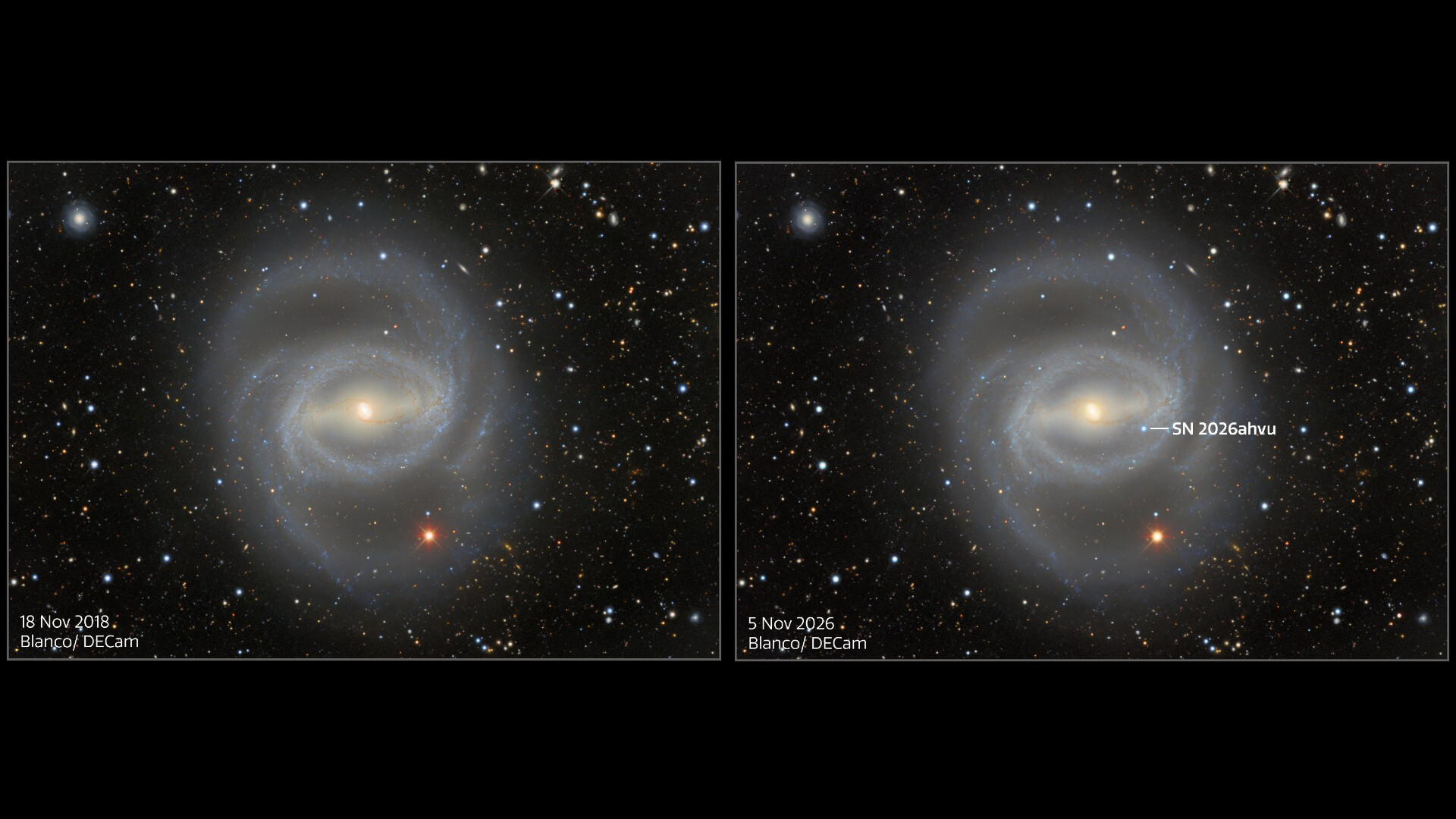
An explosion seen near the beginning
A newly identified supernova in the spiral galaxy NGC 1433 is giving astronomers an unusually early look at a stellar explosion. The event, designated SN 2026ahvu, lies about 50 million light-years from Earth and was found while it was becoming brighter rather than fading.
That timing is the important part. Supernovae are routinely detected across the universe, but an observation made early in an explosion can preserve information that is difficult or impossible to recover later. By the time an event is first seen in decline, researchers can infer that it is already past its peak. In the case of SN 2026ahvu, the available observations indicate that the explosion was caught during its rise.
The discovery offers an opportunity to compare images of its host galaxy taken before the event with observations made during the outburst and with future observations after it fades. That sequence can help researchers investigate both the Type Ia supernova itself and its effects on the stellar system where it occurred.
What Type Ia means
SN 2026ahvu is classified as a Type Ia supernova. These explosions occur in binary systems, where two stars orbit one another. In the typical description of this kind of event, one of the stars is a white dwarf that draws material away from its companion. As material accumulates on the white dwarf’s surface, conditions can eventually lead to a catastrophic explosion.
Type Ia supernovae are therefore not simply isolated stellar deaths. They are tied to interactions between two stars, and their observed behavior can depend on the properties of that system. Catching one early gives researchers a better chance to study how the brightness develops over time, rather than reconstructing the beginning only from later measurements.
The supplied observations do not establish every detail of SN 2026ahvu’s progenitor system. But its early detection creates a useful observational window. Continued monitoring can show how its light changes, while archival and follow-up observations of NGC 1433 can help place the event in its local environment.
ATLAS expands its role beyond asteroid warnings
The supernova was discovered with ATLAS, the Asteroid Terrestrial-impact System. ATLAS is a robotic astronomical survey using telescopes in both hemispheres. Its core purpose is to find near-Earth objects, including asteroids that could pose an impact threat, but repeated automated surveys of the sky can also reveal fast-changing objects much farther away.
That is what happened here. A system designed to notice moving or newly visible hazards in the solar system can also flag a sudden new point of light in a distant galaxy. Follow-up observations then allow astronomers to determine what the transient source is and how it evolves.
This dual use illustrates why wide-area, repeat surveys have become so valuable in astronomy. The sky is not static: stars flare, galaxies host explosive transients, and objects appear or change brightness on timescales that can be short compared with traditional observing schedules. Robotic surveys provide the recurring observations needed to recognize those changes quickly.
Why the next observations matter
The first image of a supernova is only the start of a longer investigation. For SN 2026ahvu, observations before, during and after the event can be assembled into a record of its evolution. Early brightness measurements are especially valuable because they can help establish the rise of the supernova rather than only its later decline.
Researchers will also be able to study how the explosion affected the system in NGC 1433. The host galaxy is close enough on astronomical scales for the event to be a compelling target, while still far beyond the Milky Way. At roughly 50 million light-years away, the light now reaching Earth began its journey long before human instruments could observe the source.
The event is a reminder that astronomical discovery is increasingly a matter of timing as well as distance. Finding a supernova is significant, but finding it at the stage when its light is still rising makes it more useful for studying the unfolding physics of the explosion.

Key facts
- SN 2026ahvu was detected in the spiral galaxy NGC 1433, about 50 million light-years away.
- It is identified as a Type Ia supernova associated with a binary-star system.
- Observations indicate it was discovered while brightening, an early phase that is not always captured.
- ATLAS, a robotic survey built to identify near-Earth objects, made the discovery.
As more observations are collected, SN 2026ahvu can provide a fuller view of an early-stage Type Ia supernova and of the environment in which it occurred. For now, its value lies in the rare chance to watch the brightness rise from close to the beginning of a cosmic explosion.
This article is based on reporting by Space.com. Read the original article.
Originally published on space.com