Senate appropriators have released a fiscal year 2027 defense spending bill that would provide $54.8 billion for the U.S. Space Force, a major increase from the service’s $32 billion level in fiscal year 2026 but below the administration’s requested appropriations level.
The proposal is part of a $1.072 trillion Department of Defense bill. While that total is essentially the same as the administration’s appropriations request, the committee incorporated some spending the administration had sought through a separate reconciliation measure.
For the Space Force, the bill combines substantial investment in surveillance, data infrastructure, missile warning, launch, and commercial capabilities with a pointed warning about reliance on noncompetitive contracts. The committee specifically raised concerns over major programs awarded to SpaceX and directed that added funding support multiple vendors.
A large increase, but below the request
The administration requested $71.1 billion for the Space Force for fiscal year 2027: $59.1 billion through appropriations and another $12 billion through reconciliation. The Senate committee’s proposed $54.8 billion is therefore lower than the appropriations request, though still far above the prior year’s funding level.
The broader defense plan reflects the administration’s call for what it described as a generational investment. Its overall fiscal year 2027 proposal totaled $1.5 trillion, split between $1.15 trillion in appropriations and $350 billion through reconciliation.
Appropriators agreed with much of the proposed expansion for space programs, but their bill indicates that agreement is not unconditional. The committee paired its funding increases with language intended to preserve meaningful competition as demand grows for military space-based capabilities.

Surveillance and data systems lead the additions
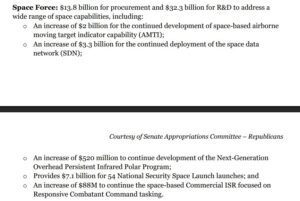
The bill highlights several large additions for Space Force priorities. It would add $2 billion for development of space-based airborne moving target indicators, or AMTI. Such systems are intended to support the detection and tracking of moving targets from space.
It would also add $3.3 billion for the Space Data Network, an effort to expand the infrastructure used to move and manage information from space-based systems. Additional funding listed by the committee includes $520 million for the Next Generation Overhead Persistent Infrared Polar Program and $88 million for space-based commercial intelligence, surveillance, and reconnaissance focused on responsive tasking for combatant commands.
The proposal also provides $7.1 billion for 54 National Security Space Launches. Together, those investments underline the degree to which the defense budget is treating space systems as operational infrastructure rather than a narrower research or support activity.
Competition becomes a central policy issue
The committee’s report raises a direct concern about the Space Force and National Reconnaissance Office using noncompetitive sole-source contracts. It identifies AMTI and the Space Data Network as examples where agencies had moved away from meaningful competition in favor of sole-source awards.
Both programs were awarded to SpaceX, according to the committee material cited in the report: $4.16 billion for AMTI and $2.29 billion for the Space Data Network. The committee wants the additional money it is providing for those efforts directed toward ensuring multiple vendors.
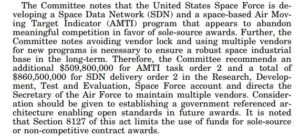
Section 8127 of the proposed bill would limit the use of funds for sole-source or noncompetitive awards. The provision would put the committee’s preference into statutory language, making procurement structure part of the policy debate rather than simply a matter of program management.
The tension is significant because the government wants to field new space capabilities quickly while also seeking a supplier base that is broader and less dependent on any one contractor. The bill signals that appropriators see those goals as compatible only if programs are structured to keep more than one company in contention.

Commercial space remains in the plan
Beyond the named surveillance and network programs, the committee recommends added funding for commercial space-based sensing, in-orbit refueling, advanced-propulsion testing infrastructure for emerging commercial launch capabilities, nonfederal spaceports, and an expansion of Protected Tactical SATCOM-Global to meet original program objectives.
These items point to a defense-space strategy that relies on commercial capacity while attempting to shape how that capacity is acquired. In-orbit refueling and propulsion testing, for example, could support more sustained or flexible operations, while nonfederal spaceports and emerging launch infrastructure could broaden access to orbit.
The bill remains a Senate appropriations proposal, not final enacted funding. Its figures and policy conditions will be subject to the rest of the congressional budget process. Still, its release establishes two clear priorities: rapid expansion of military space capabilities and closer scrutiny of whether the biggest programs are open to genuine competition.
For the Space Force, the proposed $54.8 billion would represent another dramatic step in its funding trajectory. For industry, the equally consequential message may be that access to this expanding market will be judged not only by technical capability and speed, but also by whether procurement rules leave room for multiple providers.
This article is based on reporting by spacepolicyonline.com. Read the original article.
Originally published on spacepolicyonline.com