A fast new probe of the Milky Way’s center
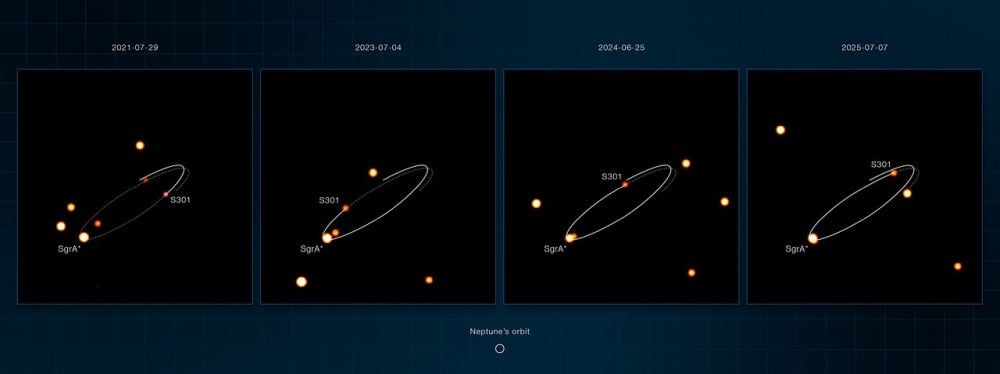
Astronomers have identified a newly recognized star orbiting extraordinarily close to Sagittarius A*, the supermassive black hole at the center of the Milky Way. The star, called S301, is described as the fastest-moving S-star yet found and the closest known member of that class to the black hole, according to reporting from Universe Today based on research headed for publication in Nature. The discovery gives researchers a potentially powerful new way to study gravity and spacetime under extreme conditions.
S-stars are a scientifically important population because their orbits provided some of the strongest evidence that a supermassive black hole sits at the center of our galaxy. These stars race around a compact object of roughly 4 million solar masses, and their paths can be tracked precisely enough to reveal how gravity behaves in one of the most intense environments accessible to observation. With S301, astronomers now have a star that pushes those tests further.
What sets S301 apart is a combination of speed and proximity. Universe Today reports that the star reaches roughly 25,000 kilometers per second and completes an orbit in only 8.7 years. It also approaches the black hole to about 12 astronomical units, placing it startlingly close on cosmic terms. That distance is only about a dozen times the Earth-Sun separation, remarkably tight for an object circling a black hole millions of times more massive than the Sun.
Why closeness matters more than spectacle
The value of S301 is not merely that it is fast. Its tight orbit makes it especially sensitive to relativistic effects, including the influence of the black hole’s spin on spacetime around it. In ordinary circumstances, relativity’s subtler predictions can be difficult to separate from the noisier gravitational interactions present in astronomical systems. But near Sagittarius A*, conditions are severe enough that those effects should become measurable with sufficiently precise observations.
That is why researchers are highlighting S301 as more than just another member of the S-star family. Universe Today cites study co-author Felix Mang describing the orbit as unprecedentedly tight, and quotes Nobel laureate Reinhard Genzel saying the star opens a new observational window on the fundamental properties of spacetime around the galactic center black hole. In practice, the key implication is that S301 may help astronomers constrain the spin of Sagittarius A*, a property that is much harder to measure than mass.
Black hole spin matters because it encodes part of the object’s history. A black hole’s rotation can reflect how it formed, what matter it has absorbed, and how it has interacted with its environment over time. Better estimates of the spin of Sagittarius A* would therefore inform not only relativity tests but also the evolutionary story of the Milky Way’s central engine.

What makes this discovery technically significant
The galactic center is one of the most challenging observing targets in astronomy. Dense gas, dust, and crowding from many nearby stars make it difficult to isolate objects and trace their trajectories over long periods. S-stars have become available to science only through sustained, high-resolution campaigns using powerful telescopes and specialized instruments. In this case, Universe Today points to observations from the European Southern Observatory’s Very Large Telescope and its GRAVITY instrument, which can resolve motion in the immediate neighborhood of Sagittarius A* with exceptional precision.
That precision is essential because astronomers are not only identifying where a star is but how its orbit changes over time. Relativistic effects can appear as tiny shifts in the orbit’s orientation or timing, and the closer a star passes to the black hole, the more pronounced those effects may become. A short orbital period also helps. Because S301 circles Sagittarius A* in less than nine years, scientists can gather repeated, comparable observations on a practical research timescale rather than waiting decades for a full loop.
That combination of short period, high speed, and close approach makes S301 an unusually efficient natural probe. Rather than relying on a one-off cosmic alignment, astronomers can keep watching the same star return through different parts of its orbit and refine their models as the data improve.
A step toward testing gravity where it is hardest to test
General relativity has passed every major experimental test thrown at it so far, from the precession of Mercury’s orbit to the detection of gravitational waves. Yet physicists still want to challenge the theory in the most extreme possible regimes, because any deviation could hint at deeper physics. The region immediately around a supermassive black hole is one of those regimes.
S301 will not settle every open question by itself. The source material does not suggest that the relativistic signatures have already been fully measured or that the black hole’s spin has already been pinned down from this star alone. But the discovery does provide a new and unusually promising target for that work. Its orbit appears to place it in exactly the sort of environment where minute predictions about warped spacetime may become observationally accessible.
There is also a broader scientific pattern here. Astronomy often advances through instruments, patience, and better probes rather than through a single conceptual breakthrough. S301 looks important because it improves the probe. It gives researchers another precise tracer of the gravitational field around Sagittarius A*, and perhaps the best one yet for studying rotational effects close to the event horizon’s neighborhood.
If follow-up observations confirm that promise, S301 could become one of the most valuable stars in modern galactic astronomy. Not because it changes what Sagittarius A* is, but because it may allow scientists to ask more exact questions about how the black hole shapes the spacetime around it. In that sense, the discovery is a reminder that even in a galaxy we have studied for decades, the most revealing objects can still emerge from closer and more careful watching.
This article is based on reporting by Universe Today. Read the original article.
Originally published on universetoday.com