Since the James Webb Space Telescope began its science operations, it has opened up wonder after wonder across the cosmos. Yet one discovery has stubbornly failed to appear: an exomoon. These moons, which would orbit planets in other star systems, remain theoretical. Not a single one has been confirmed. JWST was expected to find them in abundance, and so far it has found precisely none.
That disappointment may be premature. A new preprint on arXiv from David Kipping, an astronomer at Columbia University and host of the Cool Worlds YouTube channel, argues that the telescope can detect exomoons. It simply needs to look in the same place repeatedly. To make the case, Kipping analyzed a stack of JWST observations of an exoplanet called LP 890-9 c. The work reframes a null result as a methodological step forward.
A Moon Hunt That Keeps Coming Up Empty
Exomoons are not easy targets. A moon is small and faint next to its planet, and the planet is itself a minuscule signal against the glare of its star. Astronomers typically search for them by watching how a planet's transit, its passage across the face of its star, shifts in timing or brightness. A moon tugs on its planet and can add its own faint shadow, producing tiny irregularities in the light curve.
Until now, most searches have leaned on a single transit. That is a problem, because a one-off observation offers no way to separate a real moon signal from random noise. The same limitation has dogged JWST's exomoon efforts. In one earlier campaign, the telescope watched the gas giant Kepler-167 e in hopes of catching a small moon in orbit around it. But "red noise" confused the computer models processing the data, making it impossible to detect any moon much smaller than Earth.
What Red Noise Does to a Light Curve
Red noise is the catch-all term for slow, wandering changes in a detector's behavior. It can come from the instrument warming up, from small drifts in where the telescope is pointing, or from starspots on the surface of the star being observed. Unlike random, high-frequency noise, red noise creates patterns that can imitate a signal or bury one.
Kipping's insight is that red noise is not consistent from one observation to the next. An exomoon, by contrast, must obey the laws of physics. It has to be at a particular place at a particular time in its orbit around the planet. It cannot simply materialize wherever an instrumental glitch happens to occur. Starspots, detector drifts and other glitches do not repeat in the same way across multiple transits.
That mismatch is the key. If astronomers stack enough transits together, the wandering noise tends to average out, while any real moon signal, tied to the planet's clockwork orbit, reinforces itself. The approach is not new in principle, but JWST's sensitivity and its ability to revisit targets make it newly practical.
Twelve Transits of LP 890-9 c
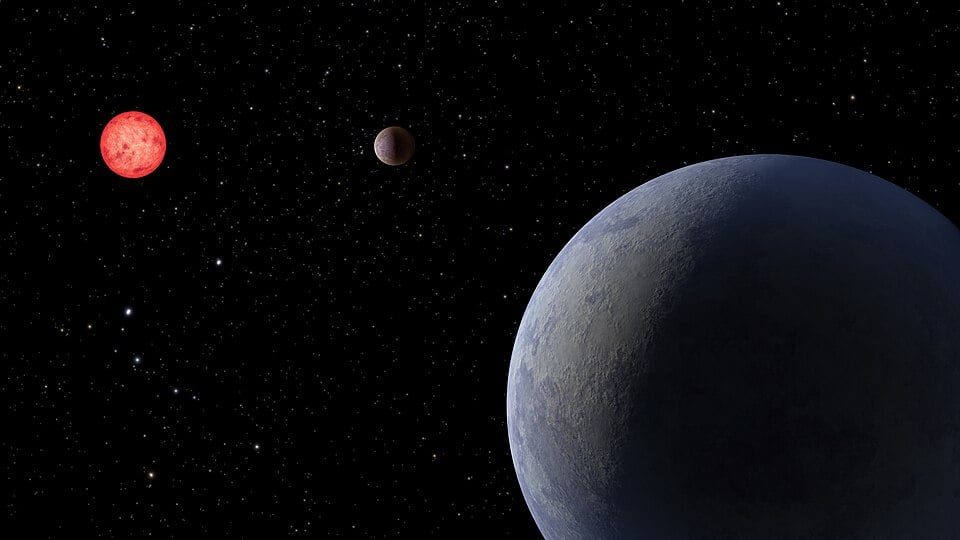
Kipping put the idea to the test with LP 890-9 c, a planet orbiting an ultra-cool red dwarf roughly 105 light years away. The planet races around its star in just 8.46 days, placing it extremely close to its host. Even so, because the star is so cool, the planet sits within the theoretical habitable zone, a rare and intriguing combination.
Critically, JWST had observed the planet's transits many times. Kipping was able to analyze data from twelve separate transits, a far richer dataset than the single-transit snapshots that have defined most exomoon searches. That repetition gave him a natural laboratory for testing whether averaging could recover sensitivity that a one-off observation would lose.
Even One Noisy Transit Can Be Rescued
The results were encouraging. One of the twelve transits suffered from pronounced red noise. On its own, that observation might have been discarded. But when Kipping combined it with just one other clean transit, the sensitivity to a possible exomoon rose significantly. More data, and more careful combination of that data, directly improved the ability to detect a moon.
The larger point is that JWST's exomoon drought is not evidence that exomoons are absent or undetectable. It is evidence that single visits are the wrong tool for the job. The telescope can find a moon if the search strategy matches the problem.
Why Ruling Out Moons Is Still Valuable
Non-detections rarely make headlines, but they do real scientific work. When a search comes up empty, it places limits on what can be there. For LP 890-9 c, the analysis constrains the presence of tiny moons, narrowing the range of possible satellite systems around that planet. Those limits feed into models of how planets form and how moons arise, questions that remain open even in our own solar system.
The work also validates a method. By demonstrating that repeated transits sharpen sensitivity, Kipping offers a template for future JWST programs. Instead of spending precious telescope time hoping for a lucky single transit, observers can design campaigns around many transits of the same target and combine them.
What Comes Next for Exomoon Science
Exomoons remain theoretical, and the field is still waiting for its first confirmed detection. But the path forward now looks clearer. The lesson from LP 890-9 c is that patience and repetition matter. JWST may eventually deliver an exomoon, not through a single dramatic observation, but through the quiet accumulation of many ordinary ones.
- No exomoon has been confirmed; they remain theoretical objects.
- JWST's earlier single-transit searches, including one of Kepler-167 e, were hampered by red noise.
- Red noise comes from detector drift, warming and starspots, and it does not repeat identically across transits.
- Exomoons follow orbital mechanics, so their signals reinforce when multiple transits are combined.
- LP 890-9 c, about 105 light years away with an 8.46-day orbit, offered twelve JWST transits for analysis.
- Combining even one noisy transit with a single clean transit significantly improved sensitivity to a moon.
For a telescope that has already rewritten so much of astronomy, the exomoon hunt is a reminder that discovery often depends as much on how we look as on what we look with.
This article is based on reporting by Universe Today. Read the original article.
Originally published on universetoday.com